How is the gold price determined?
Gold trades around the clock, mainly on the international bullion market in London, where banks and dealers trade over the counter, and on futures exchanges such as COMEX in New York and the Shanghai Gold Exchange. In addition, the LBMA Gold Price is set twice a day in London as a benchmark used in many contracts.
As in any market, supply and demand set the price. Supply grows only slowly because new mines take many years to start production. Demand comes from jewellery, central banks, investors buying bars, coins and funds and, to a lesser extent, technology.
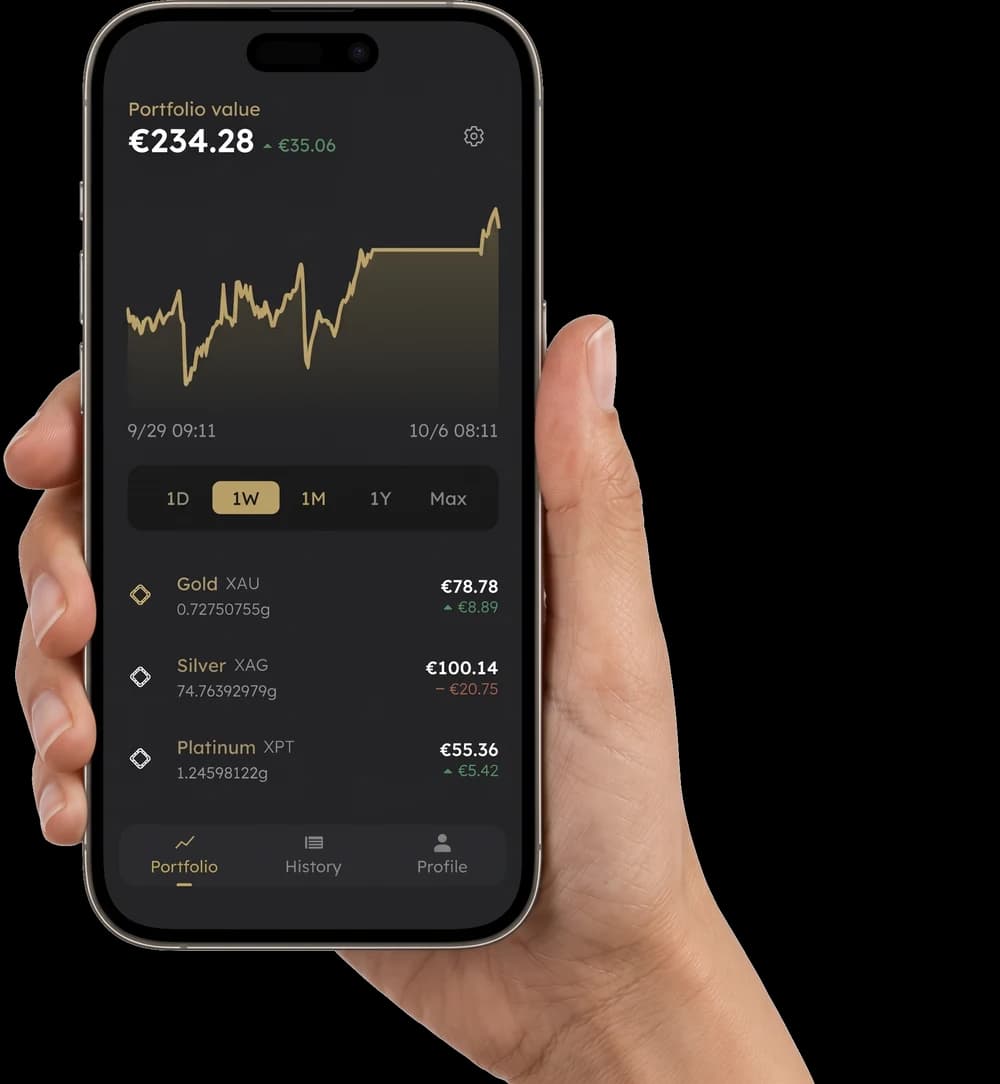
Want to own real precious metals instead of just following the price? With the Spargold app you buy physical gold, silver and platinum from €5.


Why does the price not change at weekends?
Precious metals do not trade on a single exchange but worldwide between banks, dealers and futures exchanges. The price forms continuously from the bids and offers of buyers and sellers. Because trading hours in Asia, Europe and America overlap, metals trade almost around the clock on weekdays.
From Friday evening until Sunday night (Central European Time) trading pauses because the major trading venues and banks are closed. No new market prices form during this time, so this page shows the last price from Friday. The same applies on major holidays such as Christmas and New Year. If the news has changed over the weekend, the price can open with a jump.
How much gold is there in the world?
According to estimates by the World Gold Council, around 215,000 tonnes of gold have been mined throughout human history. Cast into a single cube, this amount would measure only about 22 metres along each edge. Almost all of it still exists, because gold does not corrode and is melted down and reworked again and again.
Mines add only around 3,500 tonnes a year, less than two percent of the existing stock. Just under half of all gold is held as jewellery, a large share is owned by private investors as bars and coins, and just under a fifth sits in central bank vaults. This slow growth in supply is one reason why gold is considered scarce and a reliable store of value.
What moves the gold price?
Interest rates matter, especially real rates after inflation: gold pays no interest, so it becomes more attractive when other safe assets yield little. The strength of the US dollar also plays a role, as gold is traded internationally in dollars.
In times of crisis, inflation fears or geopolitical tension, gold is seen as a safe haven and demand rises. Central banks have also increased their gold reserves significantly in recent years, which has supported the price.
Gold price and inflation
Gold is regarded as a hedge against currency debasement because its supply cannot be increased at will. Over decades, gold has preserved its purchasing power far better than cash, which loses value to inflation year after year.
In the short term, however, the gold price does not track inflation month by month. What matters is how inflation compares with interest rates. When interest rates are below the rate of inflation, savings lose value in real terms and demand for gold rises. When rates rise sharply, the gold price can fall despite high inflation, as happened at times in US dollar terms in 2022.
Gold price in euros and dollars
The world market price of gold is quoted in US dollars per troy ounce. The gold price in euros follows from this dollar price and the current exchange rate. If the euro strengthens against the dollar, the euro gold price can fall even though the dollar price is unchanged, and vice versa.
For investors in Germany and the rest of the euro area, the euro price is what counts. The tables on this page therefore show the gold price in Germany today, in euros per gram, ounce and kilogram, alongside the dollar price.
Gold price per gram, ounce and kilogram
The standard trading unit is the troy ounce, which equals 31.1035 grams. For small amounts the price per gram is easier to grasp, for large bars the price per kilogram. The table above converts the current price into all three units.
Jewellery usually contains less gold: 14 karat gold (585) is 58.5% pure gold, 18 karat gold (750) is 75%. Its material value per gram is the gold price multiplied by the fineness, as shown in the fineness table.
Spot price and purchase price
The price shown here is the spot price, the wholesale price for immediate delivery. When buying bars or coins, investors usually pay a premium for minting, dealing and shipping, and receive somewhat less when selling.
With Spargold you buy gold from €5 and without shipping costs, because the gold is stored directly in an insured vault. You find the current fees on our pricing page.
Bid price, ask price and spread
In trading there are always two prices: the bid is the price at which dealers buy gold, the ask is the price at which they sell it. The difference is called the spread. The spot price on this page lies between these two values and shows the market value without any premiums.
How large the spread is depends on the form of the gold. It is small for large bars and considerably higher for small coins and bars under 10 grams, because minting and handling cost more per gram. When comparing offers, look not only at the purchase price but also at what you get back when you sell.
When the gold price moves the most
Trading starts on Monday morning in Asia and then follows the sun westwards. Activity is particularly high when London and New York trading hours overlap, i.e. in the afternoon Central European Time (CET). The LBMA Gold Price is set at 10:30 and 15:00 London time, which is 11:30 and 16:00 in Germany.
Sharp swings are triggered above all by US economic data such as the monthly jobs report or inflation figures, which are usually released at 14:30 German time. Interest rate decisions by the US Federal Reserve, announced in the evening at around 20:00, and by the European Central Bank also move the price. There is no fixed time of day when gold is particularly cheap.
The gold price through history
Until 1971 the gold price was pegged to the US dollar: a troy ounce cost 35 dollars, and other central banks could exchange dollars for gold at this rate. When the US abandoned this convertibility, the price began to be set freely by the market. During the years of high inflation it rose to around 850 dollars by January 1980.
Two decades of falling and sideways prices followed; around the turn of the millennium an ounce at times cost only around 250 to 300 dollars. With the financial crisis from 2008 and the euro crisis, gold climbed to about 1,900 dollars by 2011. In August 2020 the price rose above 2,000 dollars for the first time, and since 2024 several new record highs have followed.
You can see how the price has developed since the start of the data available on this page in the chart under “Max” and in the “Price performance” table. Looking back also shows that long rallies were repeatedly followed by years of significant declines. Anyone buying gold should therefore have a long investment horizon.
Taxes on buying gold in Germany
Investment gold is exempt from VAT in Germany and throughout the EU. This includes bars and wafers with a fineness of at least 995 parts per thousand as well as certain bullion coins such as the Krugerrand or Maple Leaf. Silver and platinum, by contrast, are generally subject to VAT.
In Germany, gains from selling physical gold are tax-free if more than one year passes between purchase and sale. If you sell earlier, the gain counts as a private sale transaction and is taxable, provided all such gains in a year together reach €1,000 or more. This information does not replace tax advice.
Gold bars, gold coins or a gold savings plan?
Traditionally, investors buy gold bars or bullion coins from a dealer or bank. The gold is then kept at home or in a bank safe deposit box, and premiums over the spot price are high, especially for small denominations. Exchange-traded products such as gold ETCs are cheap to trade, but they only represent a claim, not direct ownership of specific bars.
A gold savings plan combines the best of both: you regularly buy small amounts at the current price and acquire ownership of real gold held in a vault. Regular purchases smooth out price fluctuations, because you automatically get more grams when prices are low. With Spargold you can start from just €5 a month, and you can pause or change your savings plan at any time.