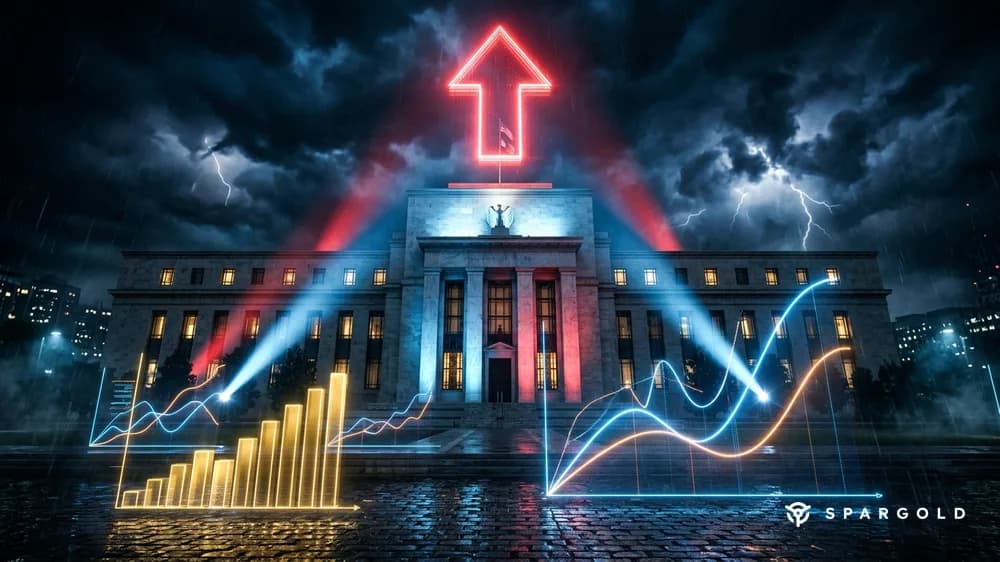
Core PCE inflation rose more than expected in September 2026, and US GDP grew by 3.4% in the third quarter. The futures market prices in a 74.9% probability of a Fed interest rate hike in December 2026. What does this mean for investors in gold, bonds, and equities?
The PCE Price Index (Personal Consumption Expenditures) is the Federal Reserve's preferred measure of inflation. Unlike the well-known Consumer Price Index (CPI), the PCE dynamically weights American spending — meaning it reacts more quickly to actual purchasing patterns. When the Fed discusses interest rate decisions, it looks at the PCE first.
In September 2026, the Core PCE Index — excluding energy and food — showed a further increase (Yahoo Finance). This is a strong signal for the Fed that inflation is not yet under control.
At the same time, the US Department of Commerce released the advance estimate for Gross Domestic Product (GDP) in the third quarter of 2026: annualized growth of 3.4% — significantly stronger than analysts had expected (Mitrade). A strong economy does not need rate cuts — it can even withstand further hikes.
The combination of higher PCE and stronger GDP growth practically rules out a rate cut before the end of 2026. The Fed has no reason to loosen policy as long as inflation and the economy are running hot simultaneously.
The Fed Funds Futures market is the most precise barometer for interest rate expectations. It currently prices the probability of another Fed rate hike in December 2026 at 74.9% (FXStreet). This represents a clear majority opinion in the market: another step up is considered the base case scenario.
The Fed kept its benchmark interest rate at 3.75–4.00% at the October meeting. Two committee members voted for an immediate hike — a signal that the hawkish faction within the Fed board is gaining influence.
| Asset Class | Expected Impact | Rationale |
|---|---|---|
| Gold and Silver | Continued pressure | Non-interest-bearing metals lose relative attractiveness |
| US Treasuries | Yields rise | Rate hike → Bond prices fall, yields rise |
| US Dollar | Appreciation pressure | Higher interest rates attract capital into USD |
| Growth Stocks | Valuation pressure | Higher discount rate weighs on prices |
Brent crude oil is trading at around $117 per barrel at the end of October 2026 — a monthly gain of approximately 13% (GSIExchange). Oil is a direct driver of inflation: higher energy prices translate into almost all production and transport costs. This forces the Fed to remain restrictive for longer — and extends the headwinds for precious metals.
Goldman Sachs recently lowered its price target for gold at the end of 2026 to $4,650, down from the original $5,379 (the annual high from January 2026) (NAGA). This reflects the shift in expectations: as long as the Fed keeps interest rates high, it limits the upside potential for gold.
There is no one-size-fits-all answer, but there are some structural considerations:
PCE stands for Personal Consumption Expenditures — an inflation measure from the US Department of Commerce. The Fed prefers it over the CPI because it captures purchasing patterns dynamically. When the Core PCE Index rises, it signals persistent inflationary pressure — and increases the likelihood of further rate hikes.
Not automatically, but it gives the Fed more room to maneuver. An economy growing at 3.4% does not need economic support through low interest rates. Strong growth combined with rising inflation — as is currently the case — is the classic argument for a further interest rate hike.
Based on the current data — high PCE inflation, strong GDP, and oil at $117 — a rate cut before mid-2027 is unlikely. The market currently prices the first step no earlier than the second quarter of next year.
Not investment advice. All information is derived from publicly available sources and is current as of October 31, 2026. Historical returns are no guarantee of future performance.