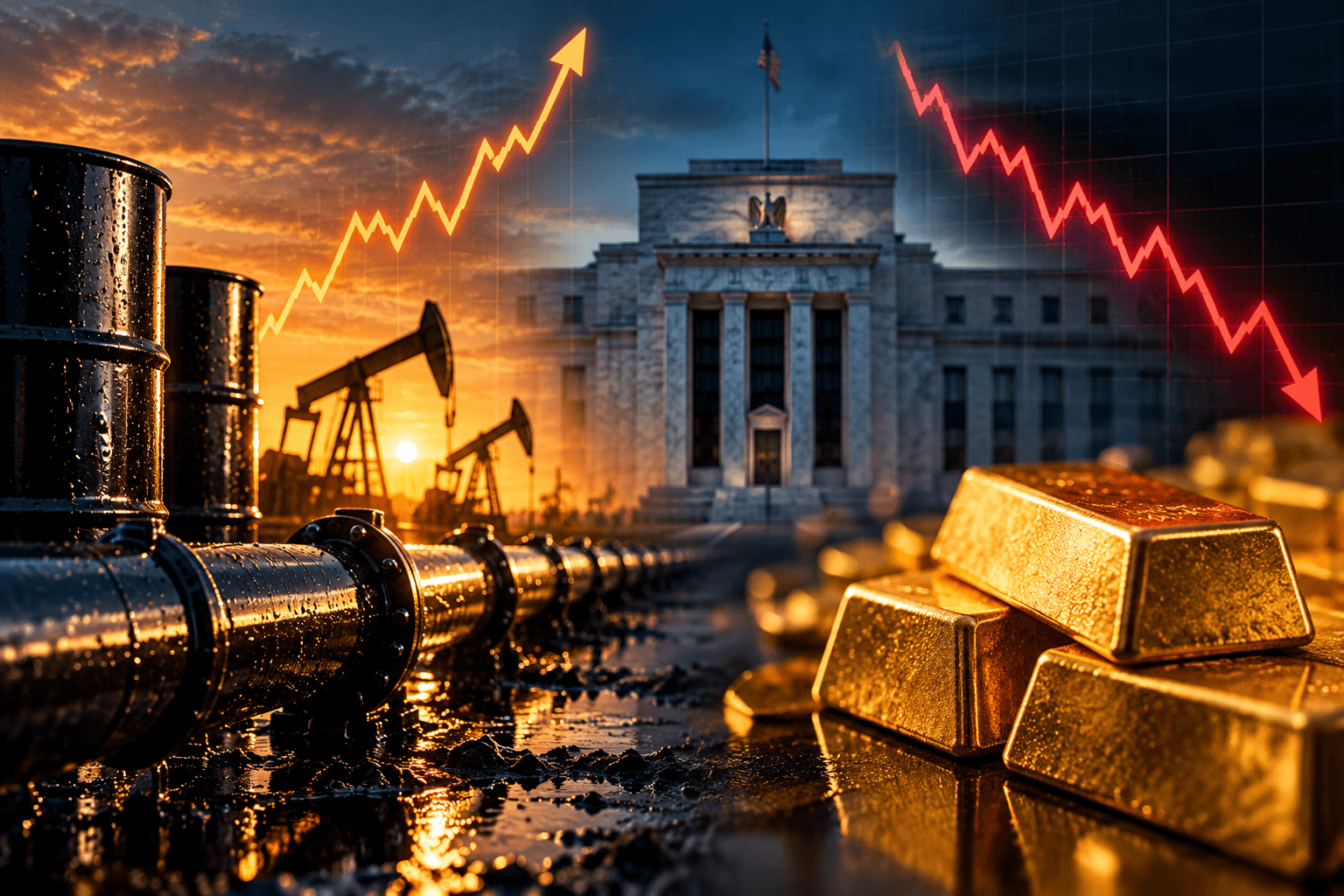
Oil: risen sharply.
Gold: temporarily below 4,000 dollars.
And at the same time:
Tech stocks under pressure.
Investors seek safety.
US Treasuries rise.
Actually, this would be exactly the situation in which one would expect:
But that is exactly what is not happening at the moment.
Instead, the precious metal has lost around a quarter of its value since its record high in January.
What is going on?
The answer leads via an asset that many gold investors do not even have on their radar at first:
Brent is currently trading again at around:
115 dollars per barrel.
On Friday, it even reached almost 117 dollars at times.
New tensions in the Middle East and attacks on Saudi energy infrastructure have brought back concerns about supply disruptions.
And high oil prices have an unpleasant characteristic.
They have an effect almost everywhere.
Transport.
Chemicals.
Production.
Agriculture.
Aviation.
Heating.
Logistics.
When energy becomes more expensive, inflationary pressure increases.
The chain currently looks something like this:
leads to:
This in turn increases the probability:
This causes:
And suddenly, gold faces competition.
Because a gold bar pays:
A ten-year US Treasury bond, on the other hand, does.
The higher safe yields rise, the higher the opportunity costs of a gold position become.
In September, the American central bank raised its key interest rate by:
25 basis points
to:
On October 27 and 28, the Fed will meet again.
For this meeting, the market predominantly expects:
no further increase.
But for December, the priced-in probability of another interest rate hike was recently around:
77 percent.
Thus, every major jump in the oil price currently has a monetary policy dimension.
This is the truly interesting development.
A rising oil price does not immediately mean:
Gold must fall.
But the market begins to calculate:
What does oil do to inflation?
What does inflation do to the Fed?
What does the Fed do to yields?
What do yields do to gold?
Therefore, oil currently acts like a lever on the gold price.
Because gold does not have a single price determinant.
The World Gold Council has examined the September correction.
Gold lost in September:
At the same time, the yield on ten-year US Treasuries rose by:
53 basis points
to:
5.3 percent.
The dollar gained around:
2 percent.
And futures investors massively reduced their gold positions.
This shows:
The gold price reacts to several forces simultaneously.
Interest rates.
Dollar.
Risk.
Positioning.
In addition, there are:
ETF flows.
Central banks.
Physical demand.
Momentum.
Liquidity.
And of course, geopolitical developments.
Oil influences several of these factors.
But oil is not the puppeteer moving gold alone.
Brent is falling today to around:
114.5 dollars.
Gold is simultaneously rising again to approximately:
4,010 dollars.
This fits perfectly with the current mechanism.
Oil slightly weaker.
Inflation fear slightly lower.
Interest rate pressure slightly lower.
Gold slightly higher.
But be careful.
One day does not prove a permanent relationship.
Let's imagine a massive geopolitical escalation.
Oil rises.
But at the same time, the fear of war, financial market stress, and economic instability increases.
Then it can certainly happen:
Because the need for safety is suddenly stronger than the interest rate effect.
That is exactly why there is no simple rule:
Oil up = Gold down.
As recently as September, the World Gold Council observed gold strength despite:
higher interest rates,
rising yields,
a stronger dollar
and significant geopolitical risks.
The WGC suspected at the time an unusually broad strategic demand from various market participants.
Markets change their reaction patterns.
What weighed on gold yesterday can be overshadowed by a stronger factor tomorrow.
Here, a second mechanism comes into play.
And this one is particularly interesting.
Tech and AI stocks came under pressure.
In the case of credit-financed positions, price losses can trigger so-called:
The broker demands additional collateral.
And suddenly, an investor must obtain liquidity.
What do they sell?
Not necessarily only what is performing poorly.
But frequently:
Gold is one of those things.
Stocks fall.
Uncertainty rises.
And the “safe haven” is sold.
But that is exactly how liquidity crises can work.
Gold is valuable.
Gold is liquid.
So it can be sold to plug holes elsewhere.
Commerzbank analyst Carsten Fritsch therefore considers forced sales as a result of margin calls to be a possible driver of the recent price slide.
DZ Bank also sees gold sales to compensate for losses in tech and AI stocks.
No.
It means above all:
A safe haven is not an investment whose price rises every day that stocks fall.
Gold has no built-in mathematical obligation to correlate negatively with stocks.
In an acute liquidity crisis, it can even fall along with stocks.
The relevant question is:
That is something completely different.
One should not downplay that.
The World Gold Council cites as a record price:
on:
January 29, 2026.
This morning, gold is trading at approximately:
4,010 dollars.
This corresponds to a decrease of approximately:
Anyone who bought in January is currently experiencing a significant loss.
Gold is simply:
In September, gold fell by:
8.5 percent.
One could conclude from this:
Investors are leaving gold.
Yet at the same time, worldwide:
flowed into gold ETFs.
This corresponded to approximately:
How does that fit together?
While futures traders reduced positions, ETF investors bought.
While short-term speculators needed liquidity, long-term investors may have just used falling prices.
The market simply does not have:
It consists of completely different actors.
Traders.
Funds.
Private investors.
Insurance companies.
Family offices.
Central banks.
All with different time horizons.
In August, the globally reporting central banks bought a net total of:
China:
20 tons.
Poland:
8 tons.
Uzbekistan:
8 tons.
China even added another:
in September.
The largest Chinese monthly purchase in almost three years.
This does not prevent a falling gold price.
But it shows:
Strategic demand does not automatically disappear just because gold corrects in the short term.
Bank of America currently describes rising oil prices as the:
Handelsblatt quotes a scenario:
Should Brent rise to:
due to geopolitical tensions, gold could average only:
in 2027.
That would be another significant decrease.
But:
That is crucial.
Scenario one:
Oil rises due to tight supply.
Inflation rises.
Fed raises interest rates.
Yields rise.
Dollar rises.
This is exactly what the BofA scenario aims at.
But scenario two would also be conceivable.
Oil rises to 150 dollars because a major war escalates.
Financial markets come under stress.
Public finances deteriorate.
Uncertainty explodes.
Which effect predominates?
The oil price alone does not decide that.
Not:
But rather:
And gold reacts to this new equilibrium.
That sounds less spectacular.
But it is much more accurate.
Anyone who owns physical gold should distinguish between:
and:
The price can fall 25 percent in a few months.
That is real.
The asset function is another question.
Physical gold:
pays no interest,
fluctuates in price,
costs storage.
But it is at the same time:
It does not depend on whether a bank or a company fulfills its promise to pay.
That is a structural property.
Not a price forecast.
It also knows nothing of:
Fed meetings.
Margin calls.
Tech stocks.
AI valuations.
Dollar indices.
It remains:
a certain amount of physical gold.
Its market price can fluctuate strongly.
Its physical quantity cannot.
On Wednesday, the Fed can move the market.
On Thursday, new inflation data can move the market.
Oil can rise again tomorrow.
Or fall.
Gold as well.
Anyone who enters into a short-term price bet must observe exactly these factors.
Anyone who, on the other hand, views gold as a long-term component of a diversified portfolio asks a different question:
Those are two completely different strategies.
Gold is not a magical crisis button.
Stocks fall:
Gold rises.
Inflation rises:
Gold rises.
War begins:
Gold rises.
The world doesn't work that way.
Markets are more complicated.
Sometimes gold rises because of fear.
Sometimes gold falls because of interest rates.
And sometimes gold is sold precisely in a crisis:
That is exactly what makes the current situation so interesting.
The oil price can set the pace in the short term.
But the long-term role of gold is not decided by the price of a barrel of Brent.
But by the question:
Stay farsighted.
Yours,
Helge Peter Ippensen
Note: This post is for informational purposes only and does not constitute investment, tax, or legal advice, nor an invitation to buy or sell precious metals or financial instruments.