Silver Ahead of the PCE Showdown: Is the Rally Really About to Collapse for Investors?

September 28, 2026
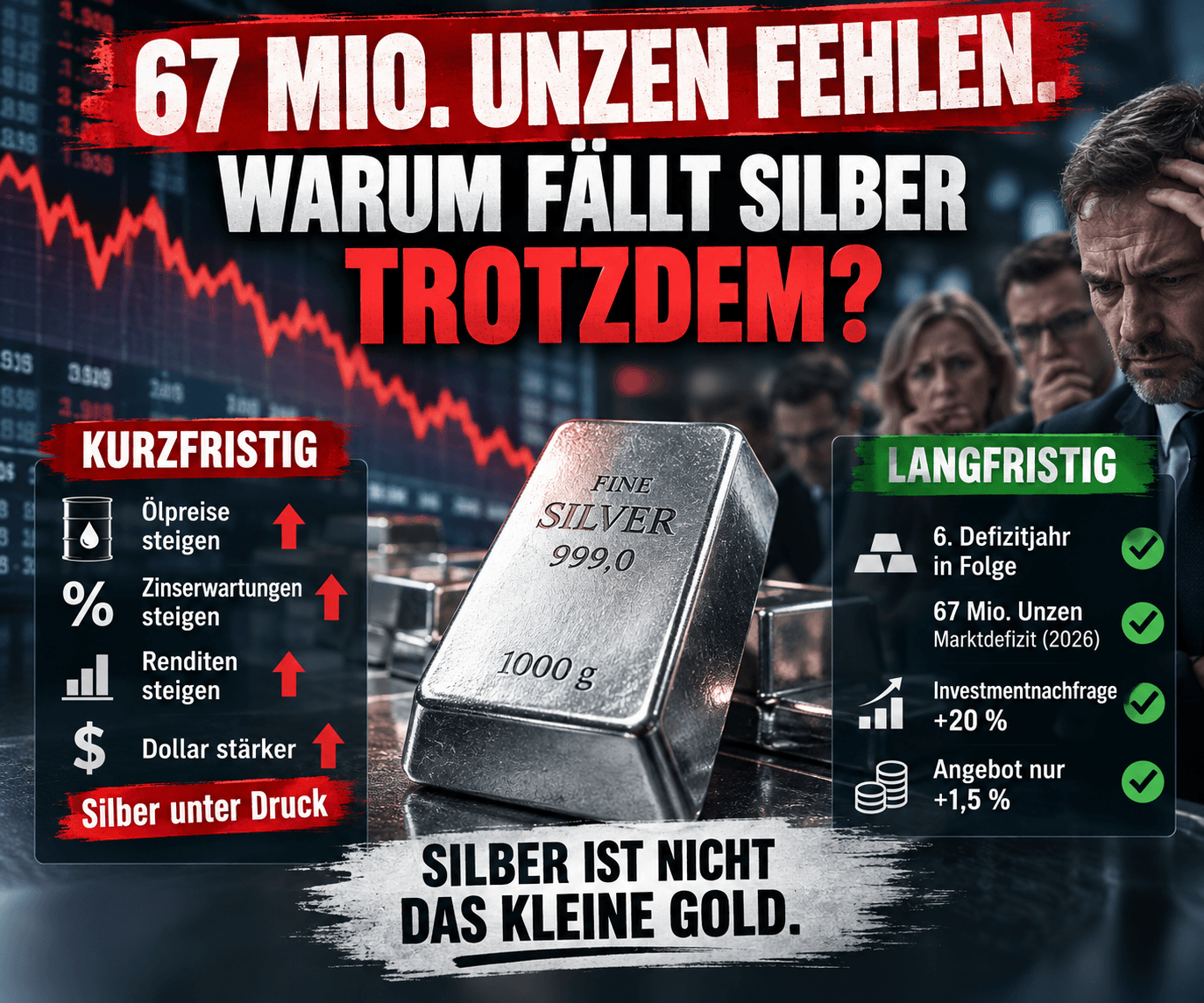
67 million ounces.
That is the projected deficit in the global silver market for 2026.
For the:
And yet, silver is under significant short-term pressure.
How does that fit together?
The answer to this illustrates quite clearly why silver is among the most fascinating – and nerve-wracking – precious metals.
For silver leads two lives simultaneously.
It is a:
Precious metal.
And an:
Industrial metal.
And currently, these two worlds are pulling in different directions.
On September 30, the American Bureau of Economic Analysis will release the August data for personal income and outlays.
Contained within is a figure that should be of particular interest to financial markets:
The Fed monitors this price index closely.
The most recently published July data was anything but reassuring.
PCE inflation:
3.7 %.
Core PCE excluding food and energy:
3.3 %. US Economic Analysis
Both figures are significantly above the Federal Reserve's inflation target.
And that is exactly why Wednesday could be volatile for gold and silver.
On September 16, the US central bank raised its key interest rate by:
25 basis points.
The new range:
It was the first interest rate hike in more than three years. Federal Reserve
The reasoning is noteworthy.
The American economy continues to grow solidly.
Investments are robust.
The labor market remains stable.
But:
Inflation remains elevated.
This is an uncomfortable combination for precious metals.
This sounds paradoxical at first.
After all, gold and silver are considered classic hedges against currency devaluation.
Why then do they fall precisely when inflation concerns increase?
Because markets do not just evaluate inflation.
They also evaluate:
If rising oil prices increase inflation and the Fed therefore raises interest rates further, the yields on safe government bonds may also rise.
Gold and silver, on the other hand, pay:
0 % interest.
This increases their opportunity costs.
This is exactly what we are currently experiencing.
The development of recent weeks shows an unusual chain:
Oil rises
↓
Inflation concerns rise
↓
Interest rate expectations rise
↓
Bond yields rise
↓
Dollar tends to strengthen
↓
Gold and silver come under pressure
On September 24, Reuters reported simultaneously on higher oil prices, a dollar at a two-month high, and very high US Treasury yields. Gold fell to its lowest level since September 16. Reuters
Silver can hardly escape this macroeconomic mechanic in the short term.
No.
That would be far too simple.
A surprisingly high PCE value could put silver under significant pressure.
A surprisingly low value, on the other hand, could reduce interest rate expectations and give precious metals some breathing room.
But:
And this is where the second story begins.
The Silver Institute expects for 2026 once again:
Specifically, of approximately:
67 million ounces. Silver Institute
This would make 2026 the:
The cumulative deficits of this phase, according to the World Silver Survey, total around:
This is not a short-term Fed story.
This is a structural market story.
For 2026, the Silver Institute expects mine production of around:
820 million ounces.
Plus:
1 %.
Total silver supply is expected to grow by approximately:
1.5 %
to around 1.05 billion ounces. Silver Institute
That is not nothing.
But it is also not an explosive supply response to high prices.
One reason:
Silver is often not extracted as the primary product of a silver mine.
It is frequently produced as a by-product during the mining of other metals.
A higher silver price, therefore, does not automatically lead to substantially more silver entering the market in the short term.
This is where it gets particularly interesting.
The Silver Institute expects physical investment demand in 2026 to be:
To:
227 million ounces. Silver Institute
Thus, rising demand for coins and bars meets a market that has already been consuming more silver than is being newly provided for years.
For silver bulls, this is a strong argument.
But this story also has a flip side.
High prices change behavior.
This also applies to silver.
This is particularly evident in photovoltaics.
Solar cells require silver.
But as silver becomes increasingly expensive, manufacturers have a strong economic incentive to:
use less silver per cell.
Or to partially replace silver with other materials.
This is exactly what is happening.
The Silver Institute therefore expects declining silver consumption in this sector despite further growing solar installations.
Overall industrial silver processing is expected to fall in 2026 by about:
2 %
to around:
650 million ounces. Silver Institute
This is the mechanism we already highlighted in our last silver post:
With gold, we can distinguish relatively clearly between investment, jewelry, and central bank demand.
Silver is more complicated.
It benefits from:
Electrification.
The automotive industry.
Electronics.
Data centers.
AI infrastructure.
Solar energy.
And at the same time, this industrial demand competes with:
Coins.
Bars.
ETPs.
Jewelry.
Silverware.
This means:
When investors discover silver, they encounter a market whose physical supply is already required by industrial consumers.
But if the price rises too sharply, these consumers react.
They economize on silver.
They substitute.
They recycle.
This is precisely why one should never automatically derive a specific silver price from a market deficit.
In the short term:
a great deal.
In the long term:
significantly less.
Should core PCE inflation turn out surprisingly high, expectations for further Fed rate hikes could rise.
The dollar and yields could gain.
Silver could fall.
Should inflation turn out weaker, on the other hand, this mechanic could reverse.
But neither answers the long-term decisive question.
Which is:
That is where the more exciting silver story is decided.
Not on a Wednesday.
But over years.
Perhaps this is the most important sentence.
Silver reacts to monetary policy like a precious metal.
It reacts to the economy like an industrial metal.
It reacts to inflation.
To interest rates.
To the dollar.
To solar production.
To electrification.
To investment demand.
And to technological substitution.
Therefore, silver can rise much more violently than gold.
And fall much more violently.
Anyone who views silver exclusively as a cheaper version of gold overlooks this very peculiarity.
Perhaps even very volatile.
But the question of whether silver stands at 60, 70, or eventually significantly higher again will not be decided by a single PCE report.
Decisive is the interplay of:
Monetary policy.
Real interest rates.
Investment demand.
Industrial demand.
Substitution.
Mine supply.
And:
physical inventories.
Therefore, with silver, one should perhaps look less at next Wednesday.
And more at the coming years.
Because:
And that is exactly why it remains so exciting.
Stay farsighted.
Yours,
Helge Peter Ippensen