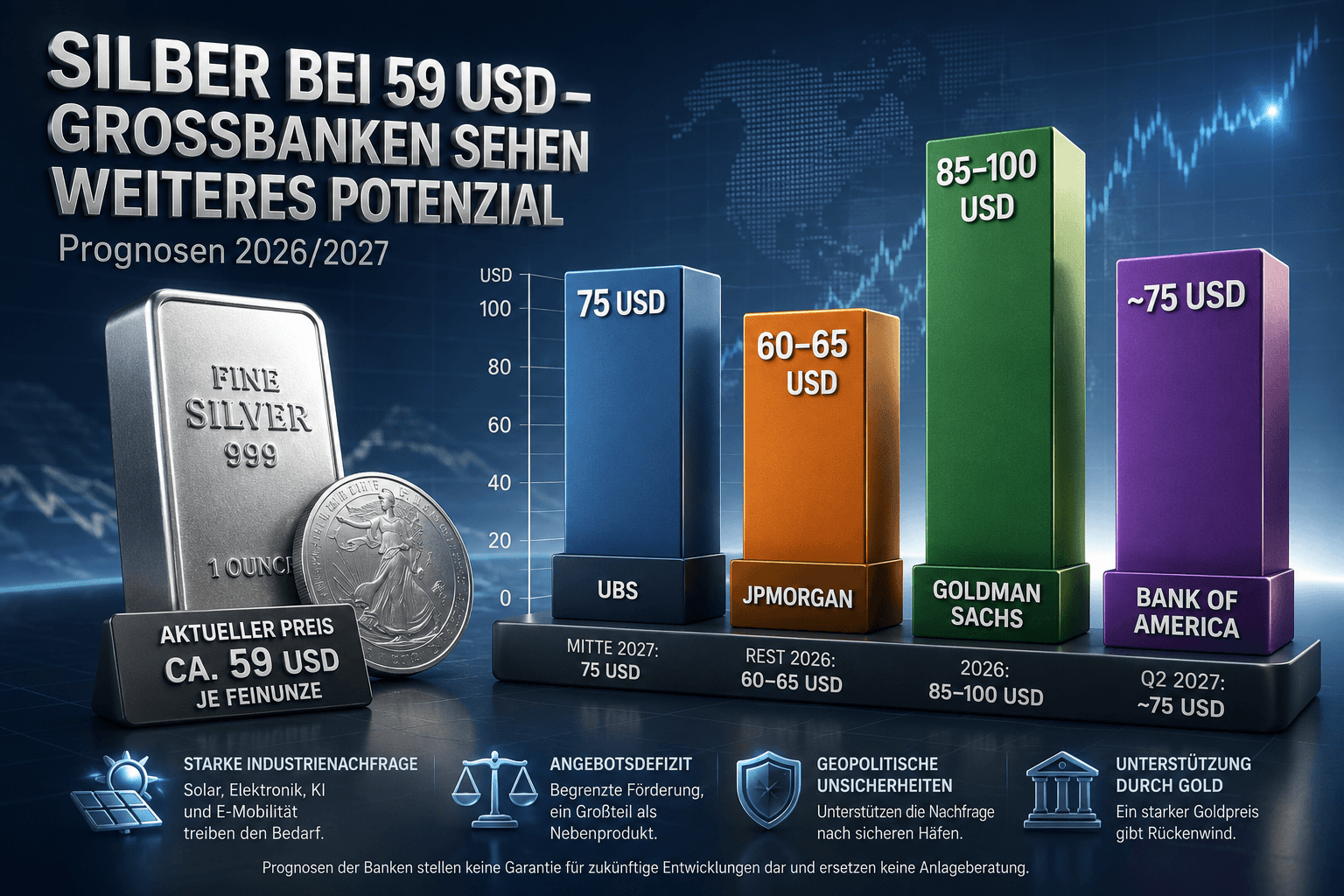
With a silver price of around 59 US dollars per troy ounce, the precious metal is once again moving into the focus of institutional investors. While many private investors are waiting for pullbacks after the strong rally of recent months, several international investment banks have published their long-term expectations – and these are predominantly optimistic.
What stands out: despite different models and assumptions, most firms expect higher silver prices in the medium term. The range of forecasts extends from moderate price increases to triple-digit price targets.
The published research assessments show that silver could continue to benefit from several structural factors. In addition to robust industrial demand, geopolitical uncertainties, the development of monetary policy, and the tight supply situation also play an important role.
| Institution | Forecast |
|---|---|
| UBS | approx. 75 USD |
| JPMorgan | 60–65 USD short-term, significantly higher long-term |
| Goldman Sachs | 85–100 USD |
| Bank of America | approx. 75 USD |
The forecasts are based on different valuation models and do not represent a guarantee for future price development. However, they illustrate that institutional analysts continue to view the long-term silver market constructively.
Silver has long since ceased to be exclusively a classic precious metal. A significant portion of demand today comes from industrial applications. In particular, the solar industry, electronics, electromobility, and applications related to artificial intelligence require substantial amounts of the metal.
This is contrasted by a supply that can only be expanded with limited flexibility. Since silver is often obtained as a byproduct of mining other metals, production only reacts with a delay to rising prices.
This combination of structural demand and limited supply has been causing recurring supply deficits for years and supports the long-term market trend.
Historically, there is a close relationship between gold and silver. If gold rises due to geopolitical risks or monetary policy expectations, silver often benefits as well.
Currently, numerous international banks continue to expect high gold prices in the coming quarters. A stable gold environment could therefore also provide additional support to the silver market.
Despite the positive analyst assessments, silver remains one of the more volatile precious metals. The strong industrial demand simultaneously makes the market sensitive to a slowdown in the global economy. Interest rate decisions by the US Federal Reserve or changes in the US dollar can also trigger significant short-term price fluctuations.
For long-term oriented investors, the focus is therefore less on short-term daily movements and more on the question of whether the fundamental supply and demand factors remain in place.
The current research forecasts from major investment banks show a remarkably consistent picture: in the view of many institutional analysts, silver still possesses upward potential. Although the specific price targets differ significantly, the underlying arguments are similar. Robust industrial demand, structural supply bottlenecks, and a supportive environment for precious metals speak in favor of a market that remains interesting from today's perspective.
However, how the silver price actually develops depends on numerous economic and geopolitical factors. Forecasts provide orientation but do not replace one's own analysis.
Stay farsighted
Yours, Helge Peter Ippensen