Diesel at 2.45 Euros: What Record Fuel Prices Mean for Inflation and Purchasing Power

September 17, 2026
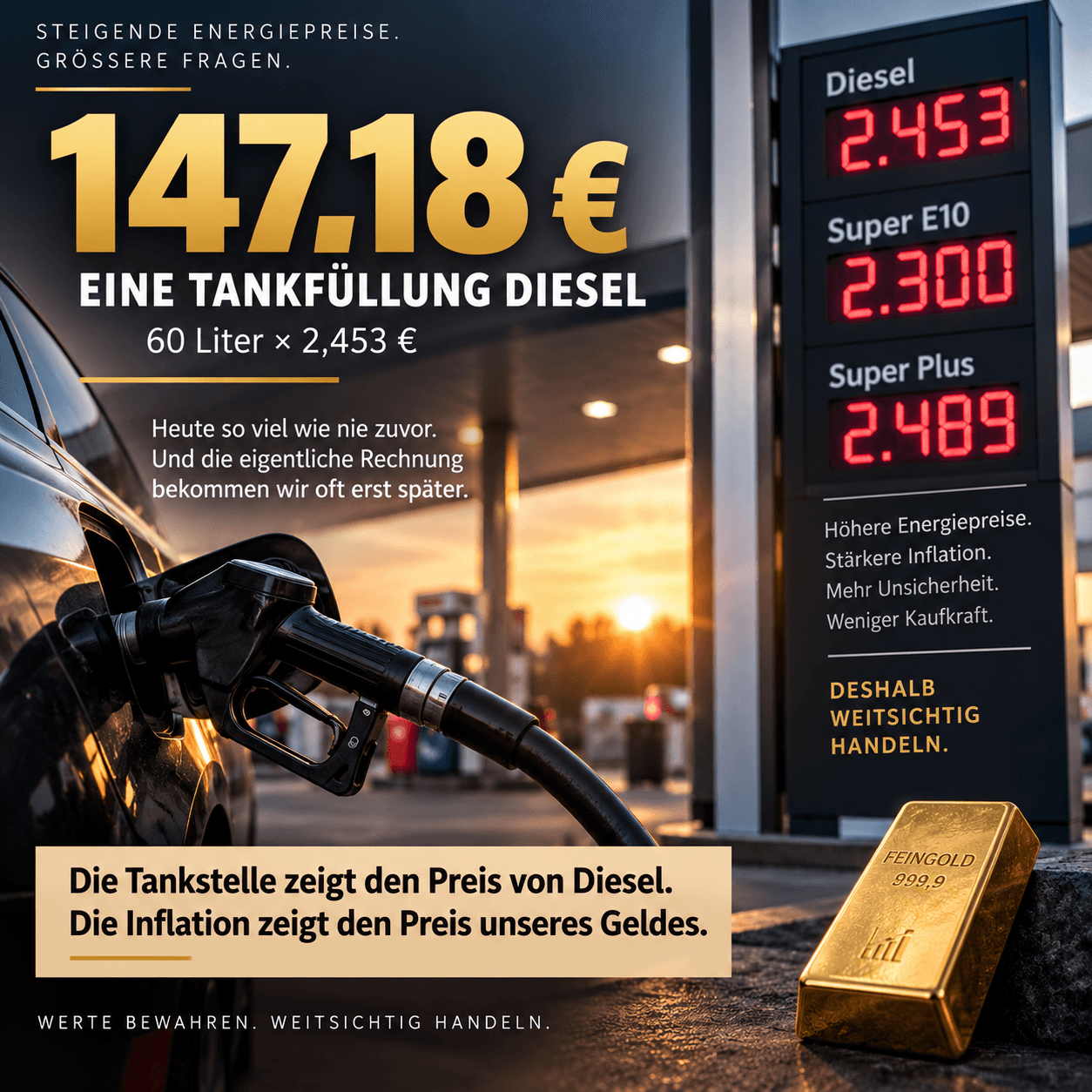
2.453 euros.
This was the cost of a liter of diesel on September 16, 2026, as a nationwide daily average.
New Record.
Super E10 also reached a historic high of 2.30 euros per liter a few days earlier.
Anyone filling a 60-liter tank with diesel pays:
147.18 euros.
At 1.60 euros per liter, it would have been 96 euros.
Difference:
51.18 euros – for a single tank of fuel.
This is already painful.
But from an economic perspective, the bill at the pump is only the beginning.
Gasoline primarily affects private drivers directly.
Diesel has an additional significance.
Trucks.
Delivery vehicles.
Construction machinery.
Agriculture.
Buses.
Logistics.
A significant portion of the goods we buy every day was at some point transported by a diesel-powered vehicle.
If the price of diesel rises permanently, costs along the supply chains increase as a result.
The Federal Association of Freight Transport, Logistics and Waste Management (BGL) is now warning of significant burdens. According to its calculations, a fleet of 50 trucks can incur more than one million euros in additional costs per year due to the increased diesel prices.
This million does not simply disappear.
Ultimately, companies have only a few options:
Bear the costs themselves.
Increase productivity.
Reduce investments.
Or raise prices.
Crude oil is, of course, a major component of the fuel price.
And Brent was recently expensive at more than 100 dollars per barrel.
But even the ADAC points to an interesting discrepancy.
At the end of April, Brent also cost approximately 110 dollars.
At that time, E10 cost around 2.10 euros.
Now E10 was at 2.30 euros.
A 20-cent difference per liter with a similar crude oil price.
This shows:
The price at the pump is not determined by the crude oil price alone.
Refinery margins, product scarcity, logistics, exchange rates, competition, as well as taxes and levies also play a role.
This statement is also too simple.
The energy tax is a quantity-based tax.
In principle, a fixed tax amount is charged per liter – regardless of whether the liter costs 1.60 or 2.50 euros.
Value-added tax (VAT) is different.
It amounts to 19 percent of the gross price.
If the price rises, the absolute VAT amount generally increases as well.
The Federal Ministry of Finance has already modeled exactly this effect.
For the sharp price increase in March 2026, it initially calculated around 116 million euros in additional VAT revenue.
At the same time, however, the quantities sold decreased. As a result, in the model calculation, revenue from the energy tax fell by around 82 million euros.
The treasury therefore does not benefit one-to-one from rising prices.
But VAT actually acts like a percentage surcharge on a rising base price.
The federal government already responded once to the first price explosion in 2026.
From May 1 to June 30, the energy tax on diesel and gasoline was reduced by 14.04 cents per liter each.
Due to the resulting decrease in VAT, the calculated relief totaled approximately:
17 cents per liter.
The federal government estimated the relief at about 1.6 billion euros.
After that, the measure expired.
Now prices are at record levels again.
And promptly, the next intervention is being discussed.
One proposal is to temporarily reduce the VAT on fuel from 19 to 7 percent.
What would that mean in theory?
With a gross price of 2.453 euros for diesel, the net price is mathematically around:
2.061 euros.
If 7 percent VAT were charged instead of 19, and the net price otherwise remained unchanged, the result would be:
around 2.21 euros per liter.
Calculated difference:
around 25 cents per liter.
For 60 liters, that would be approximately:
15 euros per tank of fuel.
This is, however, a theoretical calculation.
Whether a tax cut is fully passed on at the pump depends on competition, market prices, and the behavior of the providers.
Germany has already had exactly this experience with previous fuel discounts.
This is where the topic becomes interesting for monetary policy.
If gasoline prices rise, the disposable income of a driver initially falls.
If diesel prices rise, the cost structure of the entire economy can also be affected.
Trucks transport food.
Building materials.
Machinery.
Packages.
Medicines.
Raw materials.
Higher transport costs can therefore end up in consumer prices through many intermediate stages.
This makes fuel prices a potential inflation amplifier.
This is where we come full circle to our recent Spargold topic.
The ECB raised its deposit rate to 2.50 percent on September 10.
The reason:
renewed rising inflationary pressure, particularly due to energy.
The problem with this:
Higher interest rates do not produce a single liter of diesel.
They do not repair a pipeline.
They do not increase refinery capacity.
And they do not open a blocked shipping route.
The ECB can only try to dampen demand and prevent the energy price shock from becoming permanently embedded in prices, wages, and inflation expectations.
A consumer can theoretically be hit multiple times as a result.
At the gas station through higher fuel prices.
At the supermarket through higher transport costs.
For services through higher operating costs.
And finally, potentially for loans through higher interest rates.
This is why an energy price shock is significantly more relevant from an economic perspective than an expensive tank of fuel.
First of all:
2.45 euros for diesel is not a gold buy signal.
Gold does not prevent rising energy prices.
It does not pay a fuel bill.
And its price can fluctuate significantly.
The connection is through purchasing power.
When energy prices spread to many other goods and services, money loses purchasing power in real terms.
And when central banks have to react to this with higher interest rates, the valuation of practically all asset classes changes at the same time.
Stocks.
Bonds.
Real estate.
Gold.
Gold pays no interest.
It generates no cash flow.
But physical gold is also not a claim against a bank, a company, or a state.
Therefore, within a diversified asset structure, it can take on a function that neither overnight money, nor stocks, nor real estate can exactly replace.
Not as a bet on the next diesel price.
But as a long-term asset component in a world where energy, inflation, and monetary policy have once again become significantly more volatile.
Today we see:
2.453 €/liter of diesel.
That is spectacular.
But the more important question in the long term is:
What remains of 100 euros of purchasing power if energy permanently claims a larger portion of our income and simultaneously drives up other prices?
Because in the end, it’s not how many euros are in an account that counts.
What matters is what you can buy with it.
The gas station shows us the price of diesel.
Inflation shows us the price of our money.
Stay farsighted
Yours, Helge Peter Ippensen