ECB Raises Interest Rates to 2.50%: What the Rate Hike Means for Gold and Investors Now

September 10, 2026
As of: September 10, 2026
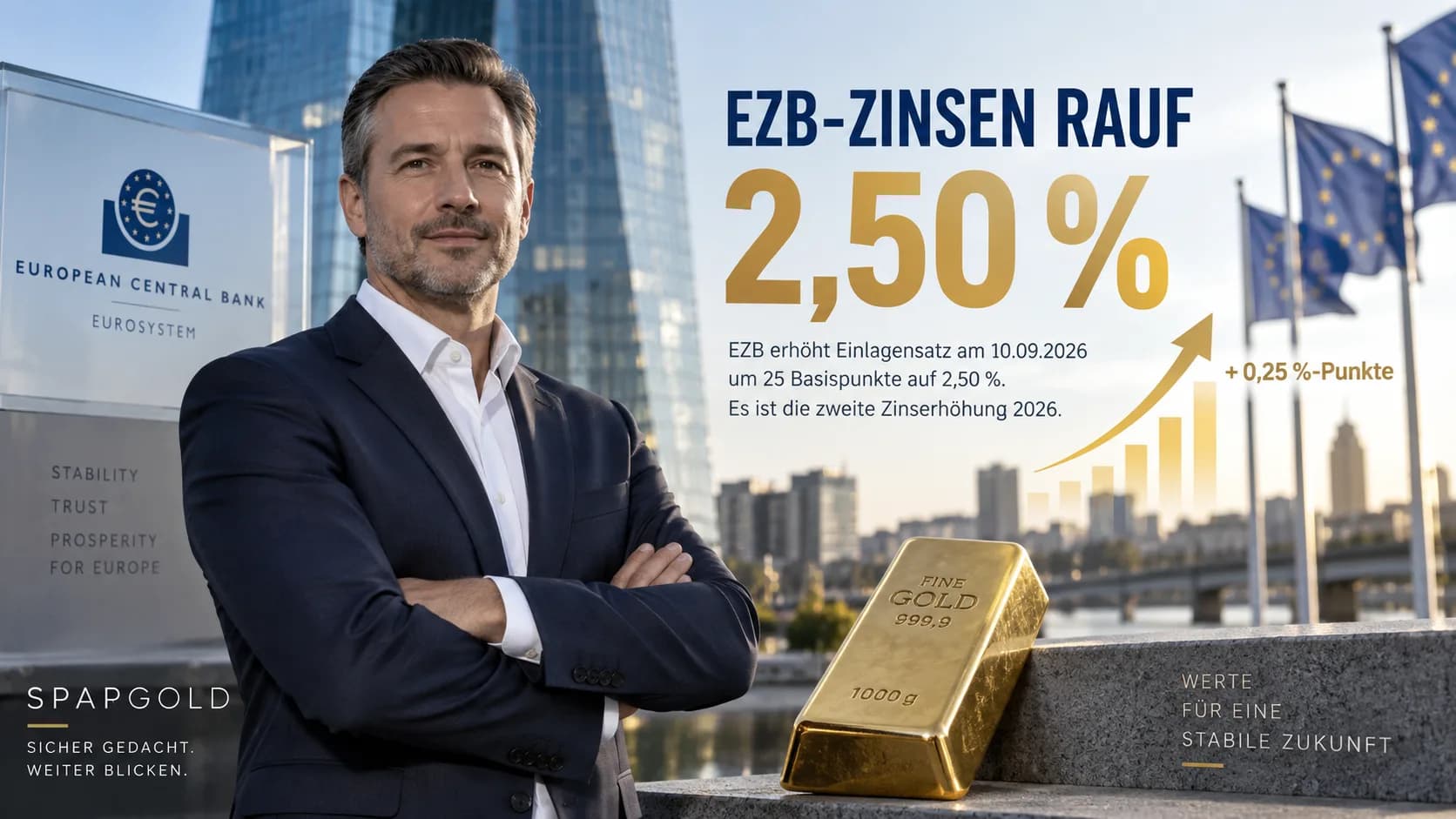
The European Central Bank has raised interest rates again. The deposit rate, which is particularly relevant for monetary policy, increases by 25 basis points from 2.25 to 2.50 percent. It is the ECB's second interest rate hike in 2026. The primary reason is the increasing inflationary pressure caused by sharply rising energy prices.
For investors, the decision is noteworthy for another reason: on the same day, gold and bonds came under pressure, while the price of oil continued to rise. Several factors are currently converging that are decisive for asset investment: higher interest rates, rising energy prices, persistent inflation, and geopolitical uncertainty.
The ECB aims to stabilize inflation at 2 percent over the medium term. This goal is once again further away. Inflation in the eurozone was over 3 percent in August. The ECB now expects an average inflation rate of 3.0 percent for the full year 2026. Expectations for 2027 have been raised to 2.5 percent.
A key driver is energy. Brent crude oil rose temporarily to 106.60 US dollars per barrel on September 10. The renewed escalation in the Middle East and the risks to important transport and supply routes have intensified concerns about prolonged energy shortages.
Rising energy prices do not only affect gas stations or heating costs. They also increase transport, production, and logistics costs. If these burdens persist over a longer period, they can spread to numerous goods and services.
| Key Figure | As of September 10, 2026 | Significance |
|---|---|---|
| ECB Deposit Rate | 2.50 % | +25 basis points |
| ECB Inflation Expectation 2026 | 3.0 % | Significantly above the 2% target |
| ECB Inflation Expectation 2027 | 2.5 % | Revised upwards |
| Eurozone Growth Forecast 2026 | 0.9 % | Slightly raised |
| Brent Crude Oil | temporarily 106.60 USD | Additional inflationary pressure |
| Gold Spot | approx. 4,358 USD/oz | After more than 1 % daily loss |
The expectation sounds logical at first: the ECB raises interest rates, so inflation should quickly decline.
However, monetary policy does not work that simply.
A central bank can dampen demand through higher financing costs. However, it has little direct influence on a geopolitically caused oil or gas shock. No higher key interest rate produces additional oil or opens blocked transport routes.
The ECB is therefore primarily trying to prevent the initial energy price shock from permanently spreading to other prices, wages, and inflation expectations.
This is precisely the current dilemma. Interest rates that are too low could further fuel inflation. Conversely, interest rates that are too high can place additional strain on investments, real estate financing, and consumption.
A simple rule often falls short when it comes to the price of gold as well.
Theoretically, rising interest rates are initially a headwind for gold. Gold itself pays no interest. If the yields on bonds and other interest-bearing investments rise, the opportunity costs of a gold investment increase.
This effect was actually visible on September 10. The gold price fell temporarily by more than 1 percent to around 4,358 US dollars per troy ounce. On the previous day, gold had still been trading at around 4,414 US dollars. In addition to rising interest rate expectations, higher US bond yields and a stronger dollar weighed on the market.
But that is not the end of the story.
Gold does not react exclusively to the nominal key interest rate. Relevant factors include real interest rates, inflation expectations, exchange rates, geopolitical risks, and confidence in the long-term purchasing power of currencies.
The current market environment provides a clear example of this. Although the ECB is raising interest rates, inflation and energy prices remain high at the same time. This increases the interest rate on nominal investments, but at the same time, the question of real purchasing power preservation remains.
For traditional savers, higher central bank interest rates are generally positive. Banks can offer higher overnight and fixed-term deposit rates because the general interest rate level increases.
However, it is not just the number on the bank statement that is decisive.
For example, anyone who receives an interest rate of 2 or 2.5 percent while the general price level rises by around 3 percent at the same time still achieves no positive real return before taxes.
Nominal interest and real purchasing power are two different metrics.
This is particularly important in a phase where many investors are looking more closely at overnight deposits and bonds again after years of extremely low interest rates. The return of interest changes asset investment, but it does not automatically solve the problem of purchasing power preservation.
The reaction of the European bond markets on the day of the ECB decision was significant.
The yield on ten-year German federal bonds rose to its highest level since 2011. At the same time, market participants increased their expectations for further interest rate steps by the ECB. On September 10, a further interest rate hike by December was fully priced into money market prices. By the end of 2027, a total of around 85 additional basis points of monetary policy tightening were priced in.
However, this does not mean that these interest rate steps will actually occur.
Market expectations change constantly. If the price of oil falls significantly or the economy weakens more sharply, the interest rate path can quickly change again.
The ECB itself therefore continues to emphasize its data-dependent approach and does not commit itself to a specific interest rate path.
Rising capital market interest rates can make financing more expensive. This affects states and companies, but also private households.
In particular, mortgage financing is not directly oriented towards the ECB deposit rate, but strongly towards longer-term capital market yields. If the yields on long-term government bonds rise, real estate loans can also become more expensive.
For existing loans with long-term fixed interest rates, nothing changes for the time being. In the case of follow-up financing or new loans, however, the current interest rate level plays a much larger role.
The interest rate hike therefore has an impact far beyond overnight deposit accounts.
For precious metal investors, it is worth taking a closer look at the reason for the interest rate step.
If interest rates rise because the economy is growing strongly and inflation remains controlled, this is a different environment than an interest rate hike due to an external energy price shock.
Currently, the ECB is raising interest rates primarily because high energy prices are driving inflation upwards again. At the same time, it warns of risks to economic growth. Christine Lagarde described the outlook as extremely uncertain.
This combination of inflation risk and growth risk is challenging for investors.
In this context, gold is not to be understood as a short-term bet on falling or rising central bank interest rates. Within an asset structure, physical gold fulfills a different function than an interest-bearing bank balance or a government bond.
Gold is a tangible asset without ongoing interest, but at the same time, it is not a claim against a bank, a state, or a company.
One of the most important metrics for gold investors remains the real interest rate.
Simply put, it describes what remains of a nominal interest rate after taking inflation into account.
If nominal interest rates rise faster than inflation, the real return on classic interest-bearing investments improves. This can put gold under pressure.
If, on the other hand, inflation rises at the same time, the real advantage can be significantly smaller.
Genau deshalb reicht es nicht, ausschließlich auf die Schlagzeile „EZB erhöht Leitzins“ zu schauen.
The market now considers further interest rate steps likely.
Following the current decision, a further hike by December was fully priced in. At the same time, market prices even indicate additional tightening until the end of 2027.
Whether this actually results in a longer interest rate hike cycle will depend primarily on how energy prices, core inflation, wages, and the economy develop.
It will be particularly decisive whether the current energy price shock spreads to other price areas. It is precisely these so-called second-round effects that the ECB wants to prevent.
The ECB interest rate hike to 2.50 percent is an important signal. The central bank is taking the renewed rise in inflation seriously and is trying to prevent higher price increase rates from becoming entrenched.
For investors, however, this does not mean that the world can be reduced to the simple formula "interest rates up, gold down."
On September 10, gold actually fell to around 4,358 US dollars per troy ounce. At the same time, Brent crude oil rose temporarily to more than 106 US dollars, yields on European government bonds reached multi-year highs, and the ECB raised its inflation forecast for 2027.
This shows how many forces are currently acting on the financial markets simultaneously.
The key takeaway is therefore: Interest is the price of money – purchasing power is the reality.
At spar.gold, we rely on a clear principle: physical precious metals and verifiable availability instead of abstract promises.
This post is for general information purposes only and does not constitute investment advice or a recommendation to buy or sell specific assets.
Stay farsighted, Yours Helge Peter Ippensen