Ray Dalio Warns of the "Debt Heart Attack," the Giga-Crash: What Happens When the World's Safest Investment Becomes a Problem?

October 12, 2026
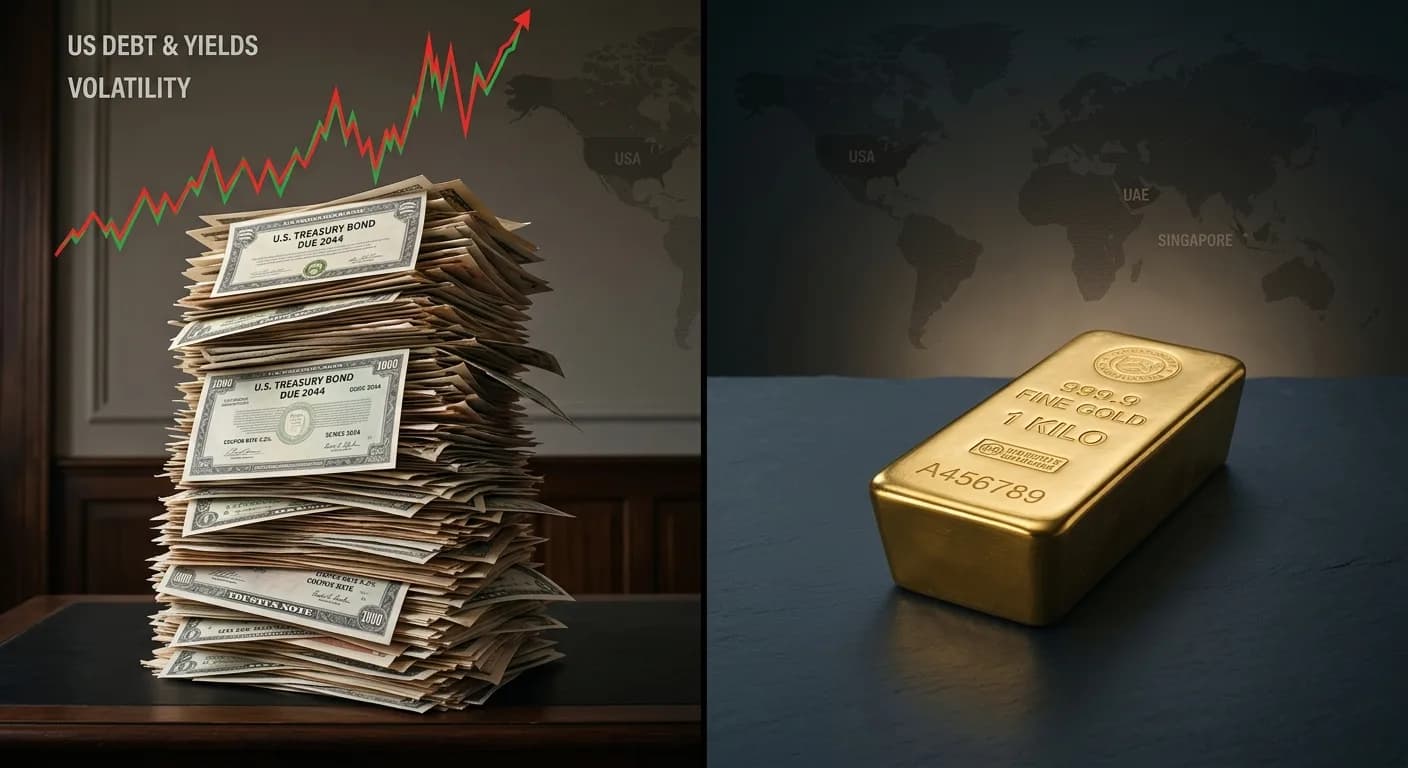
40,000,000,000,000 Dollars.
That is how high the American national debt has now become.
Forty trillion dollars.
And one of the world's best-known macro investors says:
The problem could escalate much faster than many believe.
Ray Dalio expects a global debt crisis:
Sometime within the coming two years. Yahoo Finance
Such forecasts should never be confused with certainties.
Ray Dalio can also be wrong.
But the numbers behind his warning deserve attention.
On August 18, 2026, the total American national debt exceeded for the first time:
Of this, approximately:
32.3 Trillion Dollars
are in the hands of the public.
The rest are intra-governmental holdings within the American state system. Reuters
This is important.
Because the state does not only have to finance new deficits.
It must simultaneously refinance existing debt.
And right now, the price of this money is changing.
That is the current yield on ten-year US Treasuries.
30-year Treasuries:
more than 5.6 percent.
At first, that sounds excellent for a buyer.
More interest.
More yield.
But for the debtor, the same number looks completely different.
And the debtor is called:
According to projections by the Congressional Budget Office, net interest outlays in 2026 will be approximately:
By 2036, this could become:
Then net interest alone would consume approximately:
4.6 % of the total American GDP
of the total American GDP. Congressional Budget Office
And this is exactly where Dalio's argument begins.
Let's take a government bond.
It was issued years ago.
Perhaps at:
1 percent.
Then it matures.
The state pays it back.
But where does the money come from?
For a permanently deficit-running state, often through:
Only this new bond today might cost:
5 percent.
Therefore, the debt amount does not even have to increase significantly for the interest bill to grow.
Old cheap debt is gradually replaced by:
replaced.
The Congressional Budget Office expects for 2026:
7.4 Trillion Dollars in spending
versus:
5.6 Trillion Dollars in revenue.
Difference:
And the problem does not disappear according to the CBO.
By 2036, the annual deficit in the baseline scenario is projected to rise to:
3.1 Trillion Dollars
rise. Congressional Budget Office
This means:
The USA must simultaneously
refinance old debt
and
take on new debt.
A state can theoretically offer a lot of bonds.
But:
And buyers ask a fairly simple question:
What interest do I get for my risk?
For a long time, this question was hardly problematic for the USA.
US Treasuries were considered:
safe,
liquid,
globally available,
the number one reserve asset.
This generally still holds true.
But the buyer structure is changing.
According to official Treasury data, China held in July:
618 Billion Dollars
in US government bonds.
A year earlier, it was nearly:
696 Billion Dollars.
Japan remains the largest single foreign holder with:
1.104 Trillion Dollars.
There, too, holdings have recently been declining. U.S. Department of the Treasury
But be careful:
It does not follow that foreign countries are avoiding American government bonds altogether.
Great Britain, for example, has significantly increased its position and stood at almost:
1 Trillion Dollars in July.
That is exactly why the statement:
„Nobody wants American debt anymore“
would be wrong.
The problem is more subtle.
And that is exactly why the development of yields is so important.
The American government continues to get money.
Vast amounts, in fact.
But investors now demand:
Reuters reports today on increasing volatility and growing risk premiums in the US bond market.
10 years:
5.23 %.
30 years:
5.61 %. Reuters
This is not yet a debt crisis.
But it is a signal.
No one can answer that seriously.
Ray Dalio says:
within about two years.
Maybe he is right.
Maybe not.
Furthermore, a debt crisis does not have to look the way many imagine it.
A state like the USA, which is indebted in its own currency, possesses options that a private debtor does not have.
The central bank can:
provide liquidity.
buy bonds.
influence interest rates.
And with that, the problem changes.
Put simply, two possibilities arise when there is too much debt.
Then debt service becomes increasingly expensive.
The state must save,
increase taxes,
take on more debt
or choose a combination thereof.
Then it can buy debt securities and create liquidity.
This reduces the immediate refinancing problem.
But another risk potentially increases:
And that is exactly why gold becomes interesting for Dalio.
At the Greenwich Economic Forum, Dalio recently explained:
He is positioning himself against debt securities.
At the same time, he views gold as an important component of a diversified portfolio. Yahoo Finance
His scale:
Not 50 percent.
Not everything.
Not:
„Sell stocks and bonds.“
But:
Diversification.
That is a significant difference.
Dalio's argument is remarkably simple.
A bond is:
For every dollar of debt, there exists on the other side:
an asset.
A promise to pay.
Gold works differently.
Thus, it has no classic issuer risk.
No one has to pay you back the gold bar in ten years.
It already exists.
That does not make it risk-free.
Its price can fluctuate significantly.
It pays no interest.
Its storage costs money.
But structurally, it differs fundamentally from debt securities.
Interestingly, he does exactly that.
By his own account, approximately:
He recognizes Bitcoin as a form of money that cannot be increased at will.
But:
He prefers gold for this purpose. Benzinga
This is noteworthy.
Because Dalio apparently distinguishes between:
technological scarcity promise
and
physical asset.
At this point, the story becomes particularly interesting for Spargold.
Dalio is not just thinking about:
but also about:
Which countries have surpluses?
Which are dependent on foreign capital?
Which are innovating?
Which have stable political and economic frameworks?
He explicitly highlights two countries currently:
and:
Dalio counts Singapore among the countries with capital surpluses.
Such states are less dependent on foreign countries constantly lending them new money.
In a world with:
rising national debt,
geopolitical tensions,
capital shifts
and higher refinancing needs
this is a structural advantage.
And that is exactly why geographical diversification is something other than an exotic addition.
It can be part of an asset strategy.
Spargold is a German company.
Our customers can purchase physical gold and silver digitally.
However, the precious metals themselves are:
This is no coincidence.
Because diversification can take place on several levels:
Asset: Gold instead of exclusively claims.
Currency: physical asset instead of exclusively Euro or Dollar.
Geography: storage outside the domestic financial system.
These three levels are often mixed up.
Yet they are completely different decisions.
This is an important correction.
While he views nominal debt securities critically, he speaks positively about:
Why?
Because their repayment or capital value is linked to inflation.
The real value of a classic promise to pay can erode through inflation.
An inflation-indexed security attempts to partially compensate for exactly this risk. CEOInterviews.AI
This shows:
Dalio's position is more nuanced than:
„Out of bonds, into gold.“
No one knows if the USA will experience a debt crisis within two years.
Not even Ray Dalio.
The decisive factor is something else.
If a portfolio only works if:
the dollar remains stable,
government bonds remain stable,
interest rates fall,
stocks rise
and the domestic financial system functions without disruption,
then one possibly possesses:
But rather different assets that depend on the same system.
It tells a story about how our modern financial system is built.
One person owns debt.
The other owns the claim to it.
States issue bonds.
Banks hold them.
Fonds hold them.
Insurance companies hold them.
Central banks hold them.
And investors hold them.
This works excellently.
As long as there is enough trust.
Not better for every purpose.
But differently.
There is no coupon.
No maturity.
No debtor.
No promise that must be fulfilled.
And perhaps that is exactly why Dalio's crisis forecast is not the most interesting statement.
But rather his consequence from it:
Gold.
Inflation-indexed bonds.
Stocks.
Geographical diversification.
Some Bitcoin.
Different states.
Different systems.
This is not a bet on doom.
This is:
And that is exactly why one should perhaps ask less:
„Is Ray Dalio right about his two years?“
But rather:
And immediately after:
A robust wealth structure should ideally be able to live with both answers.
Stay far-sighted.
Yours,
Helge Peter Ippensen