Mahsa Doorfard from coinIX speaks with Spargold about DeFi, AI, tokenization, and blockchain. Why AI could finally make the technology invisible – and thus suitable for the mass market –:
https://youtu.be/KLyx2BdSilc?si=LEBif60pA4xPtYeF
For years, it was said:
Web3.
DeFi.
NFTs.
Metaverse.
Time and again, the big breakthrough was said to be imminent.
And then?
Crypto winter.
Bankruptcies.
Regulation.
Disappointed investors.
Many projects disappeared.
But perhaps we have been waiting for the wrong kind of mass adoption all along.
Perhaps blockchain will not become successful when millions of people learn what:
Wallets,
Private Keys,
Gas Fees,
Bridges
and Smart Contracts
are.
But rather precisely when they no longer need to know all of that.
And of all things:
could be the key to this.
We spoke about this in the current Spargold podcast with Mahsa Doorfard.
Her own story reflects a significant part of the development of the blockchain industry.
Born and raised in Iran.
Came to Germany at the age of 26.
Studied at the University of Kiel.
During the COVID-19 period, she began to engage intensively with cryptocurrencies and blockchain.
Initially out of an interest in trading.
Then came the decisive realization:
She began to learn.
And she did something that would later prove to be particularly valuable:
Once she understood something, she explained it to others.
Videos.
Articles.
Content.
Because anyone who has to explain something quickly realizes whether they have truly understood it.
At a blockchain event in Hamburg.
It was the peak of the crypto cycle at the time.
Capital was abundant.
New protocols were emerging almost daily.
DeFi promised to rebuild financial services.
And Paycer was trying to do exactly that.
The original Paycer idea was remarkable.
Decentralized financial protocols were to be linked with traditional banking services.
The user was to notice as little as possible of the technical complexity behind it.
Even then, one of the biggest problems with DeFi was not necessarily that the technology didn't work.
But rather:
Install wallet.
Secure seed phrase.
Select blockchain.
Buy tokens.
Pay gas.
Use bridge.
Select protocol.
Understand smart contract.
Fascinating for crypto enthusiasts.
For the average bank customer?
Hardly suitable for the masses.
Ukraine war.
Rising interest rates.
Declining risk appetite.
FTX.
Collapse of several crypto companies.
Venture capital funding dried up.
Paycer also reached a point where the company could no longer be financed.
In the podcast, we speak quite openly about it.
About the shrinking bank account.
About cut founder salaries.
And finally, about the decision to have to lay off employees.
For a startup, this is not an abstract market statistic.
These are people.
And Mahsa describes that she didn't get emotional back then because she lost a job.
But because a team fell apart that had felt like a family.
Perhaps this is one of the most valuable lessons from that time.
A product can be technically interesting.
A market can have enormous potential.
A team can be convinced.
And yet, a company can still fail.
Because in addition, you need:
Capital.
Timing.
Regulation.
Sales.
Customers.
Liquidity.
Partners.
And sometimes simply:
Luck.
This realization is more relevant than ever in 2026.
coinIX is a Hamburg-based investment company for blockchain and crypto investments.
Mahsa is the Sales and Marketing Manager there.
This puts her on the other side of the table today.
Instead of seeking capital for a startup herself, she sees pitch decks from teams wanting financing. coinIX
And her observation is interesting.
The next big term is often no longer:
NFT.
Metaverse.
DeFi.
But rather:
Many former blockchain developers are now working on AI.
Venture capital is flowing into AI.
Meetups revolve around AI.
Startups are writing AI into their presentations.
We know this.
Because technological cycles often function similarly.
First, a new technology emerges.
Then:
Euphoria.
Then, almost all problems are supposedly solved with it.
Then follows:
Disappointment.
And only after that does the truly useful infrastructure emerge.
The dot-com bubble is the classic example.
The internet did not disappear afterward.
On the contrary.
It became infrastructure.
The first blockchain phase revolved heavily around making blockchain visible.
„Powered by Blockchain.“
„Web3.“
„On-chain.“
„Tokenized.“
Perhaps the next phase is exactly the opposite.
Not technically.
But rather:
from the user's perception.
Anyone sending a WhatsApp message today does not concern themselves with:
TCP/IP.
DNS.
Routing.
TLS.
Server architecture.
APIs.
You press:
Send.
The rest happens in the background.
Blockchain has not yet fully reached this stage.
Nils formulates an interesting thesis in the podcast:
Perhaps AI will become the user interface that blockchain has lacked until now.
Because AI can translate complicated technical processes into natural language.
Today, a person without programming experience can already say:
„Create a website for me.“
Or:
„Connect this data source to my dashboard.“
And AI handles a significant part of the technical work.
Let's apply this development to finance.
In the future, a user could say:
„Transfer 10,000 euros to my supplier in Singapore as quickly and cheaply as possible.“
They wouldn't have to decide:
SWIFT?
Stablecoin?
Which blockchain?
Which stablecoin?
Which wallet?
Which network?
Which bridge?
Which fee?
The agent could make this decision in the background.
Not because billions of people had understood blockchain.
But because:
This is a hypothesis so far.
But the first applications are already emerging.
AI agents are being prepared to execute payments themselves.
Stablecoins are fundamentally well-suited for this because software can interact directly with digitally available means of payment.
We are still at the very beginning.
But the combination possesses a clear logic:
AI decides.
Blockchain documents and transfers.
Smart contracts execute.
An AI agent that misphrases a text is annoying.
An AI agent that:
sends 10,000 euros to the wrong address,
executes the wrong smart contract,
grants permissions to a malicious protocol,
or makes a wrong trading decision,
can destroy money.
And blockchain possesses a property that suddenly becomes a disadvantage in this case:
A wrong bank transfer can sometimes be stopped.
A finalized blockchain transaction often cannot.
Therefore, AI in the financial sector needs:
permission limits,
controls,
identity verification,
risk management,
compliance,
human approvals,
and reliable technical standards.
So AI does not eliminate complexity.
It can only:
Perhaps the most astonishing thing about current blockchain development:
It is no longer just happening in the crypto industry.
The ECB launched Pontes in September.
This allows tokenized financial transactions to be settled in central bank money. European Central Bank
In parallel, the Eurosystem is working with Appia on a long-term infrastructure for tokenized financial markets. European Central Bank
This is a fundamental shift.
The question is no longer:
But increasingly:
BlackRock CEO Larry Fink writes:
Stocks.
Bonds.
Funds.
In principle, every asset could be tokenized. BlackRock
Why?
Because tokenization can theoretically:
speed up settlement,
enable fractional ownership,
extend market hours,
automate settlement processes,
and make transactions more efficient.
But Fink also mentions a decisive hurdle:
Because securities are not simply digital files.
They have:
owners,
rights,
obligations,
regulation,
taxes,
anti-money laundering regulations,
sanctions.
That is exactly why a house can be technically tokenized within minutes.
But the legal questions are far from resolved.
This sounds banal.
But it is crucial.
A token is a digital representation.
Its value depends on what legally stands behind it.
Do I actually own a co-ownership share?
A claim?
A security?
Or merely a token from an issuer who promises me something?
With so-called Real World Assets, blockchain is therefore not the most difficult question.
But rather:
Take a gold token.
It can be sent from Germany to Singapore within seconds.
Technically elegant.
But where is:
Who controls it?
Who audits it?
Who stores it?
Who guarantees that it is not used twice?
What happens in the event of insolvency?
How can the token be redeemed?
Who performs KYC?
Who checks anti-money laundering regulations?
The blockchain does not solve these questions automatically.
We do not necessarily turn the gold bar into a tradable crypto token.
The metal remains:
Physical.
Audited.
Stored.
Insured.
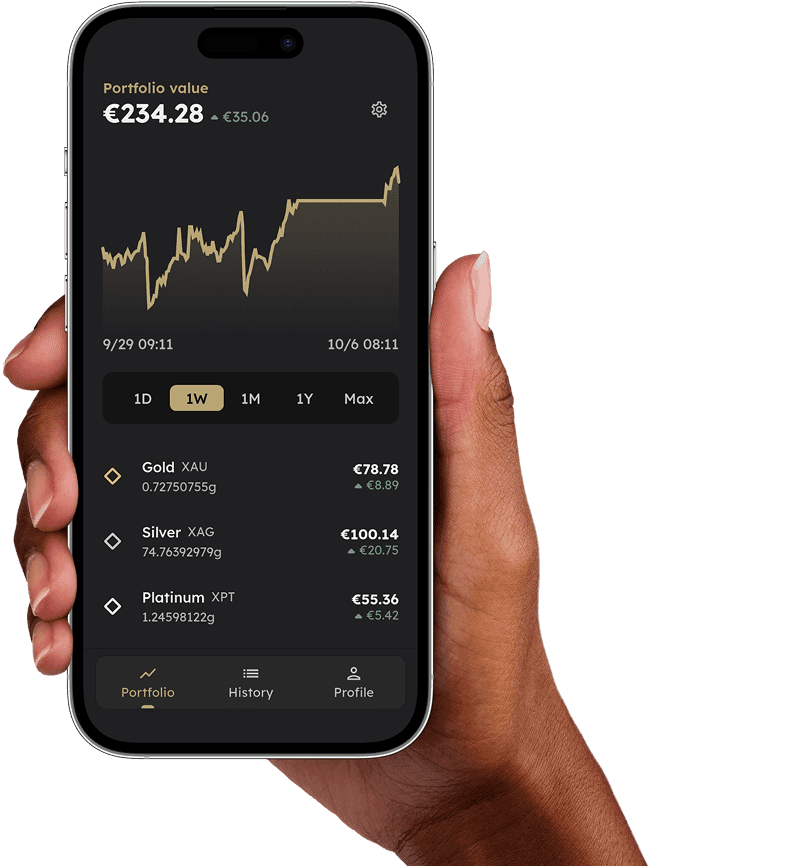
In a high-security vault in Singapore. Spargold
Digital technology handles the administration.
And blockchain can fulfill another task in the background.
Not:
speculation.
But rather:
And perhaps a good one for that very reason.
Nils describes in the podcast how data on a physical bar can be cryptographically secured.
Photo.
Bar information.
Audit data.
Metadata.
This creates a digital fingerprint:
a hash.
This can be anchored on a public blockchain.
If someone changes the original data later, the fingerprint no longer matches.
No meme coins.
No 100x promise.
No NFT image.
Only:
Perhaps real mass adoption looks exactly like this.
When you pay with a credit card today, you probably aren't interested in which clearing infrastructure is working in the background.
When you navigate with your smartphone, you don't think about GPS satellite protocols.
When you upload a photo to the cloud, you don't concern yourself with the database cluster used.
Why should it be any different with blockchain?
It becomes a matter of course.
The big hype cycles have become smaller.
Many crypto events disappeared.
DeFi is less spectacular.
NFTs no longer dominate the headlines.
But at the same time:
the ECB is developing tokenized settlement systems,
BlackRock is dealing with tokenized assets,
institutional investors are using blockchain products,
regulated crypto funds exist,
and stablecoins are increasingly being investigated for real payment processes.
Perhaps less hype is therefore not a bad sign at all.
Perhaps it is:
Not:
„Buy crypto.“
But rather, in essence:
Also towards AI.
Also towards blockchain.
You don't have to invest in a technology to understand it.
And especially when a technology causes fear, knowledge can help to assess risks more realistically.
This is a surprisingly sober message for an industry that has lived off extreme narratives for years.
Not with:
a new coin.
Not with:
a new NFT hype.
And perhaps not with:
a new bull run.
But with infrastructure.
AI.
Tokenization.
Regulation.
Stablecoins.
Central bank money.
Automation.
And applications where eventually no one asks:
Because that is exactly when the technology might have arrived where the internet has long been.
In the background.
Invisible.
And indispensable.
Stay farsighted.
Yours,
Helge Peter Ippensen