The world carries more than 300 trillion dollars in debt. In 2026, the USA will pay over one trillion dollars in interest per year — more than its entire defense budget. The gold price stands at 4,157 USD/oz as of September 29, 2026. Anyone who understands the mechanics behind public debt and the gold price understands why gold has increased in real value during every major debt crisis of the past decades.
For centuries, states have financed wars, infrastructure, and social services through bonds. What changed in the 18th century: When the British Crown first paid off debt with new debt, a principle was born that government after government has adopted. The result: a global debt carousel that can hardly be stopped.
Technically, state capital comes from three sources: its own population via government bonds, other sovereign wealth funds such as US Social Security reserves, and foreign creditors. The USA alone has borrowed around 9.3 trillion dollars from foreign governments — more than double Apple's entire market capitalization. Since practically all industrialized nations are deeply in debt, wealthy states ultimately lend each other money — in a system held together only by trust.
The real problem is not the level of debt itself — but the price for it. When interest rates were historically near zero, public debt was cheap. Not anymore. In 2026, US interest payments will exceed defense spending for the first time: Washington is paying more than one trillion dollars in interest per year — approximately 2.7 billion dollars daily. The IMF warns: Globally, government debt will rise to over 102% of global GDP by 2031 — a level last reached after the Second World War.
| Country | Debt-to-GDP Ratio (% GDP, 2026 est.) | Notable Fact |
|---|---|---|
| USA | ~125 % | Interest exceeds defense budget |
| Japan | ~260 % | Largest single item in the budget |
| France | ~115 % | 5 government changes due to budget crisis |
| Italy | ~140 % | Interest burden continuously rising |
| Great Britain | ~100 % | 2022 Liz Truss crisis as a warning |
| Germany | ~65 % | Lowest ratio in the G7 |
When a state can no longer service its debt, there are basically two options: actual insolvency — or printing money. Since most industrialized countries are indebted in their own currency, the latter is technically possible: in extreme cases, the Federal Reserve can create dollars out of thin air.
The price for this is inflation. More money chases the same amount of goods — and the purchasing power of savings silently erodes. This is exactly what we have observed since 2020: post-pandemic inflation of up to 10% in all G7 countries. According to the so-called Fisher Effect, creditors automatically demand higher interest rates when inflation expectations are higher — which further drives debt costs. For investors, this means: savings in cash or bonds lose value in real terms. Gold, on the other hand, has no counterparty, cannot be printed — and historically reacts to exactly this type of fiscal stress.
The pattern repeats itself: states accumulate debt, central banks react with expansive monetary policy, the purchasing power of paper money dwindles — and gold rises. Historical returns speak a clear language:
| Phase | Driver | Gold Price Return |
|---|---|---|
| The Seventies | End of the gold standard, oil crisis | +2,300 % |
| Financial Crisis Era | Stimulus packages, debt explosion | +170 % |
| Pandemic Era | Record debt, interest rate reversal, inflation | +177 % |
The current debt level is higher than ever before in history. And unlike in previous crises, the problem this time is not limited to one country: all G7 nations are simultaneously in a debt vortex.
The consensus among major banks is strikingly bullish. Almost all institutions have revised their 2026 gold price targets upward:
| Bank | Gold Price Target End of 2026 | Target End of 2027 |
|---|---|---|
| Goldman Sachs | 4,900 USD/oz | 5,600 USD/oz |
| Bank of America | 6,000 USD/oz | – |
| J.P. Morgan | ~6,000 USD/oz | – |
| Wells Fargo | 6,100–6,300 USD/oz | – |
| Morgan Stanley | 5,200 USD/oz | – |
Current gold price: 4,157 USD/oz. Silver price: 60.80 USD/oz. Gold-silver ratio: approx. 68.
When government debt rises, the pressure on central banks to print money or keep interest rates low increases. Both devalue currencies in the long term. Since gold is limited in supply and cannot be printed, its relative purchasing power increases. Historically, gold has gained in real terms during every major debt expansion.
Technically, states indebted in their own currency cannot go bankrupt — they can theoretically always print money. However, the political price is enormous. The 2022 Liz Truss collapse in Great Britain shows how quickly bond crises can escalate when markets lose confidence.
Valuation is relative. Measured against the M2 money supply, gold is no more expensive today than in previous peak phases. The structural drivers — public debt, inflation risk, geopolitical uncertainty — have not disappeared. Banks like Goldman Sachs see further potential up to 4,900 USD per troy ounce.
The gold-silver ratio shows how many ounces of silver are needed for one ounce of gold. It currently stands at approx. 68. Historically, it has fluctuated between 40 and 80. High ratios indicate a relative value in silver — a signal that many investors use for silver investments.
The global debt crisis is not an abstract macro concept. It is reflected daily in real budget items: in 2026, the USA will pay more for its debt interest than for its army, France has gone through five governments in two years, and the IMF warns of a global debt level beyond Second World War levels. The system holds because trust holds. But every trillion newly printed, and every interest rate hike that makes debt more expensive, strengthens an alternative store of value in the long term — gold.
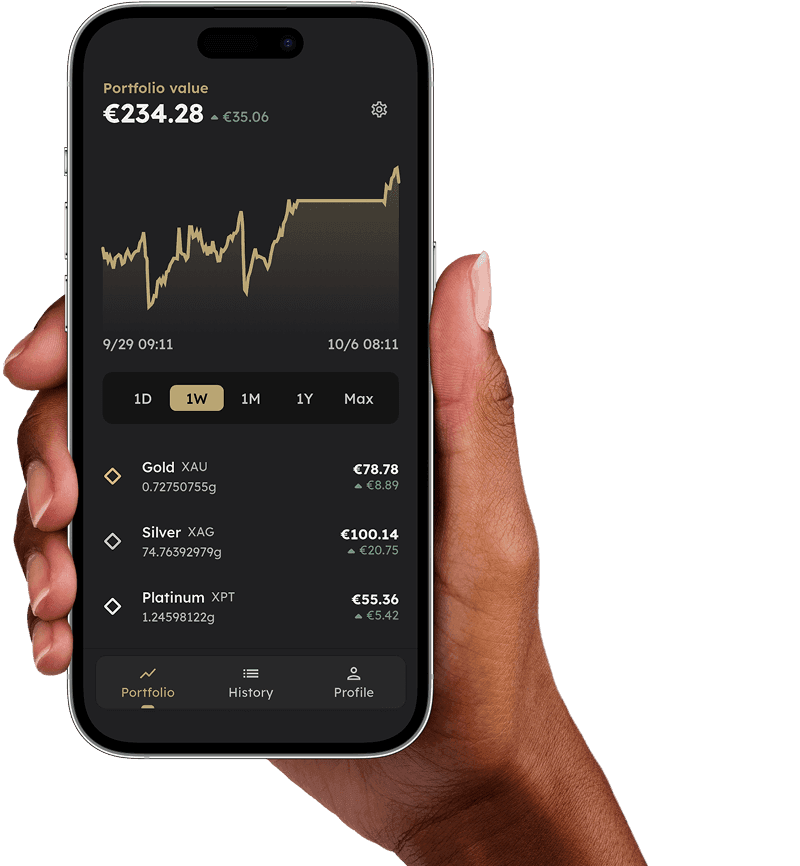
Anyone who wants to buy physical gold easily and securely will find transparent access to gold bars and coins on spar.gold and in the spar.gold app — without unnecessary surcharges.
Further information can be found in the Spargold Glossary and in the article on the Goldman Sachs gold price forecasts.This article is for information purposes only and does not constitute investment advice.