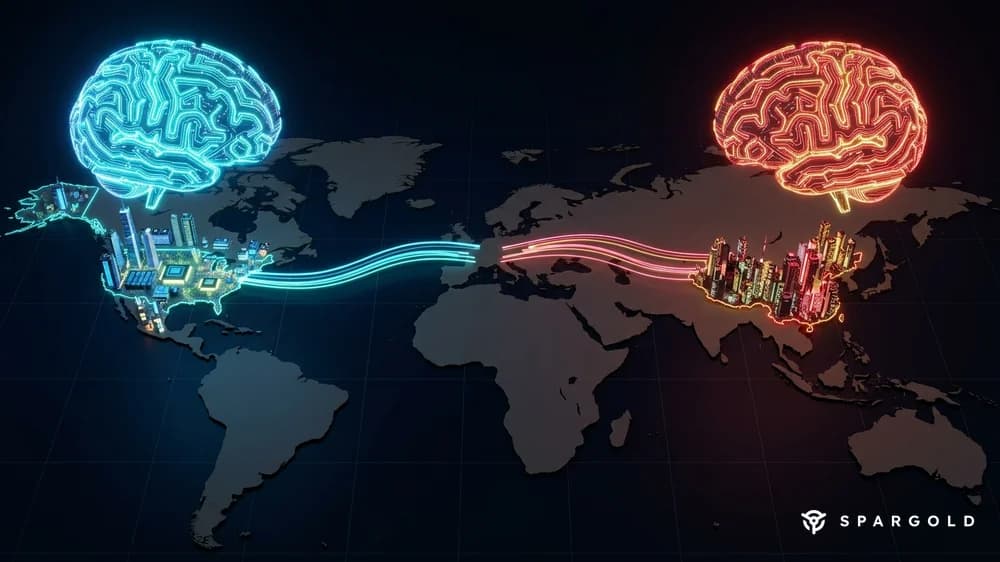
Europe's AI dependency at its peak: ASML — Europe's most valuable company and global monopolist for EUV lithography machines — sold not a single device in Europe in the first half of 2026. Europe's share of ASML revenue: zero percent. The USA controls around 75 percent of global AI computing capacity, Europe less than 5 percent. In a world where technological dependency means geopolitical risk, the demand for golden safety anchors is growing.
Frank Heemskerk, Executive Vice President for Public Affairs at ASML, spoke plainly in Amsterdam: "We essentially have no sales business in Europe. Europe is not investing — no chip factories are being built." The figures behind this are even clearer: in the second quarter of 2026, Europe's share of ASML revenue was exactly zero percent. In the entire first half of 2026, the Dutch company did not sell a single chip manufacturing system in Europe.
What makes this so remarkable? ASML is not just any supplier. The Eindhoven-based company is the only company worldwide that manufactures Extreme Ultraviolet (EUV) lithography machines — the devices without which no modern high-performance chips for AI, smartphones, or data centers can be produced. Without ASML machines, there is no TSMC chip, no Samsung processor, nor an Apple M-chip. ASML is the bottleneck of the global semiconductor industry — and its European home market is buying: nothing.
The European Union has allocated billions for domestic semiconductor production through the EU Chips Act. The problem: most European chip factories — from Infineon to STMicroelectronics — produce chips for the automotive industry. Reliable, profitable, but technologically a generation behind. These automotive chips require older lithography processes — not modern EUV machines from ASML.
The market for AI processors, on the other hand — GPUs for data centers, High-Bandwidth Memory, advanced logic chips — is completely dominated by factories in Taiwan, South Korea, and increasingly China. Europe simply has no production facility here. The EU Chips Act strategy was a response to the chip crisis of 2021 — not to the AI era of 2026.
| Region | Share of Global AI Computing Capacity | Chip Manufacturing (High-end) |
|---|---|---|
| USA | approx. 75% | NVIDIA, AMD (Design); TSMC capacities in AZ/OH |
| China | approx. 15% | SMIC, growing strongly despite export controls |
| Europe | less than 5% | Automotive chips, no high-performance AI chip |
| Taiwan/South Korea | Manufacturing site for everyone | TSMC, Samsung — for USA, China, and Europe |
These figures illustrate the problem relentlessly: Europe consumes massive amounts of AI infrastructure — cloud services, AI models, chips — but produces almost none of it itself. The continent's digital infrastructure depends on data lines from overseas.
What happens if the USA extends its AI export control policy to Europe? What happens in the event of a Taiwan conflict that cuts off the chip supply? In 2025 and 2026, China proved with targeted raw material export controls that technological dependencies can be used as a geopolitical weapon. Europe faces a scenario in which its critical digital infrastructure depends entirely on geopolitical actors with whom it is partly in competition.
This is not a theoretical risk. European companies pay for their AI computing capacity in dollars — to American cloud providers. Every European AI application, every language model, every corporate AI runs on infrastructure that Europe neither controls nor can replace in the event of a crisis. ASML VP Heemskerk formulated it precisely: Europe builds the machines — but does not buy them. The value creation takes place elsewhere.
Geopolitical risks are one of the strongest and most persistent drivers of the gold price. Gold always benefits when investors identify structural instabilities that cannot be resolved in the short term. Europe's technological dependency is exactly such a structural problem: it developed over decades, is deeply politically anchored, and cannot be fixed with a single resolution.
Specifically, this means: if Europe does not regain its technological sovereignty, its economic weight in the global balance of power will decline — relative to the USA and China. Historically, a weaker geopolitical position is accompanied by a weaker currency, higher capital flight, and growing demand for tangible assets. Gold, as an international store of value without issuer risk, benefits precisely from this dynamic. According to the World Gold Council, geopolitical risks are permanently among the top 3 reasons for institutional gold purchases. Read more in the Spargold Glossary on Gold as a Store of Value.
ASML is not calling for more subsidies for existing factories from the EU, but for something fundamentally different: the creation of demand for state-of-the-art chips. Specifically, this means: building European hyperscalers, equipping European data centers with European AI chips, and launching AI sovereignty projects modeled after the European space program. This requires political will, capital, and decades — three things that Europe last mustered in this combination during the post-war period. Until then, technological dependency remains real — and with it, the geopolitical risk premium that gold prices in.
With Spargold, you can invest in physical gold — as a hedge against geopolitical and economic uncertainties. Find more articles in the Spargold Blog.
Because no new chip factories for state-of-the-art high-performance chips are being built in Europe. European manufacturers produce automotive chips with older technology — not the AI processors for which ASML's EUV machines are required.
ASML is a Dutch company and the global monopolist for EUV lithography machines — without which no modern high-performance chips can be manufactured. It is Europe's most valuable company and a critical link in the global semiconductor chain.
Less than 5 percent — compared to around 75 percent for the USA. Europe consumes AI services on a large scale but hardly controls the underlying infrastructure.
Geopolitical risks and structural economic weaknesses are historically strong drivers of the gold price. A technologically dependent region is more vulnerable to external shocks — and in such scenarios, investors shift into gold, which carries no issuer risk.
All information refers to the status as of September 29, 2026. This article does not constitute investment advice. Investments in precious metals are associated with risks.