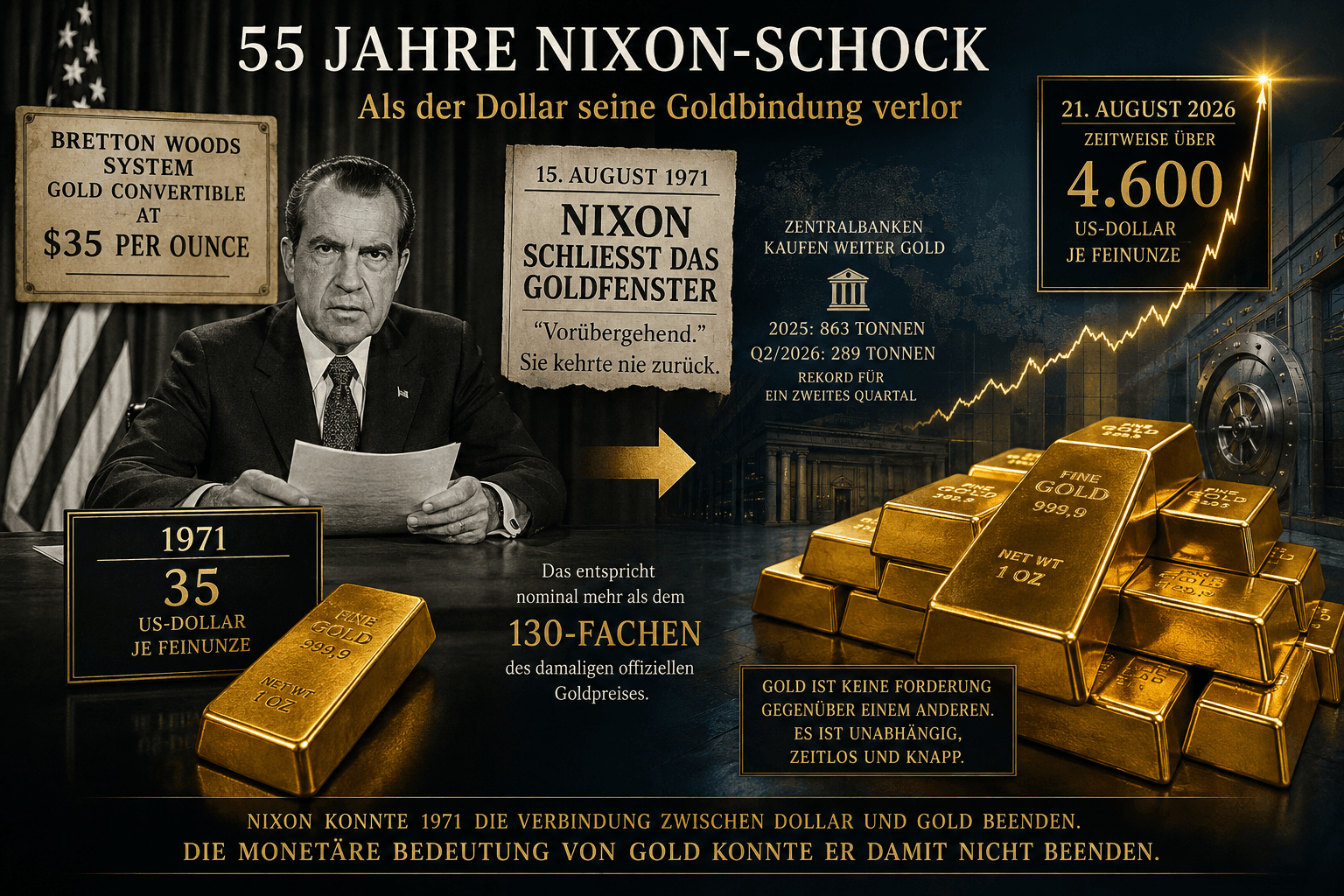
35 US dollars per troy ounce.
At this price, foreign central banks could once exchange their dollar reserves for gold.
On August 15, 1971, US President Richard Nixon suspended this convertibility.
“Temporarily.”
It never returned.
55 years later, on August 21, 2026, gold temporarily exceeded 4,600 US dollars per troy ounce.
In nominal terms, this corresponds to more than 130 times the official gold price at that time.
But to conclude from this that gold has simply “become more valuable” by this factor would be too simple.
The story is more complicated.
By 1971, general convertibility of dollars into gold for American citizens had long since ceased to exist.
Bretton Woods was an international monetary system.
Other currencies were fundamentally pegged to the dollar. The dollar, in turn, was convertible into gold for foreign monetary authorities at an official price of 35 dollars per troy ounce.
The dollar thus formed the center of the international monetary system.
And gold ultimately limited the promise behind this dollar.
As long as the global economy grew, it required additional dollars.
These dollars reached foreign countries through American spending, investments, and deficits.
This created a fundamental contradiction.
The world needed dollars as an international reserve currency.
However, the more dollars that existed outside the US, the more difficult it became for the United States to maintain the promise to exchange these dollars for its limited gold reserves at 35 dollars per troy ounce.
This problem became known as the Triffin dilemma.
In the 1960s, the situation intensified.
The US financed high government spending, the Vietnam War, and social programs. At the same time, inflation rose.
More and more dollars met a limited American gold supply.
Eventually, the decisive question was asked:
What happens if everyone actually wants to exchange their dollars for gold?
Nixon reacted.
On the evening of August 15, he announced a comprehensive economic policy program.
One component was historically particularly consequential:
The convertibility of the dollar into gold was suspended.
This marked the beginning of the end of the Bretton Woods system. In 1973, major currencies finally transitioned largely to flexible exchange rates.
From then on, there was no longer a fixed amount of gold against which foreign central banks could exchange their dollar reserves.
The dollar remained.
The promise of redemption disappeared.
This is exactly where the story gets interesting.
One might have expected gold to lose importance with the end of its formal monetary function.
The opposite happened.
Gold transformed from the official anchor of the monetary system into a freely traded asset.
1971: Official gold price of 35 dollars.
Today: more than 4,600 dollars on the market.
But this comparison requires a crucial qualification.
In nominal terms, the magnitude is correct.
Economically, however, it only tells part of the story.
Between 1971 and 2026 lie 55 years of inflation, economic growth, changes in the money supply, interest rate cycles, financial crises, geopolitical conflicts, and a massive expansion of global financial markets.
Naturally, 4,600 dollars in 2026 do not possess the same purchasing power as 4,600 dollars in 1971.
Therefore, the comparison is not interesting as a return calculation.
Something else is interesting:
The unit of measurement has changed.
Gold has remained gold.
The dollar of 2026 is monetarily no longer the same dollar as under Bretton Woods.
Even more remarkable is what central banks are doing today.
They continue to hold large gold reserves.
In 2025, central banks bought a net total of approximately 863 tons of gold.
And in 2026, the trend continues.
According to the latest data from the World Gold Council, net central bank purchases in the second quarter alone amounted to 289 tons.
This was approximately 62 percent more than in the second quarter of the previous year and a record value for a second quarter.
Gold was thus decoupled from its fixed link to the dollar 55 years ago.
Central banks have by no means abandoned it because of this.
Gold possesses a property that has not changed since 1971.
A government bond is a claim against a state.
A bank deposit is a claim against a bank.
A currency is ultimately part of a monetary system supported by institutions.
Physical gold, on the other hand, is not a claim against another party.
It has no issuer that must fulfill a promise.
Particularly in a world of increasing government debt, geopolitical fragmentation, and financial sanctions, this property is once again gaining strategic importance.
No.
There are currently no reliable signs of this.
Even the strong gold purchases by central banks do not mean that the dollar or the euro are on the verge of being replaced.
The US dollar remains the dominant international reserve currency.
Gold fulfills a different function.
This is precisely why one should be cautious with spectacular calculations according to which a new gold standard would automatically require gold prices of 10,000, 20,000, or even more dollars.
Such scenarios can be constructed mathematically.
They are not a forecast.
The actual lesson of the Nixon shock is not that we are on the verge of a new gold standard.
It is more fundamental.
Monetary orders are not laws of nature.
They function as long as their political and economic prerequisites function.
Bretton Woods appeared as a new international order after the Second World War.
27 years after its founding, it began to fall apart.
The dollar survived the system change and remained the most important international currency.
And gold?
Gold also survived.
No longer as a fixed monetary anchor, but as a freely valued reserve and investment asset.
Nixon was able to end the link between the dollar and gold in 1971. He was not able to end the monetary significance of gold.
Perhaps that is why, after 55 years, the development from 35 to more than 4,600 dollars is not the most interesting figure.
But rather the fact that in 2026, central banks are still buying hundreds of tons of gold.
Stay farsighted
Yours, Helge Peter Ippensen