Goldman Sachs Gold Price Forecast 2026: 4,900 USD Despite Fed Rate Hike

September 28, 2026
Executive Summary: Goldman Sachs gold price forecast 2026: The U.S. investment bank is maintaining its annual target of 4,900 USD/oz — despite the surprising Fed interest rate hike in September. Central banks continue to buy around 70 tons of gold monthly, the 10-year U.S. Treasury bond is yielding near 5.20%, putting short-term pressure on the price. In the medium to long term, Goldman Sachs and other institutions see gold in a structural upward trend. As of: Sept 28, 2026.
Goldman Sachs is sticking to its gold price target of 4,900 U.S. dollars per troy ounce for the end of 2026 — despite a turbulent September. On September 20, 2026, the U.S. Federal Reserve surprisingly raised the benchmark interest rate by 25 basis points to 3.75 to 4.00 percent. It was the first rate hike since 2023 — and it sent the gold price down to around 4,200 USD/oz in the short term. However, commodity analysts Lina Thomas and Daan Struyven from Goldman Sachs reaffirmed: the structural upward trend for gold remains intact.
The history of the Goldman Sachs gold price target for 2026 is one of ups and downs: In January 2026, the firm raised its forecast from 4,900 to 5,400 USD — citing accelerated central bank purchases and an expected Fed interest rate pivot. In June 2026, Goldman Sachs then revised the target back to 4,900 USD after the probability of new Fed rate hikes increased. Now, after the actual rate hike in September, the firm is staying at 4,900 USD — a clear signal that long-term drivers are being weighted more heavily than short-term interest rate risks.
1. Central Banks Buying Undeterred: Goldman Sachs' central argument is the persistently high demand from central banks worldwide. Central banks are buying an estimated 70 tons of gold monthly — China, Turkey, Poland, and other emerging markets are systematically diversifying their foreign exchange reserves away from the U.S. dollar. According to the World Gold Council, over 1,000 tons were bought net in 2025 alone. This trend is structural and independent of short-term interest rate decisions by the Fed.
2. Geopolitics and De-dollarization: In a multipolar world with growing geopolitical tensions — the Middle East conflict, Ukraine, U.S.-China rivalry — demand for the ultimate safe haven is rising. Gold is not dependent on an issuer, cannot be frozen or sanctioned, and has no counterparty. This makes it the preferred asset for state actors wanting to reduce their dollar dependency.
3. Hedging Demand from Investors: Goldman Sachs points to another element in its analysis: investors using gold derivatives to hedge portfolio risks could drive the price beyond the annual target. Rising uncertainty about the Fed's course makes such hedges more attractive — creating additional buying pressure.
The Fed's interest rate hike to 3.75 to 4.00 percent on September 20, 2026, put gold markets under short-term pressure. Rising interest rates increase the opportunity costs of holding gold — as gold pays no interest or dividends. The 10-year U.S. Treasury bond is currently yielding near 5.20 percent, while the 30-year reached a 22-year high. Such yields make fixed-income investments more attractive than the yellow metal in the short term.
Nevertheless: historically, gold has achieved long-term gains even in phases of rising interest rates when inflation remained high or geopolitical risks dominated. Goldman Sachs emphasizes that the market has already priced in another rate step — and the upward potential during a Fed pause would be significant.
| Bank | Gold Price Target 2026 | Rationale |
|---|---|---|
| Goldman Sachs | 4,900 USD/oz | Central bank purchases, de-dollarization |
| J.P. Morgan | up to 6,000 USD/oz | Structural bull market, geopolitical premium |
| HSBC | 5,000 USD/oz | Institutional investor demand |
| Bank of America | 5,000 USD/oz | Dollar weakness, fiscal deficits |
The consensus among major investment banks shows: all expect gold to be above the current level of around 4,149 USD/oz — the range extends from 4,900 USD (Goldman Sachs) to 6,000 USD (J.P. Morgan). This is remarkable, as analysts are rarely so uniformly bullish on a commodity.
Gold is trading at around 4,149 U.S. dollars per ounce on September 28, 2026 — following a setback due to the Fed decision. Compared to the beginning of the year, this still represents a gain of around 8 percent. Two years ago, in the fall of 2024, gold was at around 2,600 USD/oz — so the value increase over the last two years is about 60 percent. More on the long-term value performance of gold in the Spargold Glossary.
The short-term weakness caused by the Fed shock is seen by many analysts as a buying opportunity: structural drivers such as central bank purchases, de-dollarization, and geopolitical uncertainties remain intact. Goldman Sachs sees potential exactly here — from 4,149 to 4,900 USD would be another 18 percent.
Goldman Sachs' gold price forecast for 2026 is 4,900 USD/oz — a target the bank confirms despite the Fed interest rate hike and rising Treasury yields. The drivers are structural: central banks buy dozens of tons monthly, geopolitical tensions remain elevated, and diversification away from the U.S. dollar continues. Short-term interest rate pressure phases are often entry opportunities for long-term oriented investors from a historical perspective. Those who save in physical gold now are entering at a price that Goldman Sachs considers a buying level in the long term. Further information in the Spargold Blog.
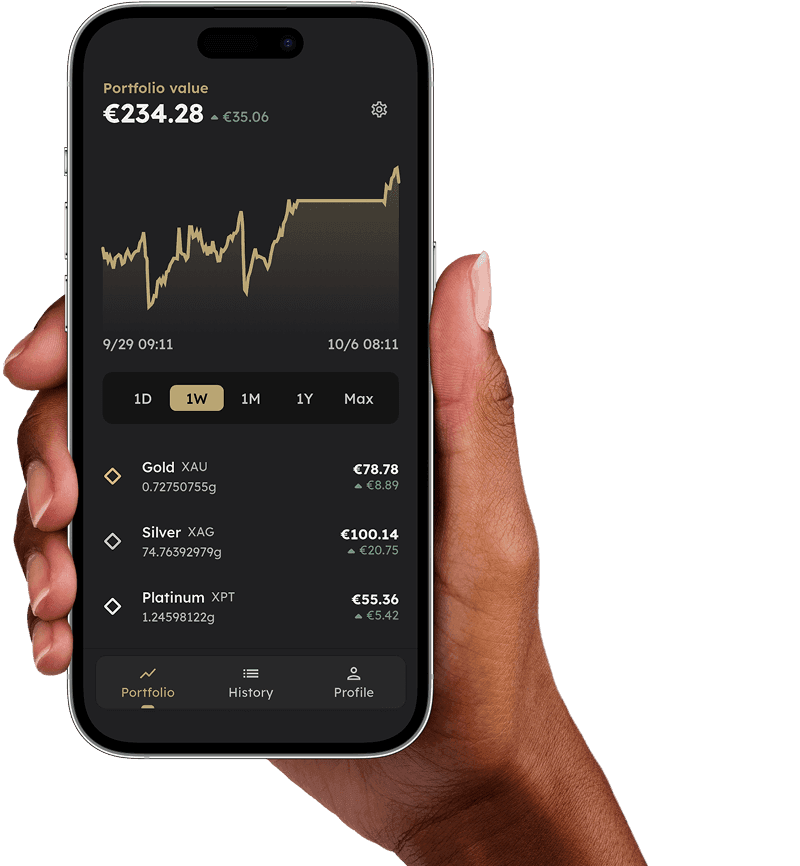
Ready to invest in physical gold? With Spargold, you save in real gold starting from small amounts — secure, simple, transparent. Download the app.
Goldman Sachs is maintaining its annual target of 4,900 U.S. dollars per troy ounce for the end of 2026. The target was lowered from 5,400 to 4,900 USD in June 2026 after the probability of new Fed rate hikes increased.
Goldman Sachs lowered its target from 5,400 to 4,900 USD because the Federal Reserve surprisingly signaled interest rate hikes. Higher interest rates increase the opportunity costs of holding gold, as fixed-income investments become more attractive.
An estimated 70 tons monthly — according to analyses by Goldman Sachs and the World Gold Council. In 2025, over 1,000 tons were bought net by central banks worldwide, primarily from China, Turkey, and Poland.
In the short term, yes — rising interest rates increase opportunity costs. In the long term, central bank purchases, geopolitics, and de-dollarization have proven to be stronger drivers. Goldman Sachs confirms the 4,900 USD target despite the rate hike.
All price information refers to the status as of Sept 28, 2026. This article is for informational purposes only and does not constitute investment advice. Investments in precious metals involve risks.