Fed & Government Bonds: Why Gold is Under Pressure — and What Applies Now

September 28, 2026
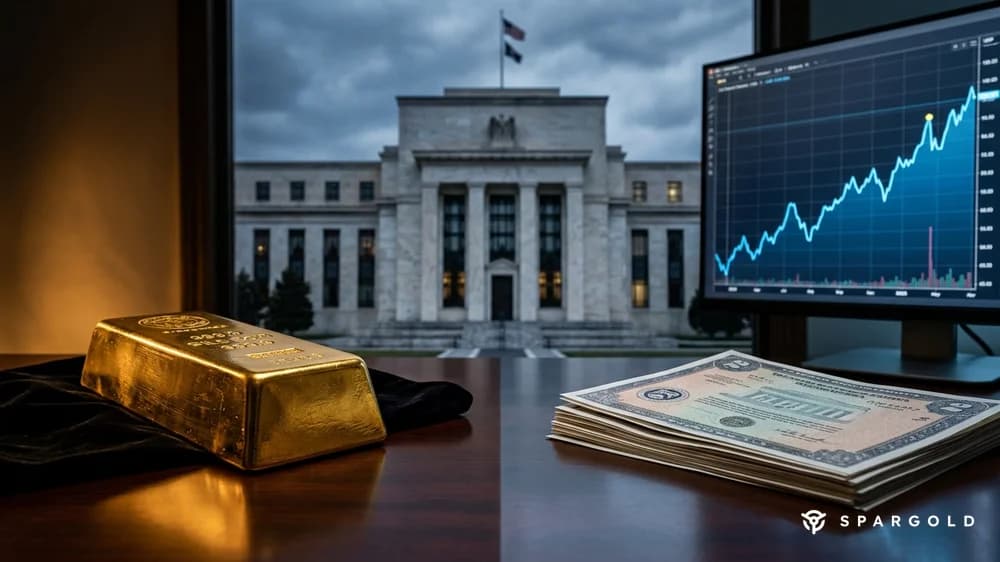
Key Takeaway: Fed and government bonds under pressure: The Federal Reserve increased the benchmark interest rate by 25 basis points to 3.75 to 4.00 percent on September 20, 2026 — the first rate hike since 2023. The 10-year US Treasury bond has since yielded near 5.20 percent, while the 30-year bond reached a 22-year high. Gold is coming under short-term pressure: down 3 percent to approx. 4,150 USD/oz — however, long-term drivers such as central bank purchases and de-dollarization remain intact. Status: 09/28/2026.
For decades, the relationship between interest rates and gold has been considered one of the most reliable correlations in the financial world: when interest rates rise, the price of gold tends to fall — and vice versa. But why is this the case? And what does the recent Fed decision specifically mean for gold investors?
Gold pays no interest and no dividends. Those who hold gold forgo the ongoing income they could achieve with government bonds or overnight money. Economists call this the "opportunity cost" of holding gold. When interest rates rise, this lost income grows — and gold becomes relatively less attractive. This principle explains why gold reacted to the Fed rate hike in September 2026 with a pullback.
On September 20, 2026, the Federal Open Market Committee (FOMC) unanimously raised the US benchmark interest rate by 25 basis points to 3.75 to 4.00 percent. It was the first rate hike since 2023 — and it surprised many market participants who had bet on a Fed pause. Fed Chair Jerome Powell justified the move citing inflation persistently remaining above the 2 percent target and a continued robust labor market.
The immediate consequences: The US dollar appreciated, the 10-year US Treasury bond climbed to a yield near 5.20 percent — the highest level in years. The 30-year bond even reached a 22-year high. Gold fell by around 3 percent to approx. 4,150 USD/oz. Equities declined: the Dow Jones lost 2.2 percent, the S&P 500 1.5 percent, and the Nasdaq 1.7 percent.
| Maturity | Yield Sept. 2026 | Historical Context |
|---|---|---|
| 2-year bond | approx. 4.80% | Highest level since 2006 |
| 10-year bond | approx. 5.20% | Highest level since 2007 |
| 30-year bond | approx. 5.40% | 22-year high |
These yields make US Treasuries the most attractive fixed-income alternative in decades in the short term. A 10-year bond with a 5.20 percent yield is a tough competitor for gold — at least from a purely numerical perspective. In the long term, the risk profiles differ fundamentally: government bonds carry inflation and default risks, while gold is a real asset with no counterparty risk.
History shows: In phases of rising nominal interest rates, gold has gained in the long term when real interest rates (nominal rate minus inflation) remained low or negative. If inflation is persistently high, gold can outperform despite rising nominal yields. Another factor: government bonds offer nominal security but do not protect against the devaluation of the currency itself — this is the core of the gold argument in a world with record-high national debt.
According to Goldman Sachs, the structural driver for gold is not the Fed, but the central banks of emerging markets: they are buying around 70 tons monthly, systematically building up dollar-independent reserves. This trend is interest-rate sensitive — but not sensitive enough to be stopped by a single Fed decision.
| Criterion | Gold | US Treasury (10 Y.) |
|---|---|---|
| Current Yield | 0% | approx. 5.20% |
| Inflation Protection | High (real asset) | Low (nominal payment) |
| Currency Risk | None (global) | USD exposure |
| Counterparty Risk | None | Issuer risk (USA) |
| Price Potential 2026 | +18% (Goldman target 4,900 USD) | 0% if held to maturity |
In the short term, headwinds remain due to high interest rates and the possibility of further Fed steps. Fed hardliners increased the probability of another rate hike by year-end following the September increase — which could keep the gold price under pressure temporarily. Those who view gold as a purely short-term trade must take this into account.
Those who understand gold as a long-term store of value — as central banks do — see it differently: a pullback to 4,150 USD is a more favorable entry opportunity than entering at all-time highs, given a Goldman year-end target of 4,900 USD. The Spargold guide to gold as a store of value explains the basic principles for long-term oriented investors.
The Fed rate hike and rising government bond yields are putting gold under short-term pressure — this is economically understandable and historically proven. In the long term, however, the structural drivers for gold have proven more resilient than interest rate phases: central bank purchases, de-dollarization, geopolitics, and inflation protection act independently of the Fed's course. Goldman Sachs sees 4,900 USD/oz as the year-end target. For long-term oriented investors, such pullbacks have historically provided entry opportunities. Find more articles in the Spargold Blog.
Ready to invest regularly in physical gold? With Spargold, you save automatically — regardless of current interest rate levels. Download the app.
Rising interest rates increase the opportunity cost of holding gold: government bonds and overnight money yield more. Gold pays no interest, making it relatively less attractive — and the price falls in the short term. The effect reverses when real interest rates (after inflation) fall again.
The 10-year US Treasury bond is currently yielding near 5.20 percent (as of 09/28/2026) — the highest level since 2007. The 30-year bond reached a 22-year high of approx. 5.40 percent.
This depends on the investment horizon and objective. Government bonds offer a 5.20 percent nominal yield — good for safety-oriented, short-term investors. Gold offers inflation protection, no counterparty risk, and a structural upward trend according to Goldman Sachs. A combination of both asset classes is possible.
A pause by the Fed, falling inflation expectations, or new geopolitical risks could drive the gold price back up. Goldman Sachs sees the year-end target at 4,900 USD/oz — approx. 18 percent above the current level.
All information refers to the status as of 09/28/2026. This article is for informational purposes only and does not constitute investment advice. Investments in precious metals involve risks.