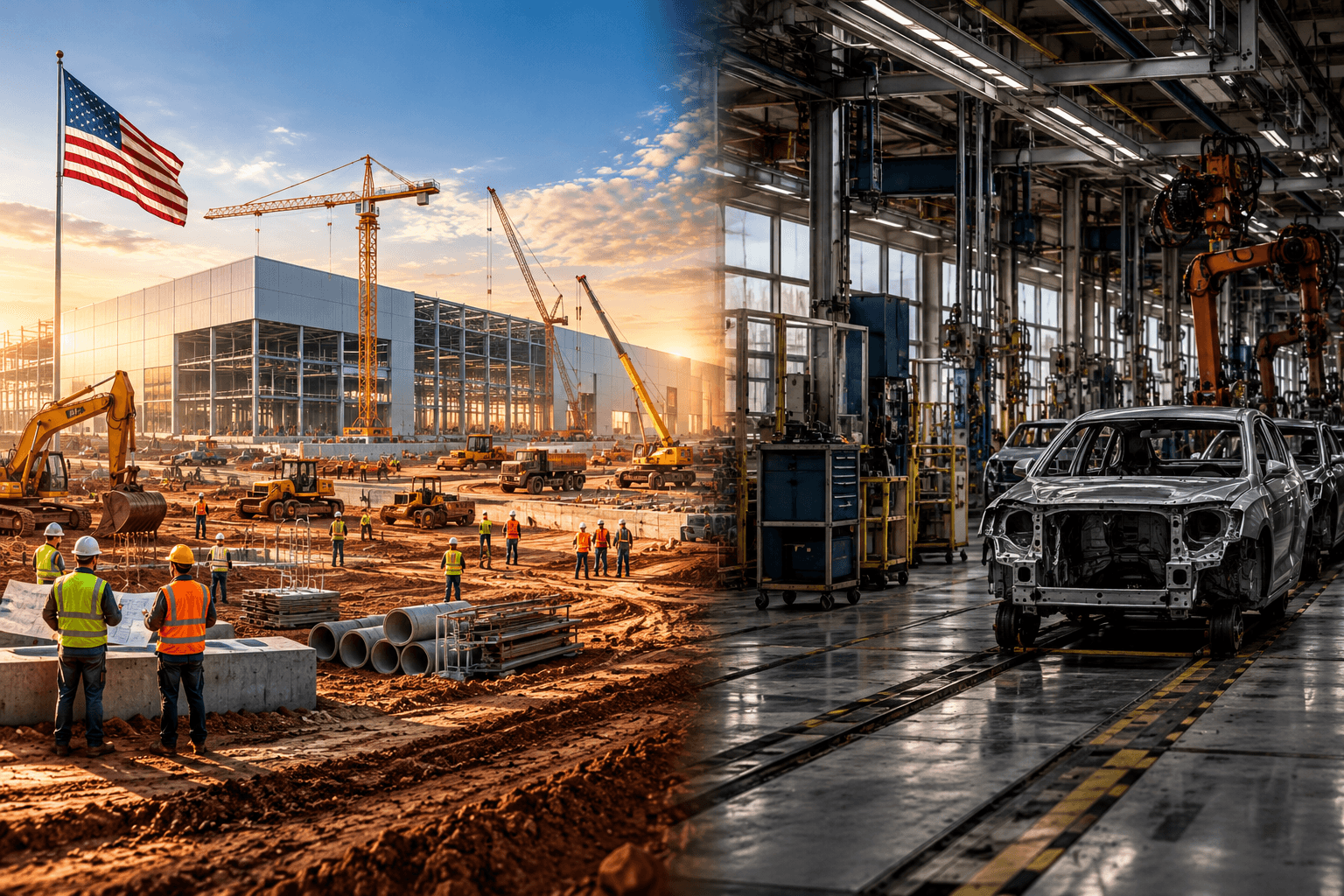
Two news items within a few days.
One comes from the USA.
Audi is planning its first proprietary American plant.
Investment:
Planned jobs:
Production capacity:
The other news comes from Germany.
Volkswagen intends to cut an additional:
at Volkswagen AG, on top of already agreed savings.
The headline is obvious:
It is not quite that simple.
But this contrast is not entirely insignificant either.
The new location is to be built in Perry, in the US state of Georgia.
It would be Audi's first proprietary plant in the United States.
Site preparation is scheduled to begin in 2027.
The actual construction is planned for 2028.
Georgia expects full production by 2031.
Audi speaks of a production start in the early 2030s.
The plant is intended to produce premium SUVs for the North American market.
The upcoming Q9 has been explicitly mentioned by Audi. The Q7 and Q8 are also being discussed as possible models.
Audi itself states:
North America is to become the third major pillar of the production network alongside Europe and China.
Behind this lies a simple business logic.
The USA is one of the largest premium markets in the world.
Those who sell there can benefit from producing there as well.
Shorter supply chains.
Less currency risk.
Local suppliers.
And meanwhile:
According to Reuters, the new US tariffs cost Audi approximately:
last year.
That is a remarkable magnitude.
When a company pays billions every year to move cars across a border, the calculation inevitably changes:
Do we continue to export from Europe?
Or do we build where we sell?
Audi has now answered this question, at least in part.
From an American perspective, one could certainly argue:
The tariffs increase the incentive to bring production to the United States.
That was exactly one of their declared goals.
But here, too, one should be cautious.
Audi had been planning its American expansion for some time.
The US market offers growth potential.
Georgia possesses large industrial areas, infrastructure, labor, and an existing automotive cluster.
The plant is therefore not being built for a single reason.
But the tariffs have significantly increased the economic pressure for localization.
Here, the comparison becomes uncomfortable.
Volkswagen had already agreed in 2024 to cut more than:
35,000 positions
at its German locations by 2030 in a socially responsible manner.
In the meantime, an additional:
are to be added at Volkswagen AG.
The group simultaneously aims to save billions in value creation and administration.
Volkswagen speaks of a drastically deteriorated economic situation.
This calculation would be incorrect.
Audi and Volkswagen AG are different business units within the group.
The job profiles are not identical.
The timeframes differ.
And VW is not loading 12,000 German jobs onto a truck and transporting them to Georgia.
Nevertheless, both decisions together tell a story.
And Germany must face this competition.
That is the decisive question for me.
Not:
Where was production 30 years ago?
But:
Companies compare daily:
Energy costs.
Labor costs.
Taxes.
Bureaucracy.
Approval times.
Subsidies.
Proximity to market.
Trade barriers.
Skilled labor.
Infrastructure.
Legal certainty.
And then an investment is made.
Or not.
Germany has achieved practically no real growth since 2019. Export market shares have declined. China has increasingly shifted from being a major customer to a competitor.
Energy and labor costs are high. Private investments in 2025 were again below the 2015 level.
And particularly in the case of cars and machinery, the Commission already sees signs that:
This is a remarkable finding.
Because Germany can lose a factory without the company disappearing.
Research can stay here.
Management can stay here.
Brand and ownership as well.
Only the machine eventually stands:
It rarely begins with a major headline.
A production line is established in the USA.
Another in Poland.
A supplier builds in Hungary.
Research grows in Asia.
A German facility is not expanded.
An investment is postponed.
And ten years later, one asks:
This dramatization would also be incorrect.
The order backlog of the German manufacturing sector in August 2026 was:
10.7 percent above the previous year's level.
Industrial production recently rose compared to the previous month.
Germany continues to possess one of the densest industrial networks in the world.
Audi itself explicitly states:
This should be taken seriously.
But a backbone only remains strong if investment in it continues.
A current VDA survey among medium-sized automotive companies shows:
67 percent
are postponing, relocating, or canceling planned investments in Germany.
Only:
2 percent
want to increase their investments here.
54 percent are reducing employment in Germany.
And of the companies cutting staff here, 44 percent are simultaneously expanding their employment abroad.
Even if this is only an association survey of 116 companies:
No.
The automotive industry is simultaneously experiencing one of the greatest upheavals in its history.
Electromobility.
Software.
China.
Battery technology.
New competitors.
Overcapacities.
Tariffs.
Weak demand in key markets.
Part of the job cuts would therefore likely be necessary even under different political framework conditions.
The interesting question is not:
But rather:
In the original post, it is stated in essence:
Germany is reducing emissions because production is disappearing.
The CO₂ has merely changed its place of residence.
That is a strong point. But it is too absolute.
If an Audi is built in Georgia instead of Europe in the future, the actual climate balance depends on many factors:
How is the electricity produced?
What materials are used?
How efficient is the plant?
Where are the suppliers located?
How far does the finished car have to be transported?
A local factory for the American market can reduce transport routes.
Therefore, one cannot simply say:
But the larger question remains valid:
If particularly energy-intensive production merely disappears from Europe and is continued elsewhere with higher emissions, this may improve the national balance – but not necessarily the global one.
Climate policy must therefore also take industrial value creation into account.
At first glance:
little.
At second glance:
quite a lot.
Because behind the Audi decision lies a universal economic principle:
It goes where the ratio of:
risk,
costs,
return
and security
appears attractive.
Companies diversify their production locations.
They produce in Europe.
China.
Mexico.
USA.
Not because they "believe" in a country.
Sondern weil Konzentration Risiken erzeugt.
Many Germans have a surprisingly strong concentration on Germany.
They earn their income here.
Their real estate is located here.
Their pension entitlements depend on the German system.
Their bank account is here.
Perhaps they own shares in their own employer.
Added to this is the euro.
This does not have to be wrong at all.
But it is:
And one should at least be aware of concentration.
It does not mean:
Germany bad.
USA good.
Gold good.
Stocks bad.
Rather:
Companies do exactly that.
Audi intends to use Europe, China, and North America as stronger production pillars in the future.
Private wealth can also consist of different pillars.
Stocks.
Real estate.
Liquidity.
Corporate holdings.
And:
physical precious metals.
This must be clear.
Gold generates:
no innovation.
no productivity.
no jobs.
no cars.
no technological progress.
A national economy does not become rich by stacking gold bars.
Prosperity arises through:
productivity.
companies.
knowledge.
capital.
labor.
innovation.
Physical gold is not tied to the success of a single company.
Not to a production location.
And it is not a claim against a debtor.
It has other disadvantages:
no ongoing yield,
costs for storage,
significant price fluctuations.
That is exactly why gold is not a substitute for productive capital.
But it can be a:
in one's wealth.
The factory is spectacular.
4 billion dollars.
4,500 jobs.
200,000 cars.
But the more important long-term question is:
Because location shifts rarely begin with a big bang.
They arise through thousands of investment decisions.
One after another.
Audi Georgia is one of them.
And Germany should neither dramatize nor downplay it.
Instead, it should ask:
Because prosperity does not arise where companies have their historical headquarters.
But where they:
invest,
develop,
produce
and employ people.
Stay far-sighted.
Yours,
Helge Peter Ippensen
Note: This post is for informational purposes only and does not constitute investment, tax, or legal advice, nor an invitation to buy or sell precious metals or financial instruments.