Germany Has Some of the Largest Gold Reserves and Its Own Gas in the Ground – Yet Imports Fracking Gas From Abroad

September 28, 2026
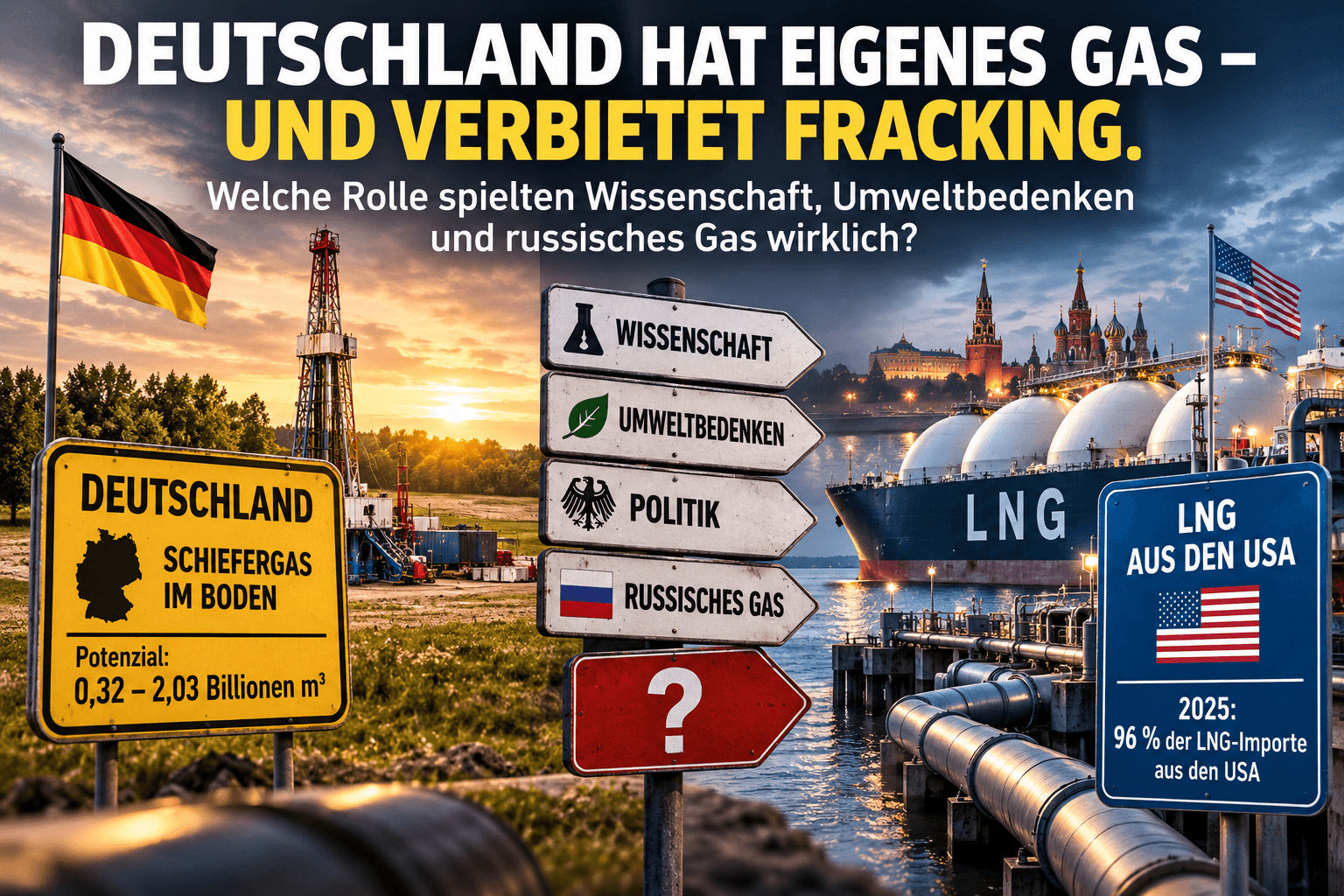

0.32 to 2.03 trillion cubic meters.
This is how large the Federal Institute for Geosciences and Natural Resources (BGR) estimated Germany's technically recoverable shale gas resources to be in 2016.
A significant portion of it:
under Lower Saxony. Federal Court of Justice
Nevertheless, the commercial extraction of this unconventional natural gas has been prohibited in Germany since 2017.
At the same time, Germany imports natural gas.
And in 2025 alone, 106 terawatt-hours of LNG entered the country via German terminals.
Around:
of these German LNG imports originated from the USA. Federal Network Agency
A country with significant potential gas resources in its own soil is thus today importing, among other things, natural gas from a country whose gas boom was largely made possible by fracking.
How could it come to this?
It shows politics, ministries, science, industry, environmental associations, media, and Russia in a large relationship diagram.
The message:
Scientists considered fracking manageable.
Russia wanted to maintain its position as a gas supplier.
Environmental associations warned against fracking.
Media amplified these fears.
Politics eventually followed the opponents.
The ban came in 2016/17.
And Germany remained dependent on imported gas.
This is a fascinating story.
Only:
Germany does indeed possess significant shale gas deposits.
The BGR studied them for years.
For Germany, it finally estimated the technically recoverable resources at:
0.32 to 2.03 trillion cubic meters. Federal Court of Justice
We are not talking about a geological curiosity here.
We are talking about a potentially significant energy resource.
This is exactly where it gets complicated.
Because:
is also a problematic sentence when it comes to fracking.
The BGR investigated, among other things, the question of whether fracking fluids could reach shallow groundwater layers through the rock.
For the geological conditions of Northern Germany, it evaluated this direct path as:
extremely unlikely. Federal Court of Justice
That sounds like the all-clear at first.
But it is not a complete risk assessment.
Because possible problems do not only arise deep underground.
Borehole integrity.
Chemicals.
Flowback.
Transport.
Storage.
Methane emissions.
Induced seismicity.
All of this is also part of the assessment.
The UBA warned of risks, particularly for groundwater, and pointed to uncertainties regarding chemicals and wastewater.
In 2012, experts commissioned by the UBA therefore recommended not using unconventional fracking on a large scale, but rather – if at all – proceeding step-by-step and with close scientific monitoring. Federal Environment Agency
The UBA remained skeptical later on as well.
In 2023, it argued that shale gas extraction was neither necessary in the short term nor could it quickly make a significant contribution to gas shortages or high prices; furthermore, in the long term, it did not fit with a greenhouse gas-neutral energy supply. Federal Environment Agency
This makes one thing clear:
There were different scientific assessments of risks, benefits, and manageability.
On June 24, 2016, the Bundestag voted.
Result:
435 Yes
109 No
9 Abstentions
Unconventional fracking was banned in principle. German Bundestag
And here, an important correction to the graphic is necessary.
The ban was not simply a Green decision.
Germany was governed by:
CDU/CSU and SPD.
They passed the law.
The Greens and the Left even demanded more extensive bans. German Bundestag
This is important when discussing responsibilities today.
And that brings us to the actually interesting point.
Germany did not decide against natural gas.
Germany decided against developing a specific domestic natural gas source.
The demand for gas remained.
So gas had to come from elsewhere.
For years, Russia played a prominent role in this.
Nord Stream became the symbol of this strategy.
Ökonomically, this appeared attractive for a long time:
large quantities,
pipeline infrastructure,
comparatively cheap supply.
Geopolitically, however, this created a concentration risk.
Russia's attack on Ukraine fundamentally changed the European energy architecture.
Germany had to diversify its gas supply in a short period of time.
LNG terminals were built.
New supply chains were established.
Other supplier countries gained importance.
And thus, a remarkable situation arose.
In 2025, 106 TWh of natural gas came through German LNG terminals.
That was 10.3 percent of all German gas imports.
According to the BDEW, approximately:
of these LNG volumes came from the USA. Federal Network Agency
And the USA became one of the world's largest energy producers precisely through the development of unconventional oil and gas deposits.
One can therefore ask an uncomfortable question:
There is no simple answer to this.
Because transport routes, methane emissions, local environmental conditions, and production standards must also be compared.
But the question is legitimate.
Here we must remain very precise.
The graphic suggests:
Russia wanted to prevent German competition.
Russian media spread negative reports.
Environmental groups picked up these narratives.
Politicians followed.
Fracking was banned.
Thus, Germany remained dependent on Russian gas.
That would be a massive story.
Of course, Gazprom had an economic interest in selling as much Russian gas as possible to Germany.
Of course, extensive German gas production would have potentially competed with imported gas.
But it does not follow from this:
Russia caused the German fracking ban.
There is no resilient evidence for this specific causal chain.
And that is exactly why we should not present it as a fact.
Because another problem is fully documented:
Germany opted for an energy architecture that involved significant import dependencies for years.
This worked as long as supply relationships were stable.
When the geopolitical situation changed, a cheap supply relationship became a strategic risk.
And this is exactly where the larger economic story begins.
This applies not only to energy.
A company can rely entirely on one supplier.
A state on one energy supplier.
An investor on one asset class.
An economy on one technology.
As long as everything works, diversification often appears inefficient.
Because redundancy costs money.
Alternative supply chains cost money.
Reserven cost money.
Warehousing costs money.
Diversification can cost returns.
Until the unlikely event occurs.
Then redundancy suddenly gets a price.
It is no coincidence that Germany possesses one of the largest state gold reserves in the world.
Gold does not produce electricity.
It does not replace natural gas.
It does not solve energy policy problems.
But the logic behind strategic gold reserves is surprisingly similar.
But resilience.
Physical gold is not a claim against a debtor.
It does not require a foreign issuer to fulfill its obligations.
It has no pipeline.
And no contractual partner whose political interests can change.
In return, it incurs storage costs.
It pays no interest.
And its market price fluctuates.
Here, too, one pays for diversification.
Not:
Fracking was right.
And also not:
Fracking was wrong.
This decision requires a balancing of environmental, climate, economic, and security interests.
The more important lesson is:
Because security of supply has a value.
Diversification has a value.
And independence sometimes has a value that is hardly visible in normal times.
This applies to energy.
To supply chains.
To currencies.
And also to assets.
The question is therefore not only:
What is cheapest today?
Sondern:
Perhaps that is exactly the difference between efficiency and resilience.
Stay far-sighted.
Yours,
Helge Peter Ippensen