Saxony-Anhalt 2026: What 43.8 Percent for the AfD Reveals About Economic Trust
September 7, 2026
43.8 percent.
This result will be remembered from the state election in Saxony-Anhalt.
The AfD has more than doubled its share of the vote compared to 2021 and has become the strongest force by a wide margin.
At the same time, the CDU fell from 37.1 to 17.2 percent.
A political earthquake.
But anyone who wants to understand what has actually changed in Saxony-Anhalt should perhaps look at another number:
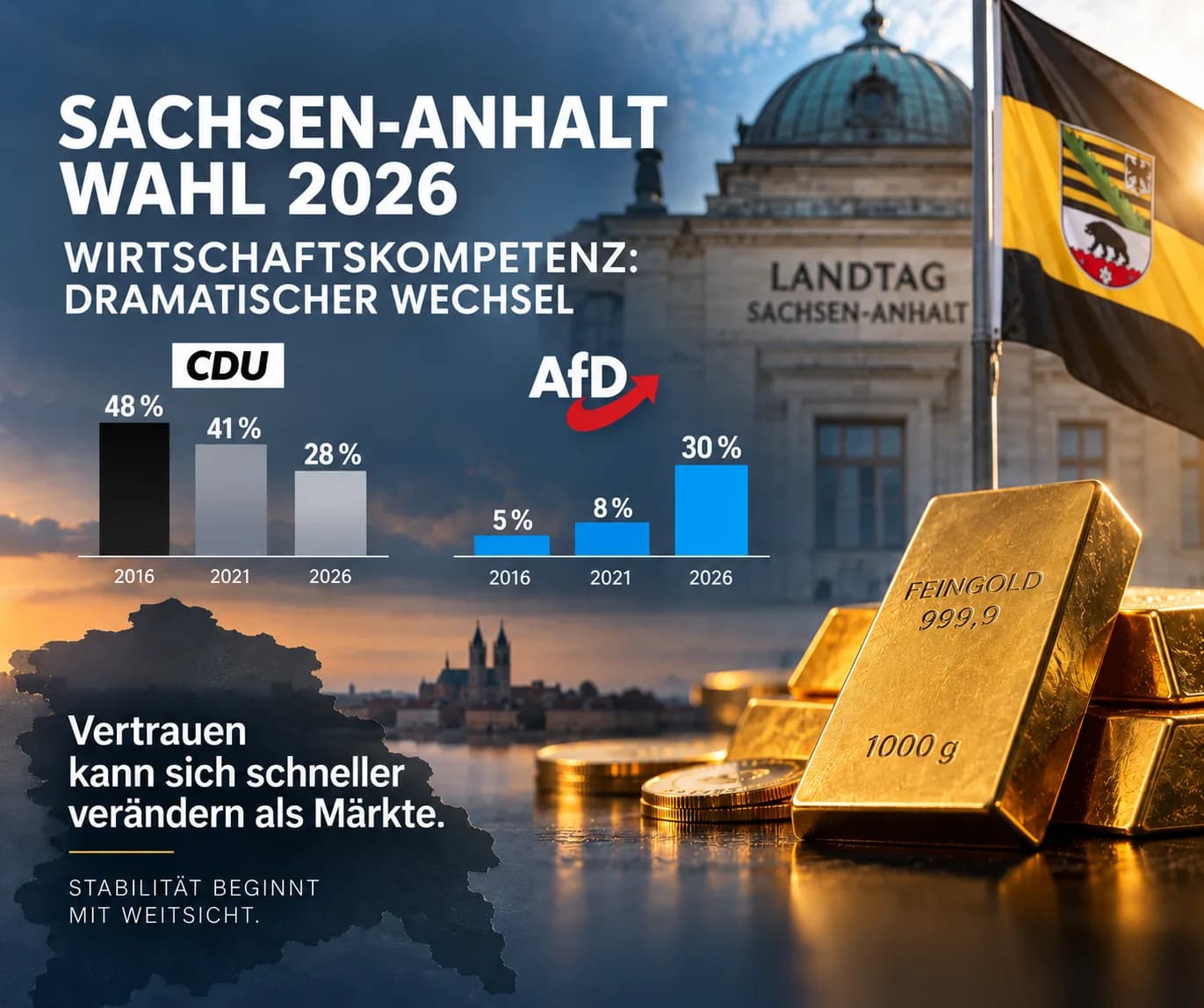
30 percent.
That is how many eligible voters now trust the AfD, of all parties, the most to move the economy forward.
In 2021, it was just 8 percent.
Back then, the CDU stood at 41 percent.
Today: 28 percent.
In the long term, this could be at least as significant as the actual election result.
After counting all 2,661 electoral districts, the following preliminary result emerges:
AfD 43.8%, CDU 17.2%, SPD 9.3%, Greens 8.9%, Left 8.6%, BSW 5.3%, and FDP 2.6%.
The voter turnout is particularly remarkable.
It rose from 60.3 to 77.8 percent.
This makes a frequently used explanation more difficult:
The AfD did not win simply because its core voters were mobilized while others stayed at home.
This time, significantly more people went to vote.
And yet – or perhaps because of it – the party reached 43.8 percent.
In the 2021 state election, the AfD reached 20.8 percent.
Now it is 43.8 percent.
An increase of 23 percentage points.
The CDU is experiencing the mirror-image development: from 37.1 to 17.2 percent.
However, it would be wrong to derive a simple direct voter transfer from the CDU to the AfD from this.
Voter migrations are more complex.
Something else is more decisive:
The trust in the parties' competence to solve problems has shifted massively.
Traditionally, economic competence is one of the Union's strongest political brands.
In 2016, 48 percent in Saxony-Anhalt still considered the CDU to be the party most likely to move the economy forward.
AfD: 5 percent.
2021:
CDU 41 percent.
AfD 8 percent.
2026:
CDU 28 percent.
AfD 30 percent.
Within ten years, the CDU's lead in competence of 43 percentage points over the AfD has completely disappeared.
This is more than protest.
At least in the perception of many voters, a party that was previously associated almost exclusively with migration and protest has now also established itself as an economic policy alternative.
Whether this attributed competence is backed by the concrete program is another question.
The ARD analysis, for example, points out that some of the AfD's economic policy demands cannot be decided at the state level at all and that its migration policy could also harbor significant economic risks in view of the shortage of skilled workers.
Exactly this distinction is important:
Perceived competence is not the same as proven competence.
Nevertheless, it is politically decisive.
In terms of energy supply, 30 percent now also attribute the highest competence to the AfD.
For jobs, it is 29 percent.
For social justice, also 29 percent.
For peacekeeping, 29 percent.
This means that the result can no longer be convincingly explained solely as a reaction to a single issue.
Rather, the election shows a more comprehensive shift in political trust.
And this is precisely where it also becomes economically interesting.
First of all:
Nothing directly.
Gold does not automatically rise because the AfD wins a state election.
And no serious gold price forecast can be derived from the election result in Saxony-Anhalt.
But behind both topics lies a common economic category:
Trust.
A currency works because of trust.
Government bonds work because of trust.
Bank deposits work because of trust.
And political systems also work because of trust.
When people are convinced that institutions can solve their central problems, systems are stable.
When this trust wanes, people look for alternatives.
Politically, this happens at the ballot box.
With assets, it can mean diversifying more strongly.
For this very reason, gold should not be politicized.
Physical gold is neither left nor right.
It is neither government nor opposition.
And it is also not a bet on the collapse of a state.
Its special property is much more sober:
Physical gold is not a claim against a debtor.
Anyone who owns a government bond trusts in the state's ability to pay.
Anyone who holds money in a bank account has a claim against a bank.
Anyone who holds a share participates in a company.
Gold stands outside this chain of claims.
This does not automatically make it a better investment.
Gold pays no interest and no dividends. Its price can fluctuate considerably. Storage incurs costs.
But that is precisely why it fulfills a different function within a diversified portfolio.
Perhaps the most interesting number of this election in the end is not even 43.8.
But 77.8 percent.
That is how many eligible voters cast their vote.
In 2021, it was 60.3 percent.
This means:
The political change did not arise from apathy.
On the contrary.
A great many people explicitly wanted to exert influence this time.
This should be a warning signal for politics and the economy.
Because people do not react to uncertainty passively in the long term.
They change their behavior.
They change their voting decision.
They change their consumption decisions.
And at some point, possibly also the structure of their assets.
The state election does not tell us where the gold price is going.
It also does not tell us how Germany will vote in the next federal election.
Saxony-Anhalt is not Germany.
But the election documents something that could be relevant far beyond Magdeburg:
Trust can be lost faster than institutions believe.
In 2016, the CDU's lead over the AfD in attributed economic competence was 43 percentage points.
Ten years later, the AfD is in the lead.
Perhaps the decisive question after this election is therefore not:
Who governs Saxony-Anhalt?
Sondern:
Why do fewer and fewer people believe that those who have governed so far can still solve their economic problems?
For politics, this is a question of power.
For investors, trust is a question of assets.
And for both, the following applies:
Diversification begins before trust is lost – not after.
Stay far-sighted
Yours, Helge Peter Ippensen