Detecting Gold Fraud: Why Magnet Tests and Hallmarking Alone Are Not Enough

October 5, 2026
A professional catalog.
A supposed lawyer.
An alleged insolvency proceeding.
And gold significantly below the market price.
What sounds like a rare opportunity can cost thousands of euros within minutes.
FOCUS online is currently reporting on a particularly perfidious scam involving gold purchases: fraudsters are allegedly hiding behind the names of real lawyers and insolvency practitioners and offering purported gold stocks for sale.
The crucial point:
And that is precisely why a fundamental question is worth asking:
How do you actually recognize a reputable gold purchase?
Discounts are completely normal for many products.
Cars.
Televisions.
Furniture.
Fashion.
With investment gold, it works differently.
A troy ounce of gold has an internationally observable market value at all times.
Of course, the premiums of different dealers vary. Procurement, production, logistics, insurance, and trading incur costs.
But a dealer cannot permanently sell genuine investment gold far below the current metal value.
GOLD.DE therefore issues a simple warning:
Conspicuously low prices are among the most important lures used by gold fraudsters. GOLD.DE
Or more simply:
Then the second level of the problem begins.
Is the gold actually genuine?
The FOCUS article mentions several methods for this:
Magnet test.
Weight and dimensions.
Sound test.
Hallmarking.
These are useful initial indicators.
But they have limits.
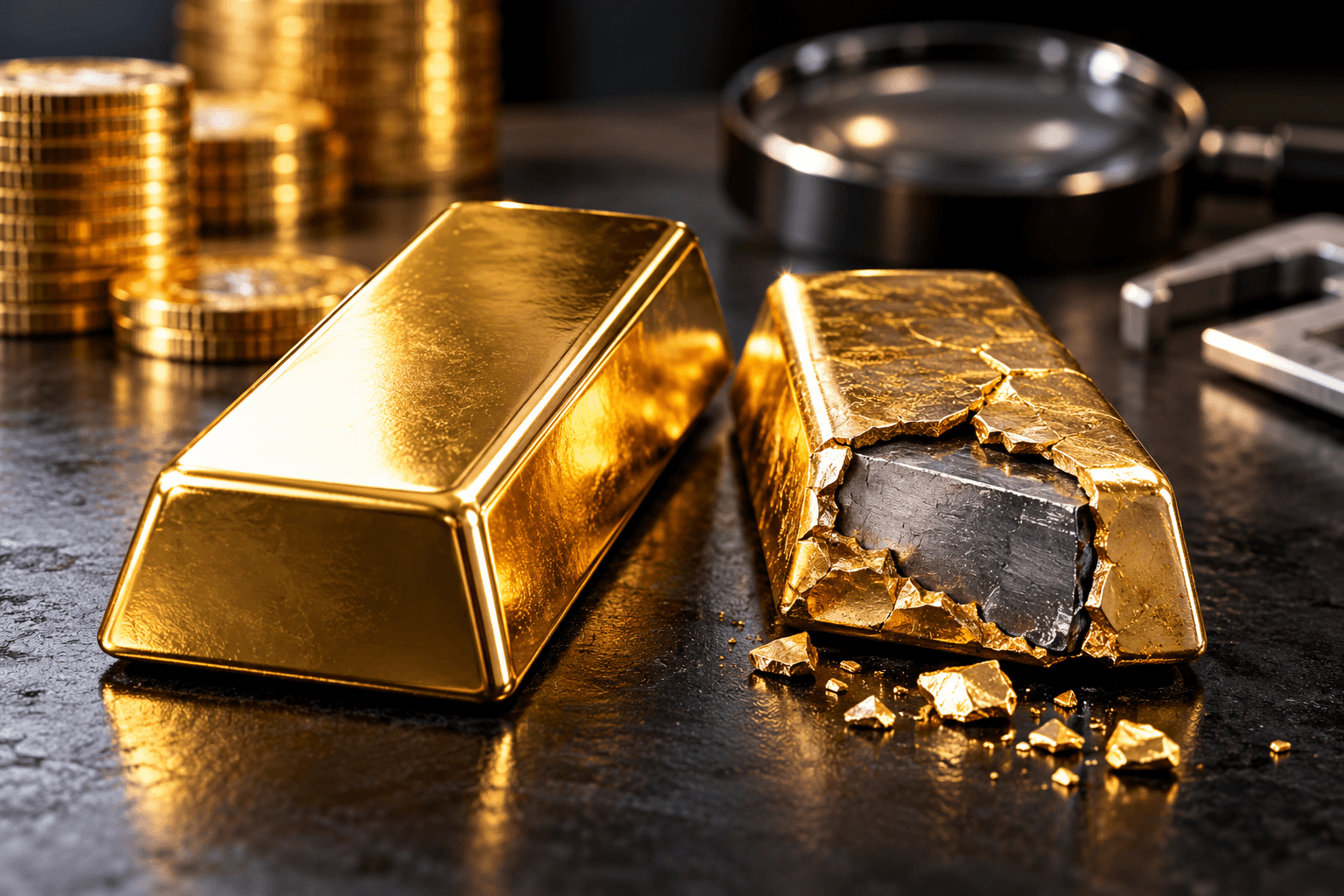
Pure gold is diamagnetic.
If a supposed gold bar is clearly attracted by an ordinary magnet, something is obviously wrong.
However, the reverse conclusion does not work:
Therefore, a magnet test should never be understood as the sole proof of authenticity.
For standardized investment coins, the weight, diameter, and thickness are precisely known.
A Krugerrand can therefore be measured and weighed.
If the values deviate significantly, there is an obvious suspicion.
But even this method has limits.
One reason is called:
Its density is remarkably close to that of gold.
This allows for the construction of high-quality counterfeits where simple weight checks are insufficient. GOLD.DE explicitly points out that differences in tungsten counterfeits may be practically immeasurable for laypersons. GOLD.DE
It is also helpful.
A bar usually bears information on the manufacturer, weight, and fineness; larger bars often additionally feature a serial number.
But:
The engraving therefore does not automatically prove the authenticity of the material underneath.
Those who trade or store larger precious metal values therefore do not rely exclusively on magnets, scales, and visual inspection.
Professional testing procedures include, for example:
X-ray fluorescence analysis, ultrasonic testing, conductivity measurement, or magnetic scales. GOLD.DE
The actual lesson from this is:
Interestingly, technology itself is now changing authenticity verification.
German gold coins from the 2026 vintage will receive a new security feature.
A so-called relief signature will be integrated directly into the surface of the coin.
It is practically unrecognizable to the naked eye.
The coding can be read via smartphone and linked to a digital certificate of authenticity. GOLD.DE
This is remarkable.
One of humanity's oldest assets is receiving a digital proof of authenticity.
Most guides ask the question:
How do I recognize genuine gold?
However, at least as important is:
Because the best magnet in the world does not help if no gold is delivered at all after a transfer.
And a perfect bar is of little use if the origin, ownership, and storage are not traceable.
Therefore, a reputable gold purchase consists of several levels:
1. Reputable provider
2. Plausible price
3. Traceable origin
4. Authenticity verification
5. Clear allocation of ownership
6. Traceable storage
Anyone who buys gold themselves and stores it at home takes on this responsibility entirely themselves.
That can be a conscious decision.
But then the origin of the metal should also be beyond doubt.
Those who have precious metals professionally stored shift the question:
No longer:
"Is this bar in my hand genuine?"
But rather:
"Can I trace beyond doubt that the precious metal allocated to me actually exists?"
This makes allocation, documentation, insurance, and independent auditing crucial.
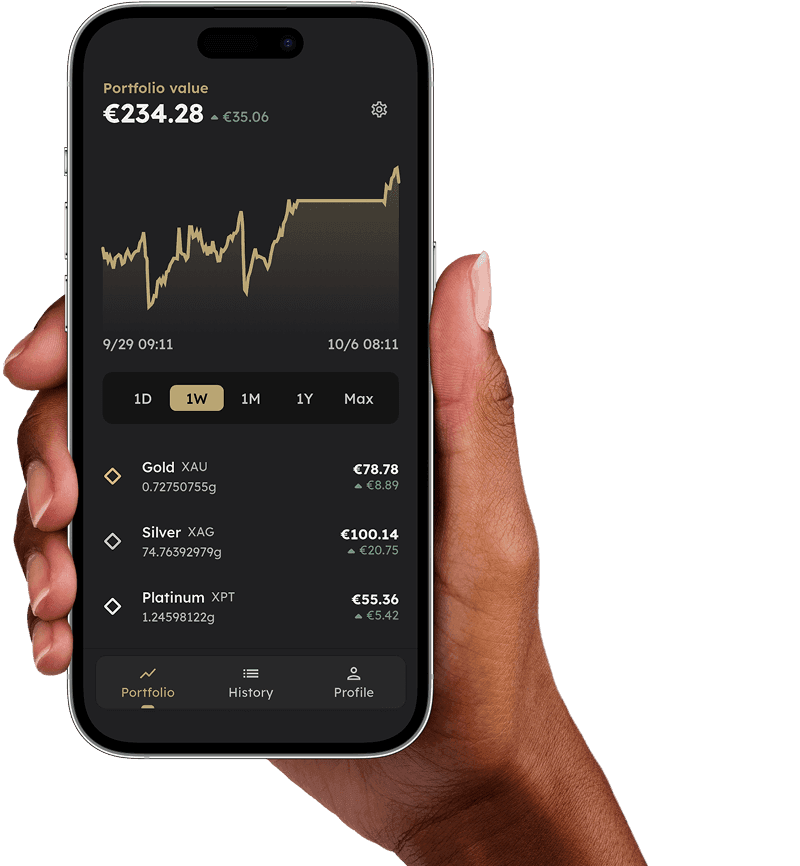
With Spargold, there should actually be physical precious metal behind the digital display in the app.
The precious metals are professionally stored in Singapore.
The decisive thought here is not:
Trust an app.
But rather:
Exactly this connection between digital management and physical ownership is crucial for us.
Physical gold is not a claim against a debtor.
But that is exactly why one must ensure that the gold one believes to own,
firstly, exists,
secondly, is genuine,
and
thirdly, is actually allocated to oneself.
Perhaps that is why the most important question when buying gold is not:
Sondern:
Gold does not require trust as an asset.
But the path to gold requires a reliable chain of trust.
Stay farsighted.
Yours,
Helge Peter Ippensen