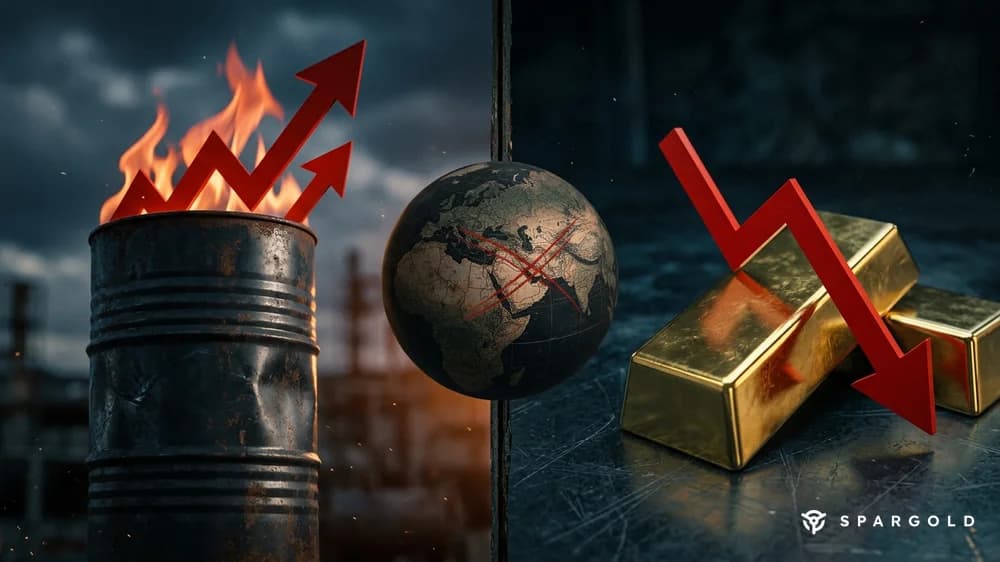
Gold Price Iran Conflict — when gold falls and oil rises, the opposite should actually happen — yet in September 2026, that is exactly what occurred. While the Iran conflict drives oil prices and raises inflation expectations, gold continues to fall. The reason: Rising oil prices increase inflation expectations, the Fed reacts with interest rate hikes — and higher interest rates weigh more heavily on gold than the crisis supports it. A structural change in the classic crisis metal narrative.
Gold has been considered the classic crisis metal for centuries. In times of geopolitical tension, war, and economic uncertainty, demand for gold as a safe haven increases. However, September 2026 shows a different picture: The Iran conflict is escalating, attacks between the USA and Iran are significantly driving up the price of oil. Gold is falling nonetheless — to a seven-week low of 4,110 to 4,157 USD per troy ounce.
At the same time, silver slumped by nearly 5 percent last week. The DAX lost ground, while the Dollar gained. Investors who relied on gold as a crisis hedge are experiencing disappointment — at least in the short term. What happened?
The causality is complex but understandable. A rising oil price increases energy costs across the entire economy. This drives inflation upward. Higher inflation forces the Fed to raise interest rates further — to ensure price stability. And higher interest rates weigh on gold because they increase the opportunity cost advantage of bonds over gold.
| Event | Direct Impact | Impact on Gold |
|---|---|---|
| Iran conflict escalates | Oil price rises | Initially neutral to slightly positive |
| Oil price rises | Inflation rises | Increased need for inflation protection — but… |
| Inflation rises | Fed raises interest rates | Negative: higher opportunity costs |
| Interest rates rise | Bond yields rise | Negative: capital outflow from gold |
| Dollar strengthens | Gold becomes more expensive in other currencies | Negative: lower global demand |
The classic crisis metal narrative works well when crises signify direct currency or systemic risks — such as sovereign defaults, banking crises, or currency devaluations. It works less well when the crisis acts primarily through the inflation and interest rate channels.
In the current environment, this is exactly the case: The USA is raising interest rates to 3.75 to 4.00 percent. Government bonds offer a 5 percent yield. Under these circumstances, the foregone interest when holding gold is very real — and outweighs the crisis bonus in the short term. This does not mean that gold has lost its protective function — it means that this function comes into play in other scenarios.
Gold acts particularly strongly as a crisis metal when the following conditions are met: interest rates are low or falling, the Dollar is weak, and the banking or currency system is under pressure. In these scenarios, gold significantly outperforms bonds as a safe haven. According to the World Gold Council, geopolitical risks are permanently among the top 3 reasons for gold investment — but in combination with rising real interest rates, they lose their dominance effect in the short term. More on gold price mechanics in the Spargold Glossary.
When the current interest rate hike cycle ends, these conditions will return. For long-term gold investors, this means: the current weakness is not a signal to exit, but a known cyclical pattern. With Spargold, physical gold can be purchased cheaply and securely — see more articles in the Spargold Blog.
The 1970s oil crisis is the best counterexample: Back then, oil and inflation also rose simultaneously — and gold soared by over 2,000 percent. The difference: At that time, there was no interest rate hike cycle acting as a counterforce. The Fed under Arthur Burns allowed inflation to run instead of fighting it. Real interest rates were negative. Gold profited because it was the only means against the loss of purchasing power.
Today, the starting position is different. Fed Chair Warsh has repeatedly stated that the Fed's priority is price stability. Interest rates will be raised until inflation falls to 2 percent. This makes bonds more attractive than gold — as long as the interest rate hike cycle continues. Historically, such phases last one to two years. A strong recovery in gold typically follows once the Fed pivots.
For the private investor, this means: Anyone buying gold as a short-term crisis hedge might be disappointed if the crisis acts through oil and interest rates. Those who hold gold as a long-term purchasing power hedge over 10 to 20 years view short-term weak phases differently — as a buying opportunity, not a warning signal.
Gold does not automatically rise with every crisis. If the crisis acts through inflation and interest rates (as with the Iran oil shock), the interest rate effects outweigh the crisis bonus. Gold reacts particularly strongly to direct currency or systemic risks.
Silver is more industrially influenced than gold. In times of economic uncertainty, industrial demand falls — this overlays the crisis bonus. Silver fell by nearly 5 percent in September 2026, as recession fears weighed on industrial demand.
In the long term, yes — over decades, gold has preserved purchasing power better than paper currencies. In the short term, it depends on the type of crisis: currency crises and systemic risks reliably drive gold. Interest rate hike cycles weigh on it temporarily.
This article does not constitute investment advice. Investments in precious metals involve risks.