Silver Price -7%: When High US Interest Rates Put Precious Metals Under Pressure

October 4, 2026
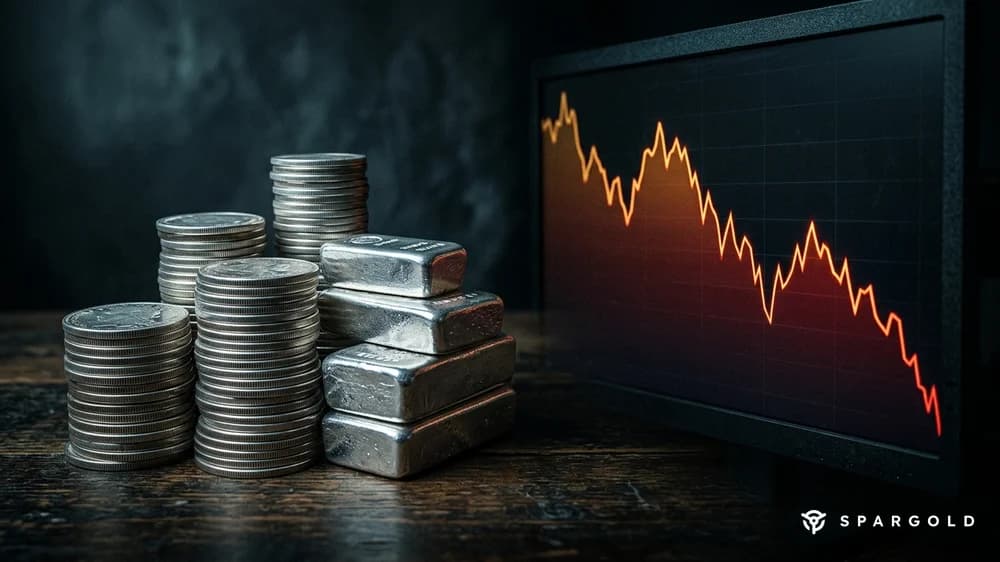
The silver price fell by seven percent in a single trading day and is currently trading at around 60.70 US dollars per troy ounce — a slump typical for silver: the metal fluctuates more than gold and reacts particularly strongly to interest rate expectations. The trigger is macroeconomic, not silver-specific: the CME FedWatch probability for a US interest rate hike in October is 68 percent, and bond yields are near a twenty-year high. For investors looking to hold or buy silver, the central question is: is this a short-term slump — or the beginning of a longer period of weakness?
A seven percent daily loss is extraordinary for silver — but not without precedent. The metal is more volatile than gold: while gold typically loses three to five percent during similar macro events, silver amplifies these movements. This is due to its dual nature: silver is both a precious metal and an industrial metal — it reacts to both interest rate expectations and economic concerns.
The current price of 60.70 USD is technically in a critical zone. Support levels at 60.90 and 60.00 USD have already been tested. Even more significant: the Relative Strength Index (RSI) stands at 29 — signaling an oversold condition. Values below thirty can indicate a technical counter-movement, but they do not guarantee one. More problematic is the medium-term technical situation: silver is trading below the 100- and 200-period averages — classic signals of an intact downtrend.
Gold and silver pay no interest. This is their structural handicap in an environment of rising yields. The causal chain works as follows:
Additionally, a third factor is shaping September and October 2026: oil prices are once again driving inflation concerns — and these concerns are causing interest rate expectations to rise further rather than fall. An inflationary environment initially sounds positive for precious metals, but it reverses when the Fed's reaction (interest rate hike) has a stronger impact than the inflation protection impulse.
Gold has weathered the same interest rate reaction better than silver. There are structural reasons for this:
For long-term precious metal investors, gold serves as an anchor of stability, while silver acts as a more speculative addition. The current pullback exemplifies this difference.
An RSI below thirty shows that silver is technically oversold — meaning the price decline was statistically stronger than the fundamental situation alone would justify. In the past, such oversold phases have often been followed by technical counter-movements.
Important: An oversold RSI is not a buy signal. It only indicates that the downward movement might be exaggerated in the short term. The decisive catalyst for a real recovery would be a decrease in interest rate hike expectations — for example, if the US jobs report is weaker than expected or if Fed communication becomes more dovish. As long as a 68 percent probability of an interest rate hike is priced into the market, silver remains under pressure.
On the current gold market situation: Gold Price Forecast from Banks: Why Experts Remain Confident Despite the Correction. On the relationship between inflation and precious metals: US Inflation Falls: Gold Price Starts October with a Gain.
Silver is both a precious metal and an industrial metal — and thus reacts to two negative impulses simultaneously: interest rate hikes make non-interest-bearing assets less attractive, and economic concerns reduce industrial demand. Gold is more strongly supported by central bank purchases and crisis demand. This explains why silver typically falls more sharply than gold during interest rate reaction phases.
Technically, an RSI of 29 indicates an oversold condition — which could point to a short-term counter-movement. Fundamentally, the pressure factors remain: a 68 percent interest rate hike probability, a strong dollar, and high bond yields. A sustainable upturn requires a change in these factors. For long-term investors with a multi-year horizon, pullbacks can be interesting — in the short term, the outlook remains clouded.
The CME FedWatch tool calculates the probability that the US Federal Reserve will raise, hold, or lower interest rates at its next meeting based on the prices of Fed funds futures contracts. A 68 percent probability for an October hike means the market majority expects an increase — but with significant uncertainty. If this expectation falls (for example, due to weak economic data), it can quickly support precious metals.
This depends heavily on the interest rate environment. In the interest rate hike cycles of past decades, precious metals have often been under pressure for several months before recovering — once interest rates reached their peak or the central bank paused. The current pullback is likely to persist as long as Fed interest rate hike expectations remain high. The next important data point: the US jobs report.
This article is for general information purposes only and does not constitute investment advice. Investments in precious metals involve risks. Please consult an independent financial advisor when making investment decisions.