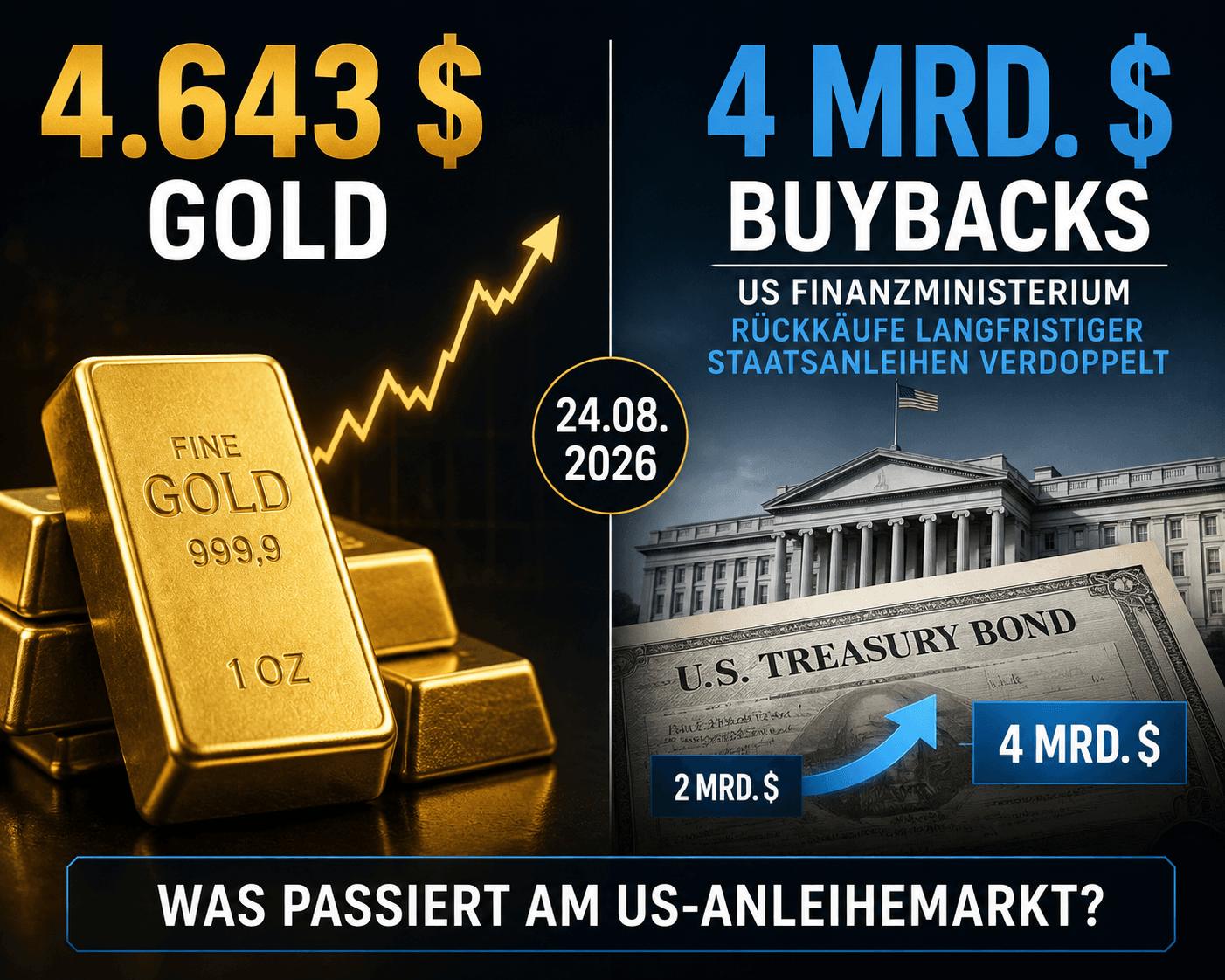
$4,643.63 per troy ounce.
This is how high gold rose on the morning of August 24, 2026.
The highest level in more than three months.
In the past week alone, gold gained more than 5%.
But perhaps the more interesting number is:
4 billion dollars.
This is the maximum size that certain buybacks of long-term US Treasuries by the US Treasury Department may reach per operation in the future.
Previously, it was 2 billion.
What does one have to do with the other?
No.
The current measure is not a new Quantitative Easing by the Federal Reserve.
The US Treasury has announced that it will at least double its so-called liquidity support buybacks for certain longer-dated government bonds.
In doing so, the Treasury buys back already issued bonds and simultaneously finances itself through its regular debt issuance.
The stated goal is to improve the liquidity and functionality of the Treasury market.
This is an important distinction.
Because monetary policy is conducted by the Federal Reserve.
Debt management is conducted by the Treasury.
Because financial markets do not only react to the technical construction of a measure.
They react to the signal behind it.
US national debt has now exceeded the 40 trillion dollar mark.
At the same time, yields on long-term government bonds have recently been at levels not seen in many years.
The higher these yields, the more expensive the refinancing of US national debt becomes.
The Treasury is now intervening more heavily in the market structure.
And that is exactly what raises a question for investors:
How far will American policy go to limit rising financing costs?
Following the announcement, three things happened:
Bond yields initially declined.
The dollar lost value.
And gold rose.
Today, the precious metal reached more than $4,640.
Simultaneously, the dollar is trading near a multi-month low.
There is now a term for this:
Debasement Trade.
In essence: Investors are positioning themselves against the risk of a creeping devaluation of money.
The data does not support this either.
The dollar is under pressure.
But to infer a general flight from American assets from this would be wrong.
Official US Treasury data even shows significant foreign capital inflows for June.
Foreign investors purchased a net $207.1 billion in long-term US securities.
Of this, $169.8 billion was attributed to private and $37.3 billion to official foreign investors.
Thus, the American capital market continues to function.
And the dollar remains the dominant international reserve currency.
The interesting development is more subtle.
Normally, investors discuss which asset they should buy.
Stocks?
Bonds?
Real estate?
Gold?
With the debasement trade, the question shifts.
Suddenly, it is:
In which unit of measurement are we actually valuing these assets?
When national debt rises and political measures are simultaneously taken to facilitate the financing of this debt, some investors grow concerned that, in the long term, the currency could take on part of the adjustment.
A weaker dollar is generally favorable for gold.
Because gold is predominantly traded internationally in dollars.
Therefore, it is not just the price that is interesting.
Institutional capital also appears to be returning.
Gold-backed ETFs tracked by Bloomberg recorded inflows of more than 28 tons of gold last week.
The highest weekly figure since January.
This is noteworthy.
Because at the beginning of 2026, gold had already risen to a record high of nearly $5,600.
A significant correction followed.
Now investors are coming back.
The founder of Bridgewater Associates warned again on Friday about the consequences of US national debt.
His recommendation: reduce bond holdings and hold up to 15% of assets in gold.
This should be put into proper perspective.
15% gold is not a scientifically correct portfolio allocation.
It is Dalio's personal assessment.
More interesting is his reasoning.
He views gold not primarily as a speculation on rising prices, but as diversification against a financial system in which many assets are simultaneously someone else's liability.
A government bond is a claim against a state.
A bank deposit is a claim against a bank.
Cash, too, is ultimately part of a state monetary system.
Physical gold, on the other hand, has no debtor.
It is no one's liability.
This guarantees neither appreciation in value nor protection against significant price losses.
Gold itself has just impressively demonstrated this:
From nearly $5,600 at the beginning of the year, the price temporarily fell back toward $4,000.
Gold is not a risk-free asset.
The gold price may rise tomorrow.
Or fall.
Real yields may rise again.
The dollar may recover.
Both would weigh on gold in the short term.
Therefore, the structurally more interesting development may not be taking place in the gold market.
It is taking place in the US bond market.
A state with more than 40 trillion dollars in debt is facing significantly higher long-term financing costs.
The Treasury is responding with larger buyback operations.
Investors, in turn, are reacting with a reassessment of the dollar, bonds, and alternative assets.
This does not have to mean a currency crisis.
But it changes the discussion.
$4,643 is the gold price.
The real story is about trust in the unit of measurement behind it.
Maintain a long-term perspective.
Yours, Helge Peter Ippensen