Germans Own 9,173 Tons of Gold – and the Most Intriguing Figure is a Different One

August 31, 2026
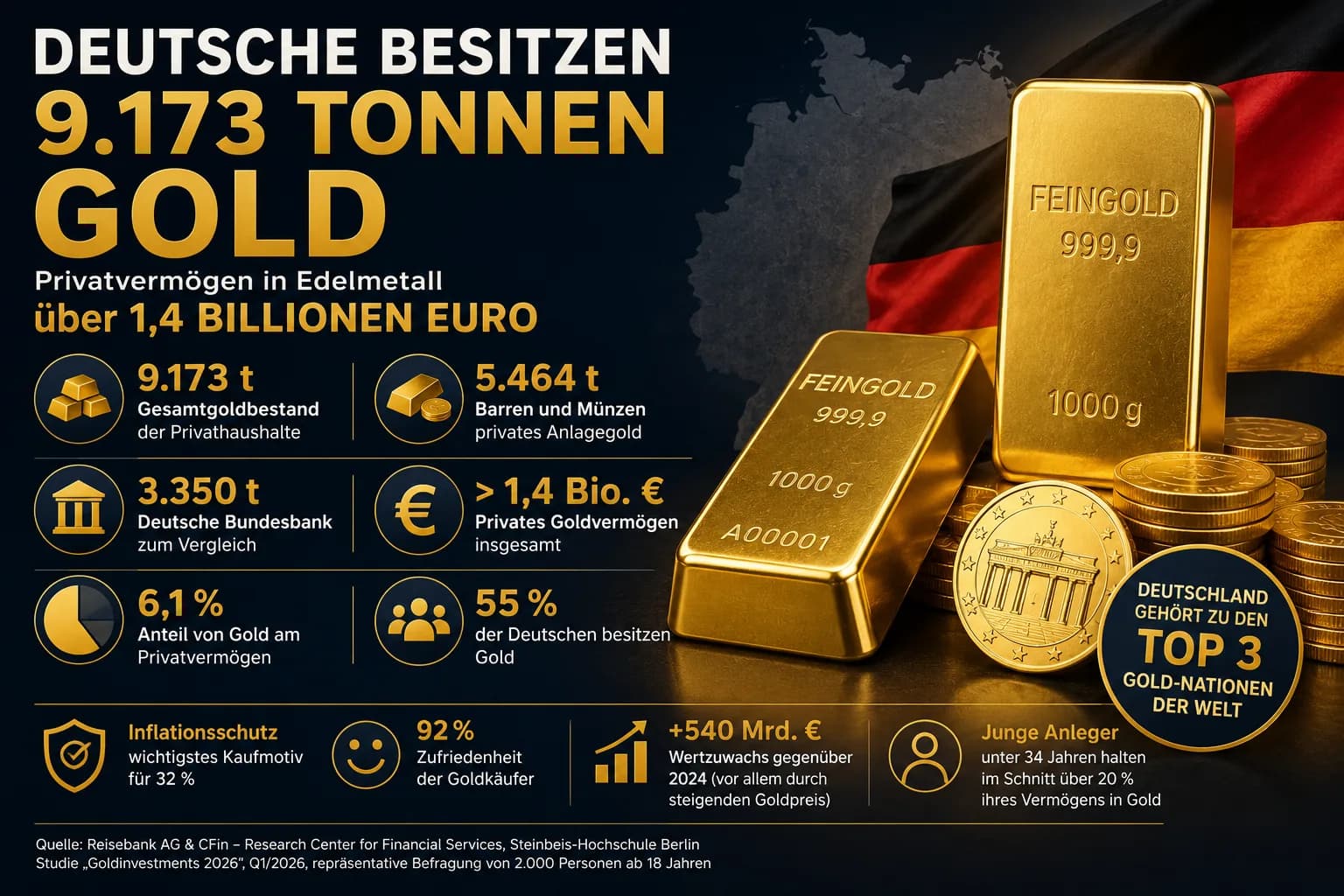
9,173 tons of gold.
This represents a new record high in what is now the ninth survey of this study series.
But perhaps even more remarkable than this figure is another:
5,464 tons.
This is the amount Germans actually hold as physical investment gold – in the form of bars and coins.
For comparison: The Deutsche Bundesbank holds approximately 3,350 tons of gold.
Thus, German private households own approximately 63 percent more gold than the Bundesbank in the form of bars and coins alone.
And in total – including jewelry and gold-related securities – private German gold holdings are almost three times as large as the gold reserves of the Bundesbank.
The scale becomes even clearer when considering euros instead of tons.
The study values the total private gold wealth of Germans at more than 1.4 trillion euros.
This is distributed as follows:
| Gold assets of German private households | Value |
|---|---|
| Investment gold and gold-related securities | €907 billion |
| Gold jewelry | €532 billion |
| Total private gold assets | approx. €1.44 trillion |
| additionally: Gold of the Bundesbank | €480 billion |
| Private households + Bundesbank | nearly €1.9 trillion |
Compared to the 2024 survey, the value of gold held for investment purposes alone has increased by around 540 billion euros.
However, this spectacular figure must be put into perspective.
Germans did not double their gold holdings within two years.
The primary reason for the doubling of the value is the massive increase in the price of gold. In contrast, the physical quantity of gold in bars and coins increased by only 235 tons to 5,464 tons compared to 2024.
This is an important distinction.
According to the study, in 2024, gold accounted for only 2.8 percent of the total assets of German private households.
In 2026, it is 6.1 percent.
More than a doubling.
Here too, price development plays a decisive role.
For the calculation, the study authors used the LBMA gold price from March 10, 2026, of 4,457.35 euros per troy ounce or 143.31 euros per gram.
Gold is thus no longer a niche investment.
55 percent of Germans own gold – as jewelry, physical investment, or through gold-related securities.
And approximately 10.7 percent of global private gold investments are in German hands, according to the study's calculations.
One figure contradicts a common image of the typical gold buyer.
Among those under 34, the average share of gold in total assets is more than 20 percent, according to the study.
In contrast, for those over 45, it is less than 15 percent.
Gold thus seems by no means to be only the wealth of an older generation.
At the same time, slightly fewer people are currently buying gold: 15 percent of respondents stated they had purchased within the past twelve months. In 2024, this figure was 17 percent.
However, those who do buy are investing higher amounts.
For a quarter of buyers, the amounts spent in 2026 were more than 4,500 euros. In 2024, the corresponding threshold was 2,500 euros.
The study also provides a remarkably clear answer to this.
39 percent view gold as a long-term capital investment and store of value.
32 percent cite protection against inflation as a motive.
More than 70 percent of respondents are concerned about rising inflation.
And 92 percent of gold buyers are satisfied with their investment.
This aligns with a trend that can also be observed internationally:
Gold is increasingly viewed less as a short-term object of speculation and more as a strategic asset component.
Here, the study provides a point that is particularly relevant for investors.
Many Germans are apparently not sufficiently aware that a special tax rule applies to physical gold in Germany:
If physical investment gold in private assets is sold after the one-year holding period, any resulting private capital gain is generally not subject to income tax.
Reisebank therefore describes the lack of knowledge about tax rules as one of the largest information gaps among German gold investors.
And perhaps that is precisely what is remarkable:
Germany has a distinct gold culture.
Millions of people hold gold.
Private gold wealth is now beyond 1.4 trillion euros.
And yet, many apparently know surprisingly little about an asset they have partially owned for decades.
Perhaps the most important insight from the new study is therefore not that gold has risen sharply.
Nor that Germans own 9,173 tons of it.
Something else is more interesting:
Gold is deeply anchored in the private wealth of Germans – and apparently more strongly than ever.
Prices will fluctuate.
There will be corrections.
And no one knows where the troy ounce will stand in one, five, or ten years.
But that is exactly why gold is not a short-term trade for many people.
It is an asset component.
And wealth rarely arises from the perfect entry point.
But rather through consistency, time, and sensible diversification.
Stay forward-looking.
Yours, Helge Peter Ippensen