Silver Price Under Pressure: Flash Crash on October 14 — When is it Worth Buying Silver?

October 14, 2026
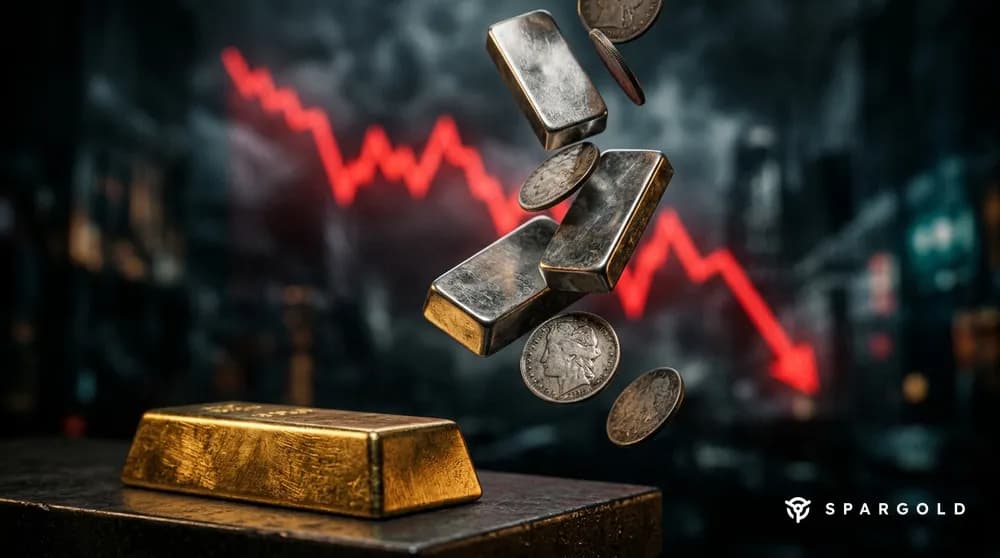
Silver plunged by 4.85 percent to 56.30 USD on October 14, 2026 — the flash crash did not come out of nowhere: US CPI data, rising bond yields, and weaker industrial demand are hitting simultaneously. The metal is now approximately 54 percent away from its all-time high of 121.66 USD. Is it worth buying silver?
Sometimes one day is enough to bring a major question to the table. Silver is falling by nearly 4.85 percent today — and anyone who has kept an eye on precious metals in recent months is asking exactly that: Buy silver now — or is this just the beginning of a further correction?
At 4:25 PM, silver was trading at 56.30 USD per troy ounce — a daily loss of 4.85 percent. In euros, this corresponds to 50.60 EUR, a decrease of 4.22 percent (EUR/USD rate: 1.1126). The decline has three causes that converged on this day.
The US CPI data for September 2026 was released on October 14 and triggered hawkish expectations for the Fed — US bond yields rose. Simultaneously, the US dollar strengthened, making dollar-denominated commodities more expensive for international buyers. Additionally, there are ongoing concerns about industrial silver demand — more on this in the next section.
Silver is not a pure precious metal. Around 60 percent of global annual consumption flows into industrial applications: photovoltaic cells, electric vehicles, semiconductors, AI data centers. This makes silver more reactive than gold — in both directions.
When growth skepticism arises, it hits silver twice: as a precious metal competing with rising interest rates, and as an industrial raw material. Industrial demand in 2025 was around 657 million troy ounces — a 3 percent decrease compared to 2024, partly because solar panel manufacturers are using less and less silver per cell.
| Pressure Factor | Impact on Silver |
|---|---|
| Rising US bond yields | Negative — non-interest-bearing assets lose attractiveness |
| Stronger US dollar | Negative — dollar-denominated commodities become more expensive for foreigners |
| Weaker industrial demand (–3 %) | Negative — silver loses industrial price support |
| Gold-Silver ratio of 73.7 | Historical: Silver is undervalued relative to gold |
With gold at approximately 4,154 USD and silver at 56.30 USD, the gold-silver ratio is 73.7. The historical 50-year average is around 60. Whenever the ratio has been significantly above this level, silver was undervalued relative to gold in historical terms — and periods of convergence toward the average followed.
A ratio of 73.7 does not mean that silver will rise tomorrow. It indicates that, in a historical comparison, silver is currently relatively cheap compared to gold. Whether this is a good time to buy silver depends on whether one believes in a return to a ratio of 60 — and what one's time horizon is.
For comparison: Silver's all-time high was 121.66 USD on January 29, 2026. From the peak to today, this represents a decline of approximately 54 percent.
The triggers on October 14, 2026, were US CPI data, which sparked hawkish expectations for the Fed. Rising bond yields and a stronger dollar weigh on non-interest-bearing commodities. Additionally, there is structural headwind from declining industrial demand — silver reacts more strongly to this combination than gold.
A flash crash typically refers to a rapid movement without a fundamental basis — followed by a recovery. Whether today's decline belongs to this category or marks a further correction is currently unclear. The pressure factors are real and could persist.
The gold-silver ratio of 73.7 is above the historical average — silver is relatively cheap compared to gold. At the same time, there is real short-term headwind: rising US yields and weaker industrial demand. Those who view silver as a long-term addition will find historically favorable levels. Those who trade short-term are buying into a headwind.
More on the gold price and central bank purchases: Military Spending and Gold: Why Armament Supports the Gold Price.
Legal Notice: This article is for informational purposes only and does not constitute investment advice. All information is provided without guarantee. Investments in precious metals and securities involve risks. Please consult an independent financial advisor before making investment decisions.