8.2 Million Germans are Thinking About Emigrating. But Perhaps That is the Wrong Question.

August 31, 2026
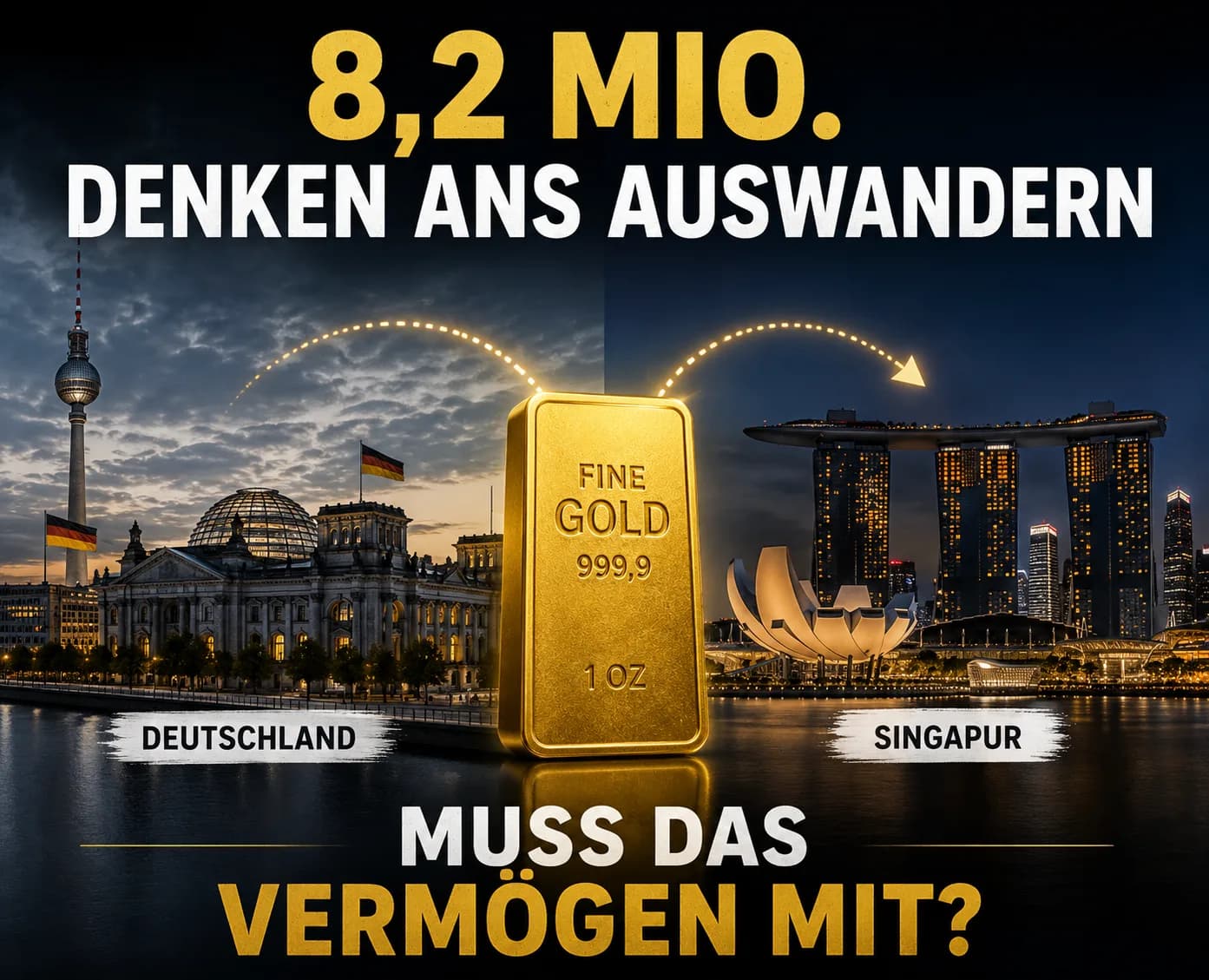
8.2 Million.
This is the number of adult Germans that would mathematically correspond to a current figure from the opinion research institute INSA.
14% of respondents state that they want to emigrate within the next five years.
Among 30- to 39-year-olds, the figure is even:
27%.
That sounds like a wave of emigration.
But is it true?
No.
The figure is an extrapolation from a survey.
14% of approximately 59.2 million adults results in about 8.3 million people.
However, this does not mean that these people will actually pack their bags.
Between the thought of Switzerland and a moving truck to Zurich lie family, workplace, real estate, friends, school, taxes, and a whole lot of bureaucracy.
The actual figures are therefore much smaller.
But they are still remarkable.
This is how many people with German citizenship left Germany in 2025.
At the same time, 191,890 Germans moved back to Germany from abroad.
The bottom line:
−96,689 people.
This means that net emigration of German citizens has increased significantly again compared to 2024.
And it is not a single exceptional year.
Since 2005, Germany has had a negative net migration balance for its own citizens compared to foreign countries.
The statistics are hardly surprising.
In 2025, the main destination countries were:
Switzerland: 23,000
Austria: 14,000
Spain: 10,000
But perhaps we are focusing too much on the people in this discussion.
Because emigrating is a rather radical form of geographical diversification.
There is a much simpler one.
Anyone concerned about political, economic, or monetary policy risks does not necessarily have to relocate their center of life.
You can live in Germany.
Work here.
Have your family here.
Pay taxes here.
And still ask the question:
Does my entire wealth actually have to be located here as well?
This is not an emigration question.
It is a diversification question.
For stocks, diversification is considered a matter of course.
No one would seriously recommend investing an entire stock portfolio in a single company.
We diversify by:
Sectors.
Companies.
Currencies.
Regions.
Asset classes.
But diversification surprisingly often ends at one point:
the jurisdiction.
Portfolio, bank account, real estate, insurance, pension provision, and precious metals can all lie within the same state and regulatory system.
This can be perfectly reasonable.
But it is not geographically diversified.
Gold offers a special feature.
It can be separated geographically relatively easily from the place where its owner lives.
An investor can live in Germany and store physical gold in Singapore, for example.
He does not emigrate.
His gold does.
Of course, risks do not disappear as a result.
They change.
German legal and custody risks are replaced by those of the respective storage country and custodian.
“Everything is safe abroad.”
But rather:
Do not concentrate all risks in one place.
Singapore is one of the major international trading and storage locations for precious metals.
For European investors, this creates an additional dimension of diversification:
Not just gold instead of euros.
Not just tangible assets instead of claims.
But potentially also:
a different custody and legal jurisdiction.
This is a difference that is often underestimated.
Very few of these people will actually leave Germany.
And possibly they don't even have to.
Because between
“I'm staying here”
and
“I'm emigrating”
there exists a large number of possibilities.
One of them is to position assets more internationally.
Not out of fear.
Not as a political demonstration.
But for the same reason that investors distribute their assets across different asset classes:
Diversification.
The perhaps better question is therefore not:
“Should I leave Germany?”
But rather:
“Does my entire wealth really have to be in the same country, the same currency, and the same jurisdiction as I am?”
Stay farsighted
Yours, Helge Peter Ippensen