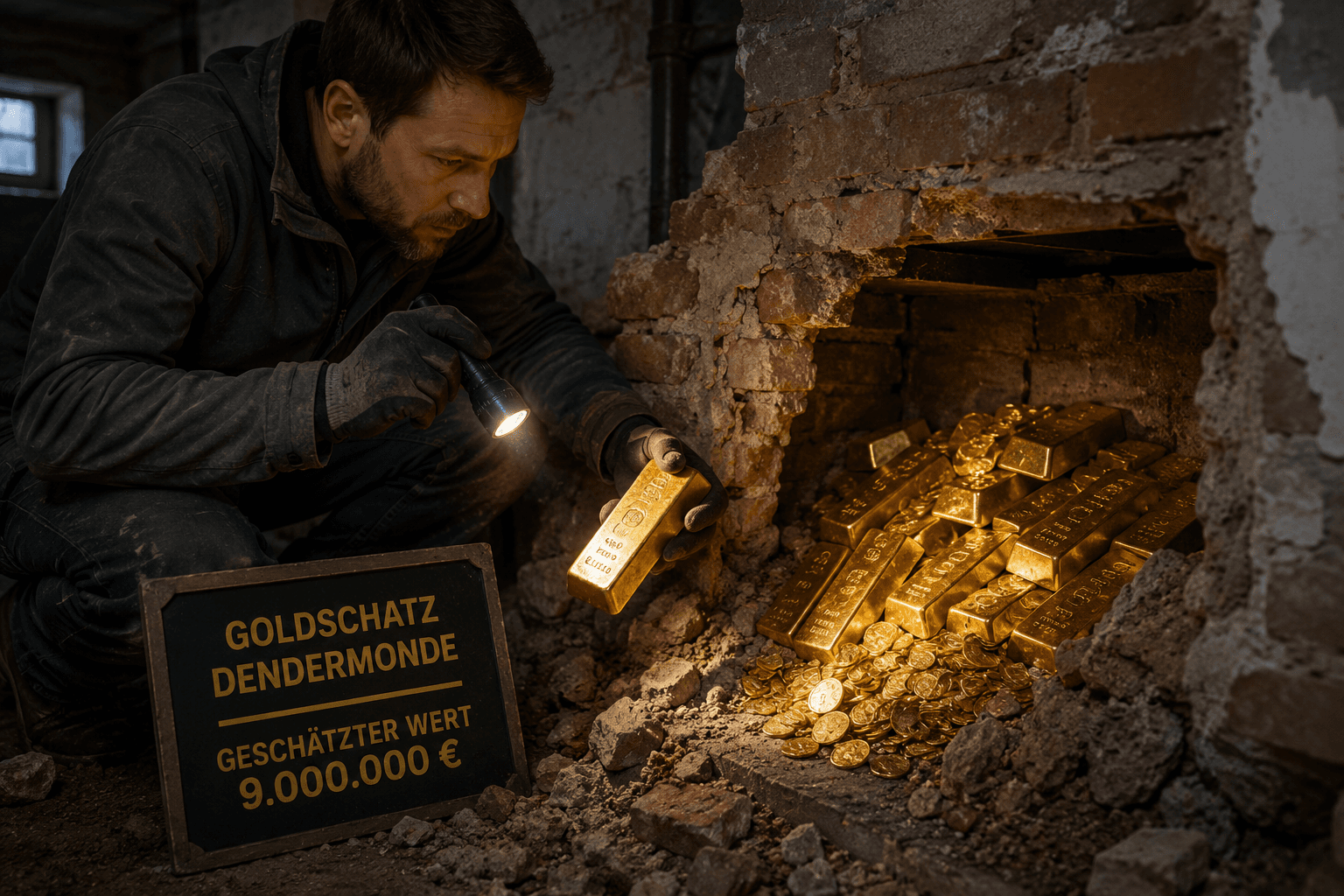
9 million euros, hidden behind a cellar wall: What was discovered during ordinary renovation work in Sint-Gillis-Dendermonde, Belgium, sounds like the beginning of a novel. Construction workers came across a hidden treasure consisting of gold bars and numerous old gold coins. In the meantime, this extraordinary find has occupied the police and the public prosecutor's office – as it remains unclear to whom the gold belongs and how it even got there.
The story is more than a spectacular treasure report. It demonstrates a characteristic of physical gold in an unusually vivid way: a gold bar requires neither an account nor an issuer or a functioning digital infrastructure to endure for decades. Its market value changes – the metal itself remains.
The find occurred during work on a building belonging to the social organization CAW Oost-Vlaanderen in Sint-Gillis-Dendermonde. According to current reports, the gold was discovered in or behind a cellar wall. The find includes gold bars as well as a large number of gold coins. Media outlets estimate the total value at around 9 million euros.
Particularly remarkable is how unspectacularly the discovery began. An 18-year-old seasonal worker named Kobe was involved in the work. After the find, the workers informed the client and subsequently the authorities. The gold was inventoried and taken to a secure location. The public prosecutor's office is now investigating its origin.
Current reports speak of 49 gold bars and numerous coins. Other sources mention more than 40 bars and around 4,000 old gold coins. Until the official inventory and investigations are completed, these quantities should therefore be regarded as preliminary.
| Key Figure | As of August 15, 2026 |
|---|---|
| Estimated value of the find | approx. 9 million € |
| Reported gold bars | approx. 40 to 49 |
| Additionally found | numerous or approx. 4,000 gold coins |
| Location of find | Sint-Gillis-Dendermonde, Belgium |
| Circumstances of find | Renovation/construction work |
| Ownership status | currently unresolved |
It is precisely this question that makes the case so interesting, in addition to the material value. The origin of the gold is currently not clarified. The competent authorities are investigating how the treasure ended up in the cellar wall and whether there is a possible connection to previous illegal activities.
The building also has a long history. According to current reports, the property or the land was formerly owned by a brewing family. Today, the property is used or developed by CAW Oost-Vlaanderen. This raises not only historical but also legal questions.
For this reason, it would be premature to attribute the find to a specific person or organization. The spectacular market value of around 9 million euros is relatively easy to quantify. The question of the rightful owner is likely to be much more complicated.
The find happens to coincide with a phase of exceptionally high gold prices. On August 14, 2026, the spot price was quoted by Reuters at approximately $4,379.95 per troy ounce. US gold futures closed at $4,437.30. A weaker US dollar and expectations that the US Federal Reserve might leave interest rates unchanged in September supported the gold price.
Another current price reading valued gold at $4,371 per troy ounce at 9:00 AM US Eastern Time on August 14. This was $24 more than the previous day and as much as $1,019 more than a year earlier.
This gives the treasure find a second dimension. The bars and coins may have been hidden decades ago. However, their current value in euros is determined by the current world market price.
Paper money can be withdrawn from circulation. Currencies can disappear. Banknotes can lose their status as legal tender through currency reforms. Gold works differently.
A historical gold bar remains, first and foremost, a specific quantity of a physical precious metal. Its price fluctuates significantly and can also fall over longer periods. Nevertheless, gold is internationally tradable and is valued worldwide.
The find in Belgium illustrates this difference quite vividly: a wall is opened, decades-old gold comes to light – and within a short time, a market value can be determined for it based on the current gold price.
This is no guarantee of value appreciation. However, it explains why gold has been used as a form of wealth storage for centuries.
Gold is moving at a historically high price level in mid-August 2026. On August 14, the spot price rose by around 0.7 percent to $4,379.95 per troy ounce, according to Reuters. At the same time, the dollar index fell by about 0.3 percent.
For gold, interest rates and currencies are important influencing factors. Since the precious metal itself yields no ongoing interest, rising real interest rates can reduce its relative attractiveness. Conversely, the prospect of lower or stable interest rates can support gold. Added to this are geopolitical risks, central bank demand, and market participants' confidence in currencies and state finances.
The treasure of Dendermonde is therefore a historical curiosity. However, its value of around 9 million euros is a figure from the year 2026.
Of course, a cellar wall is not a contemporary concept for the storage of significant assets. Rather, the find shows why, in the case of physical gold, storage, ownership documentation, and security are crucial alongside the purchase.
For investors, one distinction is important: the gold price on international markets and the actual acquisition of a specific physical product are not the same thing. For bars and coins, factors such as denomination, minting costs, trading spreads, and availability come into play.
In the case of gold savings, the focus is therefore on physical gold. The decisive factor is not an abstract number on a screen, but clearly attributable precious metal.
The story from Dendermonde is fascinating because it connects two completely different eras. Someone once decided to hide a substantial stock of gold. Decades later, the wall is opened – and the metal still possesses an immediately determinable market value.
The Belgian authorities must clarify who hid the gold, why it was there, and who is ultimately entitled to the approximately 9 million euros.
For investors, however, there is a remarkable thought in the story: the price of gold changes every day. The physical substance behind it remains.
Gold does not have to be new to be valuable today.
Stay farsighted
Yours, Helge Peter Ippensen