Gold Purity and Karats: 585, 750, 333 and 999.9 Gold Explained
Gold purity and karats tell you how much pure gold a piece of jewellery, a coin or a bar contains. To estimate the value of scrap gold, heirlooms or investment gold, you only need this figure, the weight and the current gold price per gram of fine gold.
What does fineness mean?
Fineness, also called purity, describes the share of pure precious metal in the whole alloy. It is given in parts per thousand. A ring hallmarked 585 therefore consists of 585 parts gold out of 1,000; the rest is other metals such as silver, copper or palladium.
These additions are not a flaw. Pure gold is very soft and scratches easily, so harder alloys are common for jewellery that is worn every day. The added metals also determine the colour: more copper produces rose gold, while palladium or silver produce white gold.
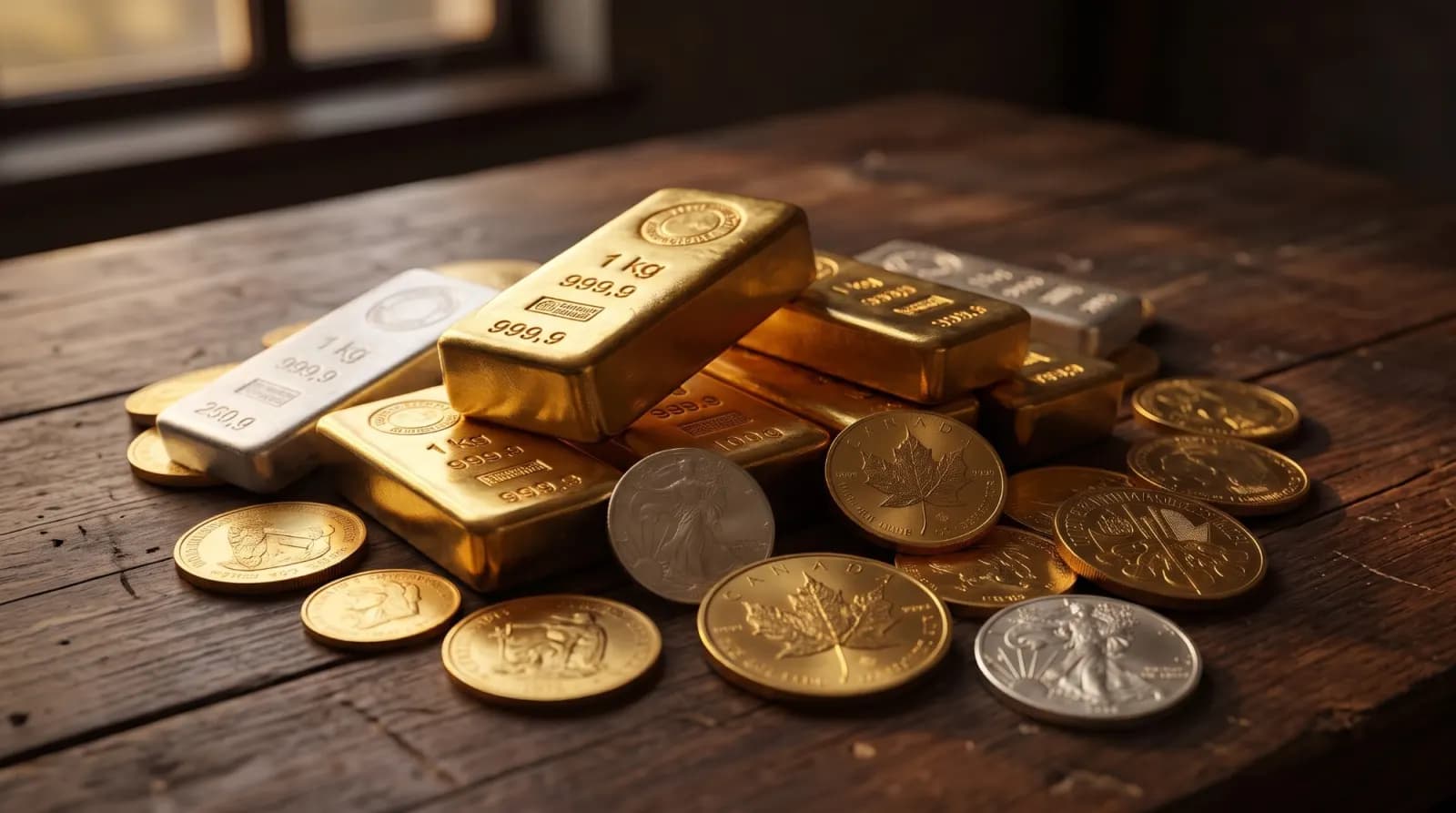
Investment bars and many bullion coins, by contrast, are made of almost pure gold at 999.9 parts per thousand. Here what counts is the metal value, not hardness.
Converting karats to fineness
The karat is the older unit. It divides the whole into 24 parts. 24 karat is pure gold; 18 karat means 18 out of 24 parts, or 75%. The conversion is simple: fineness = karat ÷ 24 × 1,000. The other way round, karat = fineness ÷ 1,000 × 24.
In Germany, jewellery usually carries the parts-per-thousand hallmarks. In many countries in Asia and the Middle East, 21 and 22 karat are common. The well-known bullion coin Krugerrand is also made of 22-karat gold.
| Hallmark | Karat | Gold content | Typical use |
|---|---|---|---|
| 333 | 8 karat | 33.3% | low-cost jewellery in Germany |
| 375 | 9 karat | 37.5% | jewellery, e.g. in the UK |
| 585 | 14 karat | 58.5% | common everyday jewellery |
| 750 | 18 karat | 75.0% | high-quality jewellery, watches |
| 875 | 21 karat | 87.5% | jewellery in the Middle East |
| 916 | 22 karat | 91.6% | jewellery in Asia, Krugerrand (916.7) |
| 999.9 | 24 karat | 99.99% | investment bars, many bullion coins |
How much is 585 gold worth per gram?
The material value depends on three things: weight, fineness and the gold price per gram of fine gold. The formula is: weight in grams × fineness ÷ 1,000 × gold price per gram.
An example with an assumed gold price of €120 per gram of fine gold: one gram of 585 gold contains 0.585 g of fine gold and so has a material value of €70.20. For 750 gold, i.e. 18 karat, it is €90.00; for 333 gold, €39.96. For 21 karat (875) the result is €105.00, for 22 karat (916) €109.92. For a real calculation, use the current daily price.
Dealers’ buying prices are below this material value. Scrap gold has to be melted down and refined, and the dealer factors in costs and a margin. So compare several offers and ask which gold price and which discount they are based on.
Why 585 and not 583?
Mathematically, 14 karat equals exactly 583.3 parts per thousand. Yet the hallmark is 585. It is deliberately set slightly above the calculated value so that the alloy reliably reaches the stated gold content. The same applies to 333 gold: 8 karat works out at 333.3 parts per thousand.
For valuation, use the hallmarked figure. For heirlooms without a legible hallmark, a dealer or goldsmith can determine the fineness with testing acid or an X-ray fluorescence device.
Purity of investment gold
For bars to count as VAT-exempt investment gold in Germany, § 25c UStG (German VAT Act) requires a fineness of at least 995 parts per thousand. Gold coins must reach at least 900 parts per thousand and meet further conditions. Jewellery is never investment gold, even if it is made of 750 or 999 gold.
In the wholesale market, the standard of the London Bullion Market Association applies: a Good Delivery bar must also contain at least 995 parts per thousand gold. Smaller investment bars for private customers usually have 999.9 parts per thousand.