US-Iran Peace Agreement: Why Oil is Falling, Stocks are Rising, and Gold Remains in Demand

June 15, 2026
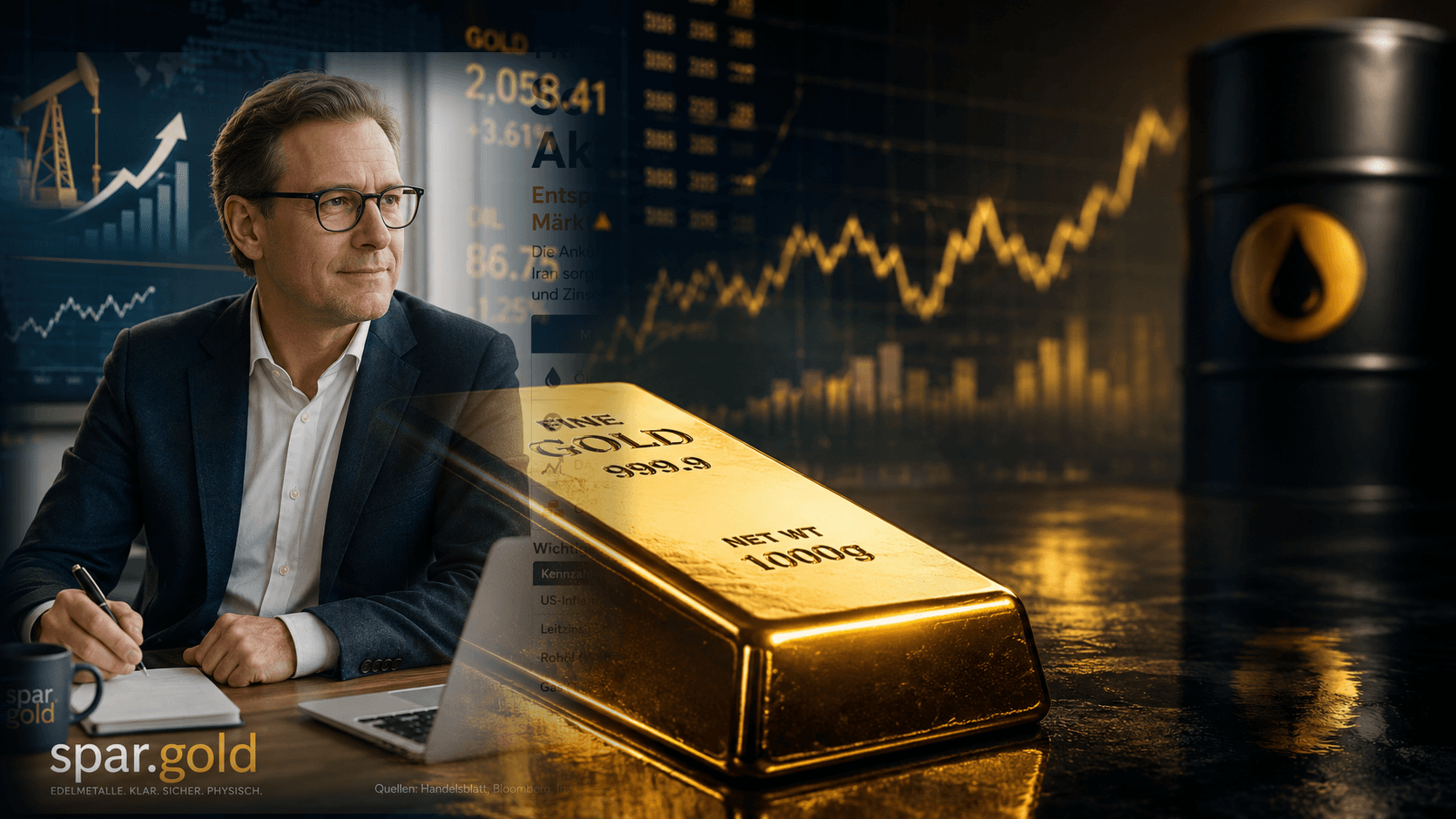
The announced peace agreement between the US and Iran has triggered a significant reassessment in the financial markets. Following the uploaded Handelsblatt excerpts, oil, interest rates, stocks, and gold reacted immediately to the prospect that the Strait of Hormuz could be reopened. What is particularly striking is not only the direction of the price movements but also their breadth: energy prices declined, bond yields fell, stock markets gained – and gold rose as well.
Reuters reported on June 15, 2026, that Brent fell by around five percent to approximately 82.94 US dollars per barrel as a result of the preliminary agreement, while WTI dropped to around 80.26 US dollars. At the same time, the situation remains not fully resolved, as the return of normal oil flows through the Strait of Hormuz may take weeks to months according to the report's assessment.
The most important lever lies in energy supply. The Strait of Hormuz is one of the central bottlenecks of global oil trade. The screenshots refer to the fact that before the start of the war, about one-fifth of the oil traded worldwide was transported through this waterway, which is only about 33 kilometers wide. As soon as the market prices in a higher probability of this route reopening, the risk premium in the oil price decreases.
The effect is immediately visible. In the available photos, Brent is shown at 82.91 US dollars per barrel as of June 14, 2026. Handelsblatt also describes a decline of nearly five percent. European natural gas also gave way significantly at times. This is relevant for consumers, companies, and central banks because energy prices are a major driver of inflation.
| Market segment | Observation from the photos and current reports | Possible market significance |
|---|---|---|
| Brent Oil | around 82.91 to 82.94 US dollars per barrel, about five percent lower | declining geopolitical risk premium |
| WTI Oil | around 80 US dollars per barrel | easing of US energy prices |
| European Gas | around 44 euros per megawatt hour in the photos | lower inflationary pressure |
| DAX | 24,951.29 points, plus 1.28 percent in the photos | risk appetite returns |
| Gold | 4,293.70 US dollars on June 14 in the photos; 4,337.11 US dollars were recently displayed | gold remains in demand despite de-escalation |
Falling energy prices also change the perspective on interest rate policy. When oil and gas become cheaper, inflationary pressure can subside. This is precisely what is crucial for the major central banks, as they must weigh how much they want to slow down the economy with high key interest rates.
The photos describe that the yield on ten-year US Treasuries fell to 4.44 percent. Ten-year Bunds were cited at 2.96 percent. This fits the typical pattern: when investors expect lower inflation risks or price in a less aggressive interest rate policy, bond prices rise and yields fall.
This is initially positive for stocks. Lower yields reduce financing costs and increase the relative appeal of future corporate profits. Interest-rate-sensitive technology stocks, in particular, can benefit from this. Reuters reported on June 15, 2026, that the European Stoxx 600 rose to a record high and the DAX was among the stronger European indices.
Stock markets reacted with relief to the prospect of peace. The screenshots describe a particularly strong increase for Asia, while Europe also made significant gains. According to the photo, the DAX temporarily crossed the 25,000-point mark and approached its record high. In the US, futures on the S&P 500, Nasdaq 100, and Dow Jones also signaled gains.
The logic behind this is understandable: less geopolitical tension means lower energy price risks, fewer inflation concerns, and more room for maneuver for companies. Oil-importing economies benefit in particular, as falling energy prices can relieve their trade balance and purchasing power.
At the same time, caution remains advised. A preliminary agreement is not yet a stable reorganization of the region. According to Reuters, further negotiations are to take place during a 60-day ceasefire; open questions such as sanctions, the nuclear program, and the actual resumption of oil flows remain crucial for the markets.
At first glance, it seems contradictory: if the geopolitical situation becomes more relaxed, gold, as a crisis metal, should actually come under pressure. However, the photos show the opposite. The gold price rose by more than three percent; a troy ounce was reported at 4,293.70 US dollars on June 14. Current data from finanzen.net recently even showed 4,337.11 US dollars per troy ounce.
The reason lies in the second market logic. Gold yields no interest and therefore competes particularly strongly with bonds and money market investments. When yields fall and the dollar weakens, the framework conditions for gold improve. Then gold can rise, even though acute crisis demand should actually decrease.
This is precisely the central insight for investors: gold does not only react to fear. It also reacts to real interest rates, currencies, liquidity, and confidence in monetary policy. This makes gold a special building block in the financial system, but not a short-term safe bet. Anyone looking at gold should therefore not only read headlines but also keep an eye on interest rates, the dollar, and physical availability.
The peace agreement shows how quickly markets reassess expectations. Oil does not fall because energy demand disappears, but because part of the geopolitical risk premium leaves the price. Stocks do not rise because all problems are solved, but because the market expects less inflation and interest rate pressure in the short term. Gold does not necessarily rise because of fear, but often because of falling yields and a weaker dollar.
For savings gold, this differentiation is exactly what matters. The price is only a signal. What is decisive is what lies behind it: real demand, available goods, supply chains, the interest rate environment, and confidence in the stability of the monetary system. Especially in volatile market phases, gold should not be understood as a speculation on headlines, but as a long-term tangible asset with its own function in wealth accumulation.
The peace signal from the Middle East can bring short-term relief. However, it does not change the fact that the world economy continues to be characterized by geopolitical bottlenecks, high national debt, monetary policy uncertainty, and fluctuating currencies. In this environment, physical gold remains an instrument of hedging for many investors, not of euphoria.
Stay farsighted
Yours, Helge Peter Ippensen