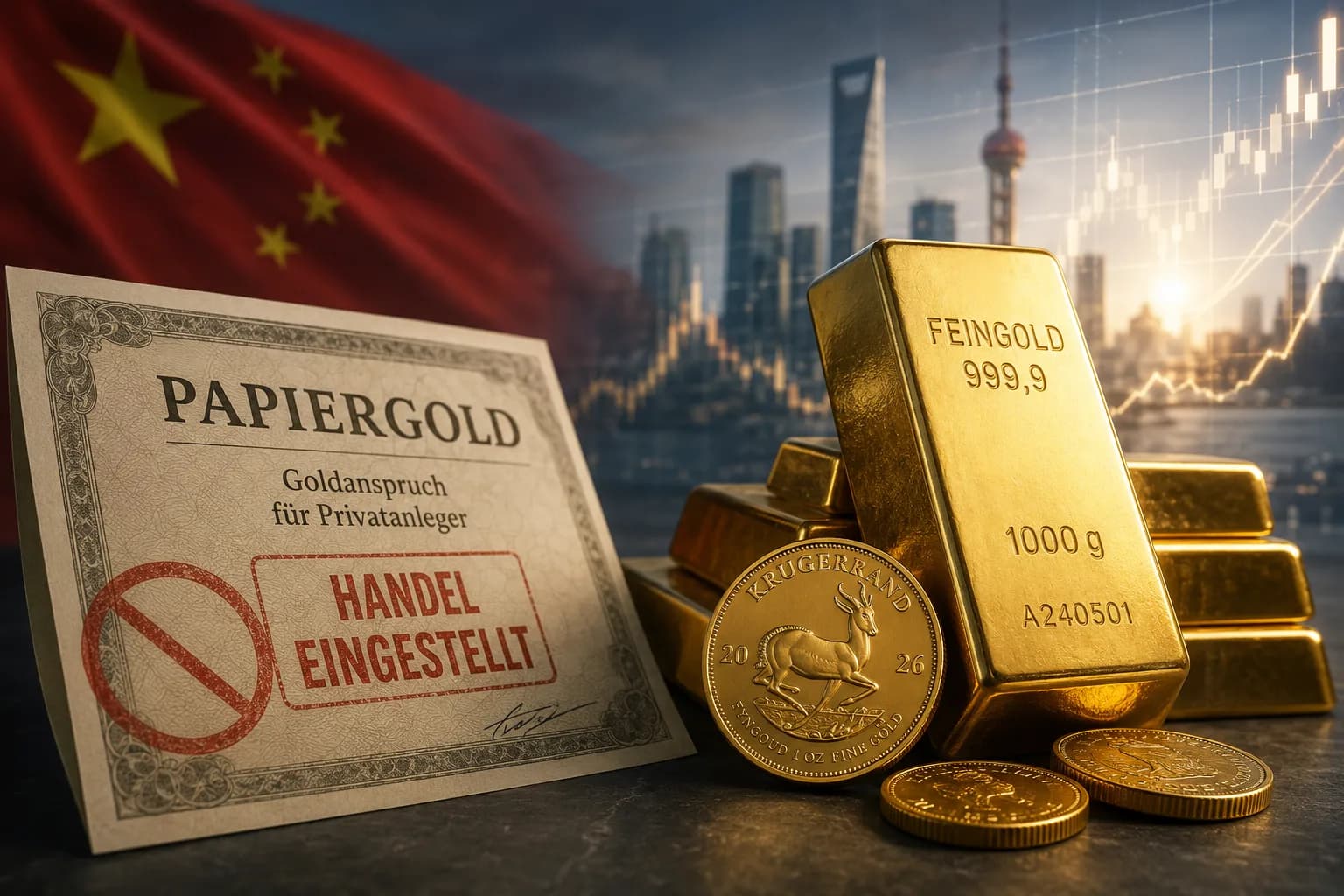
China has taken a remarkable step: several major banks have ceased trading in certain paper-based gold products for private clients. Existing positions must be closed or – where provided for – delivered in physical gold.
At first glance, this seems like a side note.
In fact, however, this development could point to a more fundamental shift.
Many investors equate gold with paper gold. In reality, however, there are significant differences.
Paper gold allows participation in gold price movements without necessarily having concrete ownership of a gold bar.
Physical gold, on the other hand, means direct ownership of a real, existing precious metal.
Especially in times of geopolitical uncertainty or increased demand, this difference can gain importance.
It is important to contextualize this:
China has not banned gold ownership.
Physical gold trading also remains possible.
Certain paper gold products for private investors have been restricted.
This differentiation is important because it significantly changes the assessment of current developments.
Should more investors prefer physical gold over paper-based products in the future, this could have several consequences:
Whether this will lead to permanently rising gold prices, no one can seriously predict today.
The gold price continues to depend on numerous factors – including interest rate policy, the development of the US dollar, central bank purchases, and global investment demand.
In parallel, China continues to invest in the expansion of its infrastructure for physical gold trading.
Regardless of short-term market movements, a trend is emerging:
The infrastructure surrounding physical gold is becoming increasingly important.
For long-term oriented investors, a fundamental question therefore arises:
Do I merely want to possess a claim on gold – or actual ownership of physical gold?
This question is likely to be more important in the long term than many short-term price fluctuations.
Perhaps that is the actual message of this development: those who wish to protect wealth permanently should not only pay attention to the price of an asset, but also to the quality of the ownership behind it.
Stay farsighted.
Yours, Helge Peter Ippensen