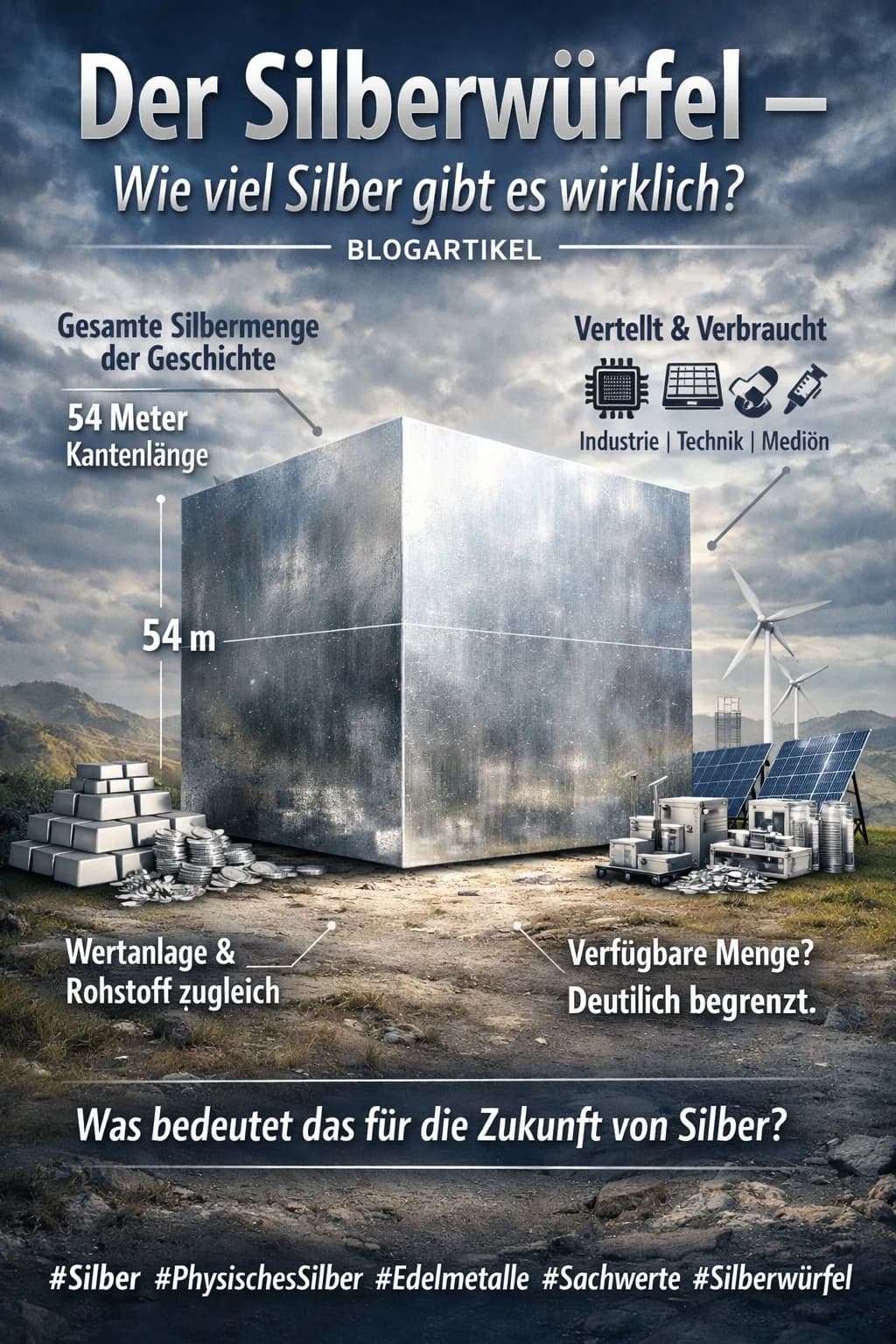
If one imagines all the silver that humanity has ever extracted from the earth and casts it into a single body, a cube with an edge length of approximately 54 meters is created.
A single object.
Manageable.
Almost reassuring.
Yet this cube exists only in our imagination.
In reality, silver is not concentrated, but widely dispersed:
as coins and bars in vaults, but primarily in technical applications – in electronics, medicine, solar energy, batteries, water treatment, and many other areas.
A significant portion of this silver is:
permanently integrated,
worn out through use,
or can only be recovered with high technical and economic effort.
Silver thus partially disappears permanently from the available stock.
Silver occupies a special role among precious metals.
It is both a store of value and an industrial raw material.
While gold is almost exclusively hoarded, silver is consumed.
It does not circulate indefinitely – a portion of it is lost.
This is precisely where the decisive difference lies.
The conceptual silver cube brings a central truth to light:
The total amount of mined silver appears large.
The actually available quantity is not.
The more silver is used industrially, the scarcer the portion that remains available as a physical investment becomes.
The silver cube is not an argument, but a mental model.
It marks the starting point for a larger question:
What does this particular scarcity mean for silver as a physical investment?
The next posts will address exactly this –
and why silver should not be viewed in isolation, but always in the context of usage, availability, and other tangible assets.