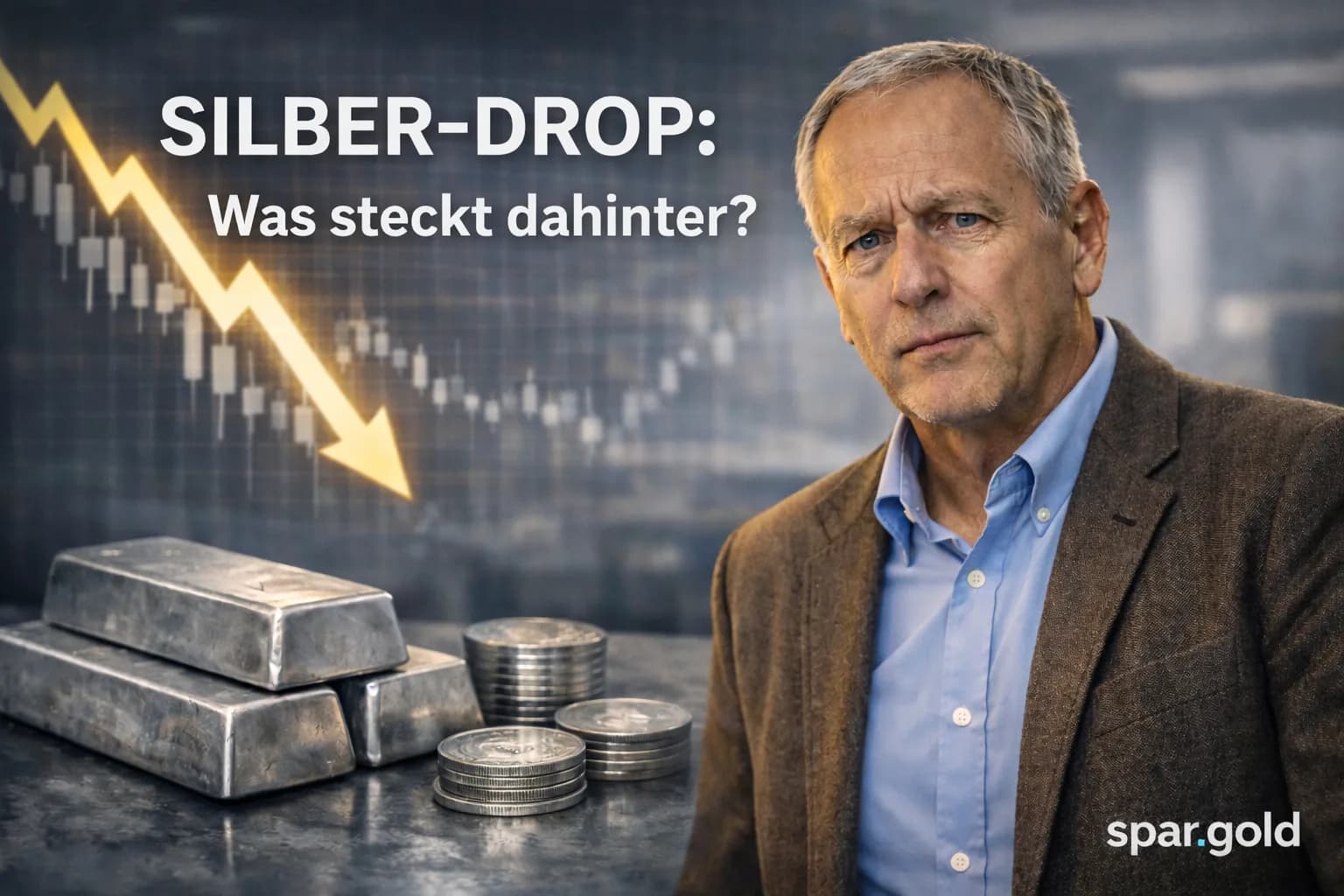
On January 30, 2026, silver experienced one of the most volatile trading days in its recent history. According to Reuters, the spot price plummeted by 27.7% to 83.99 US dollars per troy ounce, after silver had previously marked a record high of 121.64 US dollars.
Kitco shows an extreme trading range of 73.67 to 118.58 US dollars for the same day.
The decisive factor in such movements is not the headline "Silver Crashes," but the interplay of macro momentum, market structure, and positioning. The drop was less a single trigger than a chain reaction.
The immediate impulse came from Washington. Reuters reports that the announcement by Donald Trump to nominate Kevin Warsh as the future Fed Chair shocked the markets and supported the US dollar; the dollar index was accordingly at +0.7%.
For precious metals, a stronger dollar is often a headwind because they are quoted in US dollars and capital flows can quickly shift toward cash and short-term interest rates.
The context was already tense: After a parabolic rally, a "new signal" is often enough to abruptly realign expectations. This was observed on the same day not only in silver but also in gold, which, according to Reuters, fell by 9.5% to 4,883.62 US dollars, after marking a record high of 5,594.82 US dollars the previous day.
The severity of the slump is primarily explained by market mechanics. After strong gains, many market participants hold leveraged positions that are automatically reduced during rapid counter-movements as margins rise and stops are triggered. The Financial Times classifies the day as the abrupt end of an extreme rally and speaks of a record-breaking one-day movement in silver.
Silver is particularly susceptible to this because it more frequently trades "risk-on / risk-off" compared to gold: It can rise disproportionately during upward phases but also turns faster and deeper in moments of stress. This is exactly what was observed on Jan 30.
The silver drop can be broken down into three precise mechanics: First, the macroeconomic trigger via the dollar and interest rate expectations; second, the unwinding of positions after overheating; third, the technical acceleration via volatility and liquidity, which can deteriorate abruptly during strong movements. In its daily commentary, Kitco also stated that after an "explosive" rally, a correction had essentially become inevitable and the speed surprised the markets.
| Observation (Jan 30, 2026) | Figure/Range | Classification |
|---|---|---|
| Silver Daily Loss | −27.7% to 83.99 USD/oz | Rapid Revaluation + Position Unwinding |
| Silver Daily Range | 73.67–118.58 USD/oz | Extremely High Volatility, Thinner Liquidity |
| Dollar Index | +0.7% | Dollar Tailwinds Weigh on Precious Metals |
| Previous Record High | 121.64 USD/oz | Parabolic Phase, Susceptible to Profit-Taking |
Many reflexively interpret daily movements as a "new fundamental truth." In practice, such days are often the opposite: an indication that price formation is dominated in the short term by positioning, liquidity, and shifts in expectations. Fundamentals rarely change entirely in a single trading day – but the risk profile and market psychology change instantly.
Those who view silver as a strategic allocation read two main things from such a drop: First, that silver is significantly more volatile compared to gold. Second, that a strong trend can flip in either direction as soon as a trigger changes the expectation landscape.
On Jan 30, 2026, many factors converged: a political-monetary impulse, a stronger dollar, profit-taking after record highs, and technical acceleration via volatility. The result was a historic daily slide. Anyone wishing to classify such days should look less for a single "story" and instead examine which mechanics are currently dominating.
Stay farsighted
Yours, Helge Peter Ippensen