Safe Deposit Box Burglaries in Stuhr and Wilhelmshaven: When "In the Vault" Suddenly No Longer Means "Safe"

February 17, 2026
14 opened safe deposit boxes in Stuhr, a targeted attack in Wilhelmshaven, plus the still-echoing mega-case in Gelsenkirchen: In just a few weeks, several crimes have come to light where the target was not the teller area, but the vault itself. This is changing the perception of many people who deliberately moved valuables, documents, or precious metals out of their own homes and stored them „at the bank.“
In Stuhr near Bremen, according to investigation reports, perpetrators entered the basement of a Volksbank branch via a light well on Friday afternoon and opened 14 safe deposit boxes. The branch has a total of more than 700 safe deposit boxes; thus, only a small portion was affected, but the symbolism is significant: access to the actual secure room was successful. Reports indicate three perpetrators who may have been wearing blue overalls; the police are requesting information from the surrounding area, among other things.
Wilhelmshaven has been in focus since the end of January: there, safe deposit boxes in the lower double-digit range, i.e., under 50, were broken into at a Sparkasse branch. Whether and to what extent loot was taken was initially left open in the reports – a circumstance that is frequently the case with safe deposit boxes due to the system, as banks do not document contents.
Classic bank robberies are about cash and a quick escape. With safe deposit box crimes, the calculation is different: high values, less direct confrontation, and the hope that the actual contents are difficult to prove. Recent cases also show that perpetrators do not necessarily have to use „brute force.“ In Stuhr, media reports of a professional approach in which several security layers were overcome without a direct encounter with employees.
The Gelsenkirchen case underlines that such acts are not isolated incidents: there, around 3,100 safe deposit boxes were broken into at a Sparkasse branch at the end of December; investigators are now recording and cataloging tens of thousands of items and speak of damages in the mid double-digit million range, possibly higher. As of early/mid-February 2026, it is reported that there is still no „hot lead.“
Perhaps the most unpleasant point is not just the burglary itself, but what follows. With safe deposit boxes, the content is of a private nature. Banks generally do not know what has been stored and are not allowed to simply ask or document it. This is precisely why the amount of loot in Stuhr remains publicly unclear, and the extent was also initially open in Wilhelmshaven.
For customers, this means: after an incident, what can be proven counts very quickly. Invoices, photos, certificates, serial numbers, purchase receipts, or previous inventory lists can be decisive – not as a „guarantee,“ but as a basis to present one's own loss plausibly at all. At the same time, the question of insurance arises: reports on the Stuhr case point out that those affected often have to take care of insurance coverage themselves, for example via special safe deposit box insurance or solutions within the framework of household insurance.
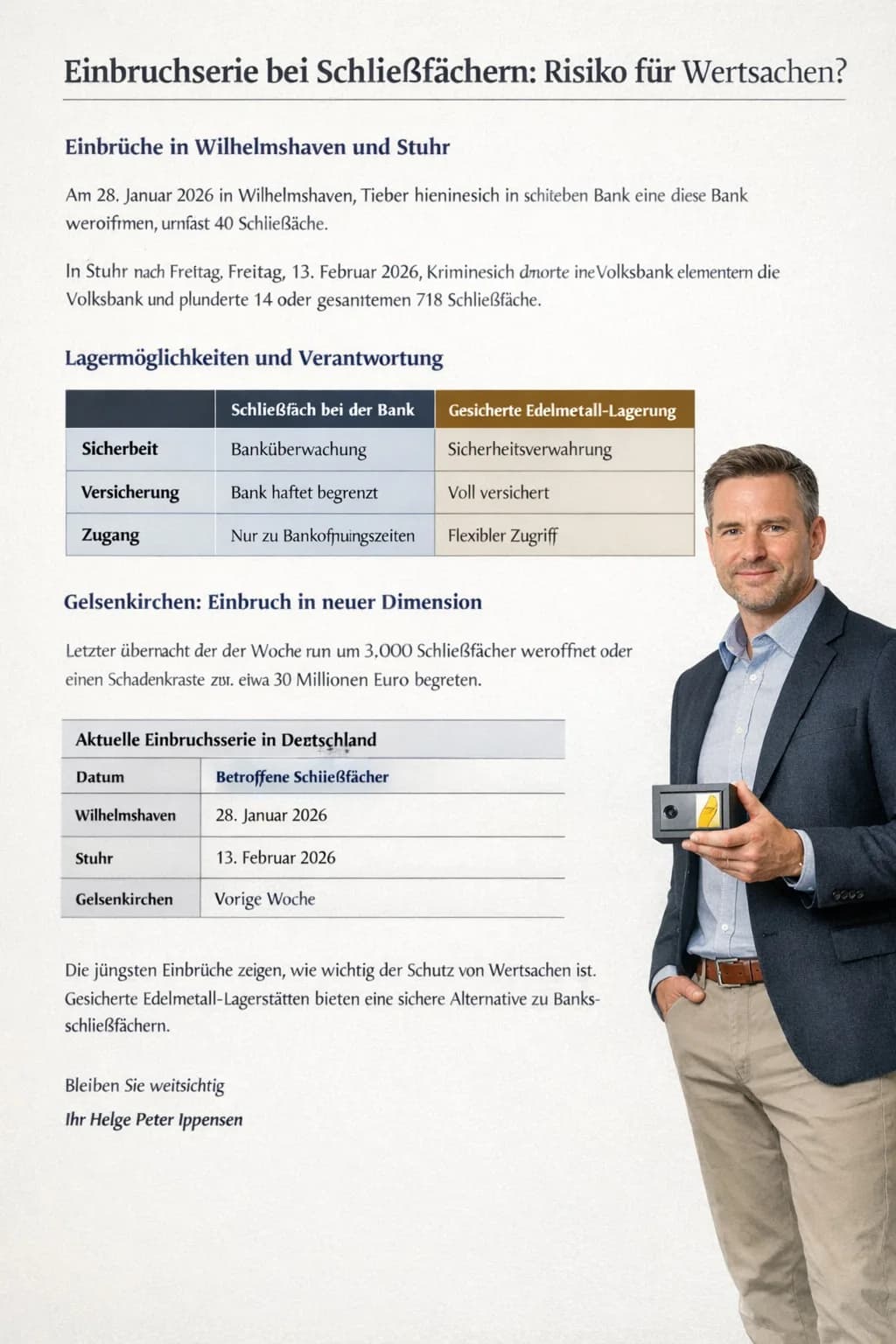
| Location | Date/Period (became known) | Bank/Environment | Affected Safe Deposit Boxes (reported) | Special Features according to reports |
|---|---|---|---|---|
| Stuhr (near Bremen) | Fri, Feb 13, 2026 (Reports Feb 13–16) | Volksbank branch | 14 (partly 13 also reported) | Entry via light well, indications of 3 perpetrators, possible overalls |
| Wilhelmshaven | Jan 28, 2026 (Reports end of Jan) | Sparkasse branch | under 50 | Break-in in the lower double-digit range, loot initially unclear |
| Gelsenkirchen | End of Dec 2025, updates until Feb 13, 2026 | Sparkasse branch | approx. 3,100 | Breakthrough into vault area, damage: mid double-digit million range possible higher, investigations without breakthrough |
Safe deposit boxes remain a sensible component for many people. But the assumption „Bank = automatically maximum security“ is placed in a more realistic context by such incidents. Those who hold physical assets today often think in three dimensions: access, verifiability, and risk diversification. This is exactly where the crucial questions arise in practice: How quickly can I access my assets in an emergency? How well can I prove ownership? And how do I distribute storage locations so that a single event does not affect everything?
Especially with precious metals, an additional point comes into play: the value is not only nominal but also depends on condition, denomination, and documentation. Anyone storing coins or bars should ensure, regardless of the storage location, that receipts are stored in a structured manner and that the pieces remain clearly attributable.
| Criterion | Bank Safe Deposit Box | At Home (Safe) | Professional Storage (Precious Metal/Value Depository) |
|---|---|---|---|
| Access | Tied to opening hours | Anytime, but at own risk | Model-dependent (processes/legitimation) |
| Transparency/Proof | Content not documented | Own proof possible | Mostly documented storage/process proofs |
| Main Risk | Targeted vault room method | Burglary/theft, notoriety | Dependence on provider/process quality |
| Insurance | To be clarified individually | To be clarified individually | Frequently integrated policies/coverage concepts (subject to conditions) |
Important: There is no „perfect“ solution, only one that fits your own security profile. Anyone dealing with this topic should think less about the location and more about the mechanics: How likely is access by third parties, how great would the damage be, and how well can I prove what is gone in the event of an emergency?
At spargold, trust in physical assets is always linked to a clear principle: transparent processes and real, verifiable holdings instead of mere promises. This is not a substitute for personal security decisions, but a useful benchmark for evaluating storage in the first place.
Stay farsighted
Yours, Helge Peter Ippensen