Is the Euro (Theoretically) Gold-Backed? What the ECB Balance Sheet Really Reveals

February 21, 2026
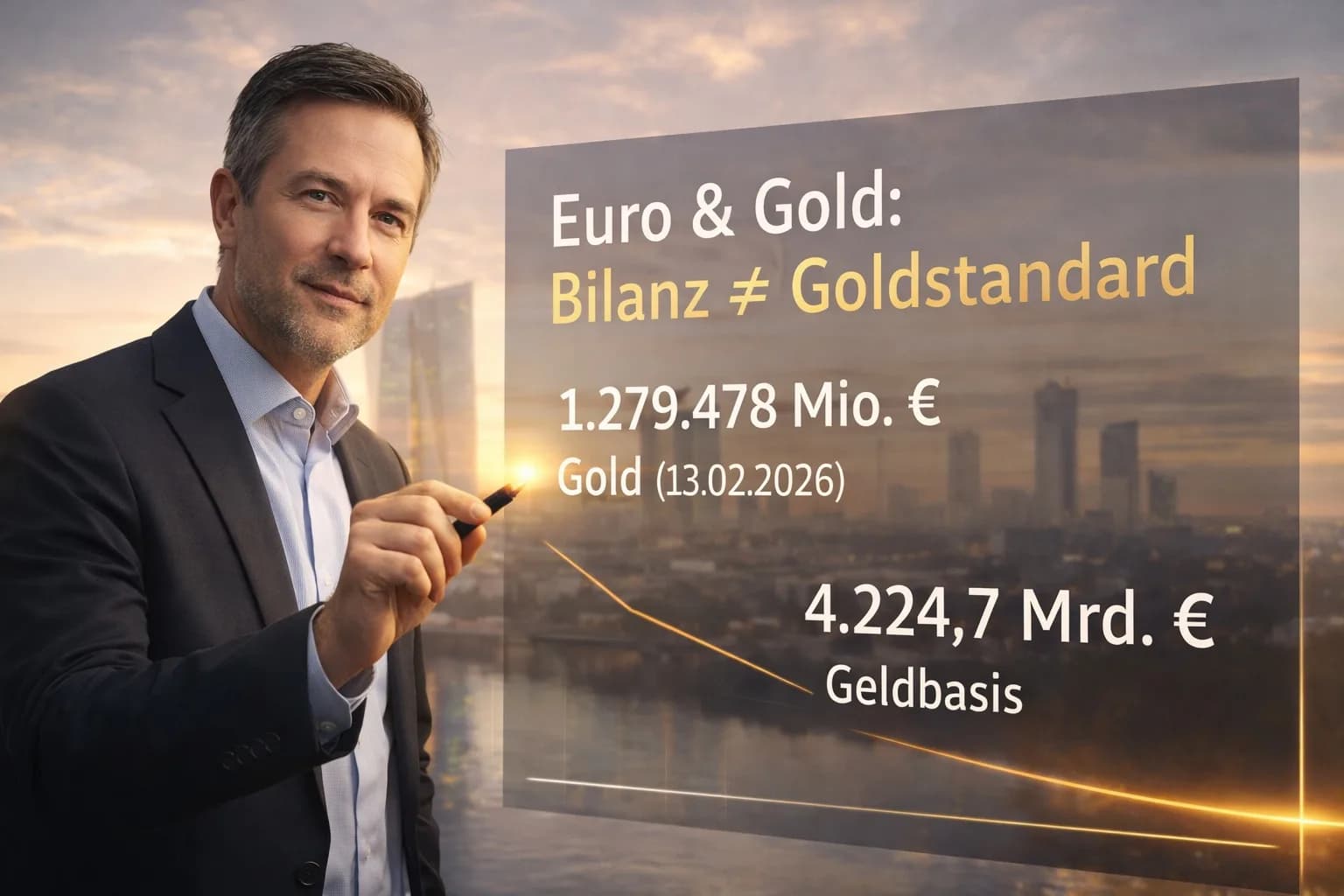
As of February 13, 2026, the consolidated financial statement of the Eurosystem lists under "Gold and gold receivables" a balance of €1,279,478 million. This is an enormous sum – and precisely the material from which the question arises: If the central bank holds gold, is the Euro then at least "a little bit" gold-backed?
The intuitive expectation is often that gold on the central bank balance sheet must automatically mean that a fixed value anchor stands "behind" the currency. The reality is more sober: The Euro is not convertible into gold, and there is no mechanism that directly links the money supply or lending to gold holdings. In the Eurosystem, gold is primarily a reserve and confidence asset – but not a redemption commitment.
Under a classical gold standard, it was crucial that banknotes or central bank money could be redeemed at a fixed rate for gold. This effectively limited money creation through gold inflows and outflows. This very constraint is missing in the modern fiat system: Gold is held, but not as "cash on hand" from which citizens or banks could exchange Euros for gold.
Nevertheless, it is worth looking at the balance sheet logic because it allows for another, more exciting question: How large is the gold block in relation to the narrow money supply? Not as a promise, but as a ratio.
For a "theoretical" coverage ratio, the value of the gold position is often compared to the money supply, typically M1 (currency in circulation plus overnight deposits). As a current orientation, one can use the most recently published figure for M1: €11,087,922 million (December 2025).
We know the gold value from the statement (€1,279,478 million). To derive an illustrative figure from this, one can additionally use a current market anchor: 1 g gold ~ €140.50 (spot-related reference value). From this, one can even roughly derive which quantity of gold corresponds to this balance sheet valuation.
| Metric (Current Status) | Value |
|---|---|
| Gold and gold receivables (Eurosystem, 13.02.2026) | €1,279,478 million |
| M1 money supply (Euro area, Dec. 2025) | €11,087,922 million |
| Theoretical ratio Gold value / M1 | approx. 11.5% (purely mathematical) |
| Derived gold quantity at €140.50/g | approx. 9,107 t (rough approximation) |
| "Gold per €1,000 M1" (theoretical) | approx. 0.82 g |
These figures are intentionally to be read as a theoretical relation. They do not mean that €1,000 today is "backed by 0.82 g of gold," because no one can claim these 0.82 g. But they show: Even a very large gold block on the central bank balance sheet is comparatively small in relation to the modern money supply.
Many expect that if gold prices rise, the coverage ratio must automatically increase. In practice, the opposite often happens – and this is the central mechanism of misconception:
The expectation: Gold becomes more valuable, so the currency is "more stably backed."
The reality: Money supply and deposits can grow faster than the valued gold block – the ratio falls.
Especially after crisis phases or in long periods of low interest rates, the banking system has built up deposits while central banks have worked with liquidity, bond holdings, and refinancing operations. Even if gold increases in price, M1 can grow more dynamically and dilute the ratio.
Gold on the balance sheet does not act as a mechanical brake on monetary policy. It acts more in three indirect ways.
First, gold is a balance sheet buffer. If the gold price rises, valuation reserves increase; this can support the appearance of strength and crisis resilience without a single Euro being "redeemed."
Second, gold is a confidence signal, especially in geopolitically turbulent times. It is documented that central banks worldwide have been accumulating gold for years: The ECB itself points out that central banks bought more than 1,000 tonnes in 2024 and that global holdings stand at around 36,000 tonnes. At the same time, recent market reports also show phases where purchases cool down again – for instance, with reported net central bank purchases of 863.3 tonnes in 2025. The point is: Gold remains highly relevant politically and psychologically – even without a gold standard.
Third, gold is a reserve diversification against currency and sanction risks. This motivation is no longer a secret but part of the public debate.
The appeal of a gold standard lies in the hope for "discipline": less arbitrary money expansion, less inflation. But this simplicity is paid for with less flexibility in crises, a weaker lender-of-last-resort function, and potentially stronger deflationary risks if money demand increases but the gold supply does not grow in tandem.
This is also why the current monetary policy reality is different: The ECB steers via interest rates, liquidity, and expectations, while inflation and the economy remain the pace-setters. In the latest ECB Economic Bulletin, for example, an inflation rate of 1.7% is cited for January 2026 – a value that shows how much the target system today discusses price stability and transmission, not redemption parities.
If one understands "gold backing" as a promise of redemption, the answer is clear: The Euro is not gold-backed. If one views "gold backing" as a balance sheet ratio, the question is meaningful – and the calculation instructive: The gold block is large, but M1 is larger. No automatism for monetary policy follows from this, but it provides a good look at an underestimated asset in the engine room of the currency.
Stay farsighted
Yours, Helge Peter Ippensen