India Opens Credit Market for Silver – A New Chapter for Tangible Assets

December 22, 2025
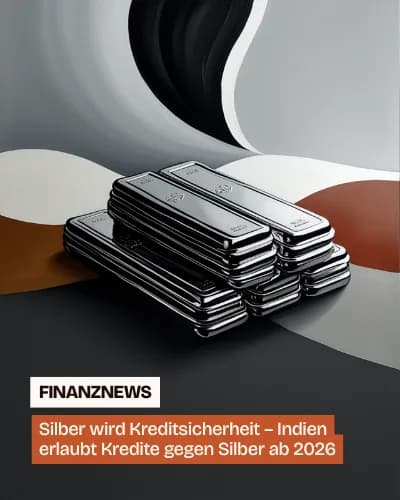
India has taken an important financial step that significantly strengthens the role of silver in the credit and financial system. From April 1, 2026, borrowers at banks and financial institutions will be allowed to use not only gold but also silver as collateral for loans.
According to the new guidelines of the Reserve Bank of India (RBI) ("Lending Against Gold and Silver Collateral Directions, 2025"), individuals and companies can:
Silver in the form of jewelry or coins as collateral
for loans at commercial banks, cooperative banks, and NBFCs
This was already common practice for gold; now silver is officially recognized.
In this context, clear weight limits apply:
a maximum of 10 kg of silver in the form of jewelry for a loan
a maximum of 500 g of silver in coins
for comparison: up to 1 kg of gold as jewelry can also be pledged.
These rules are intended to standardize the silver credit market, create transparency, and offer borrowers more access to liquidity.
Many reports claim that India has "fixed" or even "valued" silver at a ratio of 10 kg to 1 kg of gold. This is not correct.
📌 The fact is:
The RBI rules merely set permissible maximum weights as collateral:
10 kg of silver for a loan
1 kg of gold for a loan
On paper, this creates an indirect reference point that approaches a gold-silver ratio of 10:1, but it is not an official price fixing by the state.
👉 This means:
The RBI has not legally fixed the value of silver relative to gold.
Prices for gold and silver will continue to be determined freely by the market.
This rule refers only to permissible collateral amounts in the lending business.
However, this creates psychologically a kind of benchmark because borrowers and lenders have, for the first time, formally compared how much silver is needed to secure a certain loan amount in a similar way to gold.
Although there is no state-fixed ratio, the RBI rule has a significant signaling effect:
Silver is being systematically made usable in the banking sector for the first time, similar to gold. This strengthens the status of silver beyond pure jewelry or industrial use.
Because loan comparisons are often made based on the amount of collateral, an impression of a gold-silver benchmark is created in the media and among market participants – which, however, does not count as a legal price ratio.
India is one of the world's largest consumers of silver (private households + industry), which makes this decision particularly relevant.
The RBI reform shows that countries with high material demand for precious metals are investing in tangible assets like silver and assigning them a financial function. This psychologically and economically strengthens interest in physical precious metals as a liquidity and tangible asset reserve.
This is where VAT-free silver investment at Spargold comes into play:
In regular trade, 19% VAT is often incurred when buying silver.
At Spargold, you can buy and store silver VAT-free – a major structural advantage over traditional purchases.
This makes silver investment more efficient and better comparable with established tangible assets like gold.
India's step underlines: Physical precious metals are gaining financial importance – even beyond traditional forms of investment. For investors in Europe, this is an additional argument for a diversified, tangible-asset-oriented strategy in which silver can play a role alongside gold.
From April 2026, India will officially allow silver as a loan collateral metal – a historic step for the role of silver in the financial system.
The frequently cited "10 kg silver = 1 kg gold" ratio is not a state-fixed value, but merely arises from the practical maximum collateral weights of the new RBI rules.
For investors, this means:
✔ increasing institutional and private importance of silver
✔ possible positive demand effects
✔ and a confirmation to view physical precious metals – especially VAT-free at Spargold – as a long-term strategy.