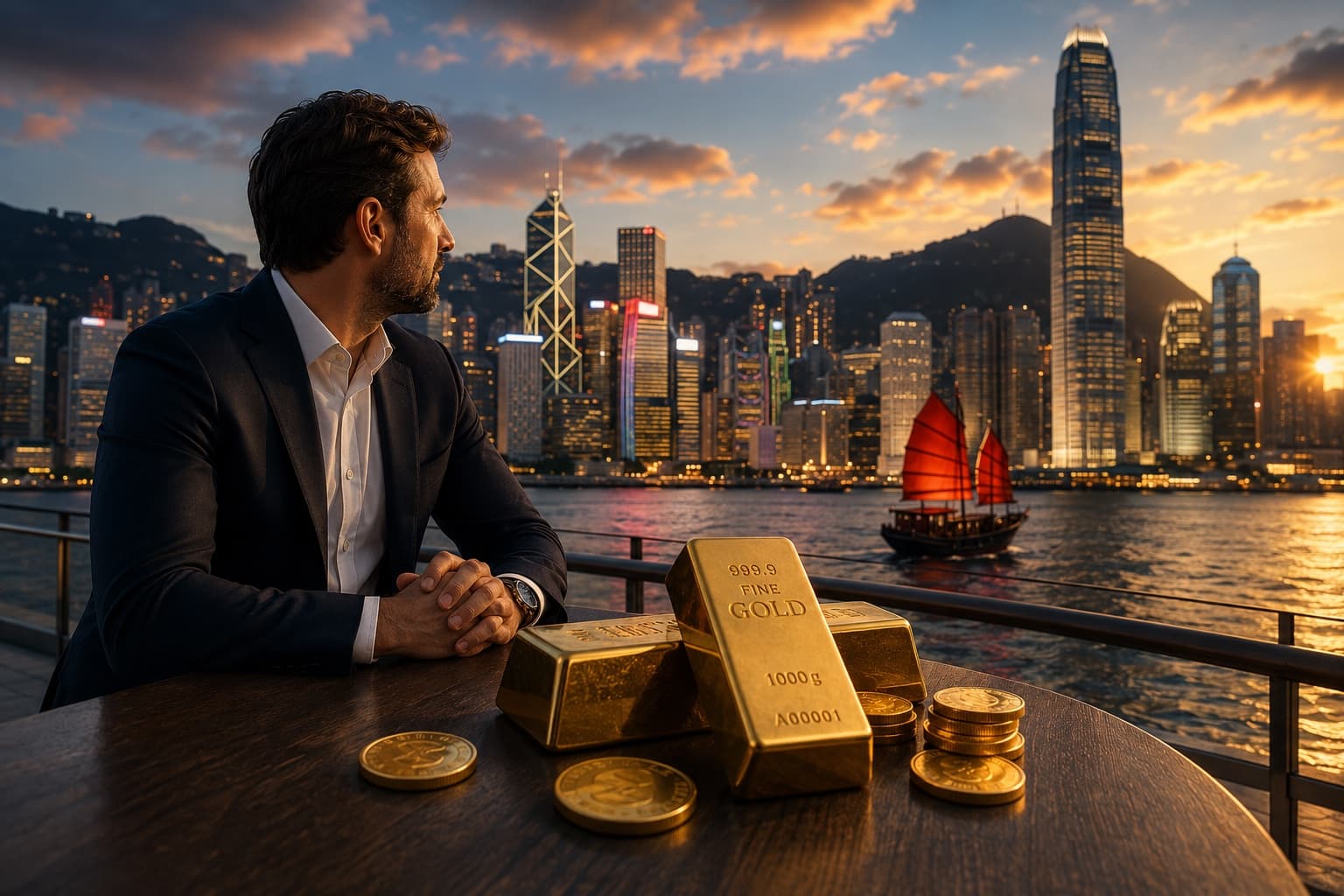
On July 7, 2026, Hong Kong launched the pilot operation of its new central gold clearing and settlement system. At first, this sounds technical. In reality, however, it concerns one of the most important questions in the global gold market: Who will organize trading, storage, price references, and physical delivery in the future?
Hong Kong does not want to be just another trading venue. The city is systematically building infrastructure to gain more weight in the Asian gold trade. This includes a central clearing system, a closer connection to the Shanghai Gold Exchange, a new Hong Kong-specific HAU price ticker, additional storage capacities, and potential tax incentives for market participants.
Gold is traded worldwide, but the central infrastructure has long been located primarily in the West. London remains the dominant OTC trading venue for precious metals. At the beginning of July, Reuters estimated the London bullion market at around 160 billion US dollars per day; the members of London Precious Metals Clearing Limited clear an average of more than 20 million ounces of gold daily on a net basis.
This is precisely why Hong Kong's move is relevant. It is not about replacing London overnight. It is about Asia, with Hong Kong and Shanghai, building its own, better-connected infrastructure for physical gold. Whoever controls clearing, storage, and price references gains long-term influence over liquidity, trade flows, and price discovery.
The new system is operated by the Hong Kong Precious Metals Central Clearing Company Limited, or HKPMCC for short. The company is entirely state-owned. The system is intended to provide clearing and settlement services for bilateral and over-the-counter (OTC) gold transactions. The core of the model is a central register that documents settlements, gold transfers, and holdings of the participating banks and is connected to the designated vault locations.
Gold holdings are maintained in the system as unallocated. Gold bars of international standard are intended for settlement, specifically around 400 troy ounces per bar. Bank of China Hong Kong has been named as the settlement institution and designated vault. According to official reports, the first gold holdings have already been stored and the first trading and settlement activities completed at the launch.
| Key Metric | Current Status | Significance for the Gold Market |
|---|---|---|
| Start of pilot operation | July 7, 2026 | Hong Kong transitions from planning to operational market infrastructure |
| Operator | HKPMCC | State-controlled clearing structure |
| Participating banks on the board | 11 | Involvement of key market players |
| Standard bars | approx. 400 troy ounces | Alignment with international wholesale standards |
| Settlement institution and vault | Bank of China Hong Kong | Connection between banking and physical storage |
| Planned storage capacity | over 2,000 tonnes within three years | Expansion of Hong Kong as a physical storage and reserve location |
| New price ticker | HAU | Local reference for Asian trading hours |
| Spot gold on July 8, 2026 | 4,061.32 US dollars per ounce | Continues to be strongly influenced by interest rates, the dollar, and geopolitics in the short term |
Particularly important is the so-called Delivery Connect with the Shanghai Gold Exchange. HKPMCC has opened a physical gold account for this purpose and created the possibility to bring gold holdings via Hong Kong into the structures of the Shanghai Gold Exchange International Board. This will allow market participants to better switch between the exchange-traded market in Shanghai and the over-the-counter market in Hong Kong in the future.
At the launch, Industrial and Commercial Bank of China Asia, HSBC, and Bank of China Hong Kong were involved as the first participants in the Delivery Connect phase. Two-way transfers have already been completed according to official reports. This shows: The new infrastructure is not just a political signal, but has already arrived in the first operational processes.
On the same day that the new Asian gold infrastructure was being discussed, the gold price was under pressure again. Reuters reported a 1.1 percent drop in the spot gold price to 4,061.32 US dollars per ounce on July 8, 2026; US gold futures for August fell nearly 2 percent to 4,074.20 US dollars per ounce. Triggers included rising oil prices, inflation concerns, and higher expectations of a possible US interest rate hike.
This is an important point for investors. A new clearing system is not a short-term buy signal. Gold can fall even during geopolitical tensions if interest rate and dollar expectations dominate. Infrastructure does not act like a price switch. Rather, it changes the market architecture: who trades where, who stores where, which prices are used, and which region gains importance for physical delivery?
The long-term significance of such infrastructure projects becomes clearer when looking at demand. The World Gold Council reported global gold demand of more than 5,000 tonnes for 2025, including OTC transactions, and a demand value of 555 billion US dollars. Central banks bought a net 863 tonnes of gold in 2025, remaining an important structural factor in the market.
When central banks, institutional investors, and Asian market participants pay closer attention to physical holdings, regional trading hours, and local settlement routes, infrastructure gains importance. This is exactly where Hong Kong comes in. The city wants not only to trade gold but to bundle parts of the value chain around gold in Asia.
For private investors, the message is sober but important. The gold market is not only moved by headlines about inflation, interest rates, or crises. The question of where gold is stored, traded, and settled can also become relevant in the long term. If more physical holdings and more trading activity move to Asia, the weighting in the global gold market can gradually shift.
This does not mean that London will disappear. On the contrary: the addition of Citi as the fifth clearing member in London shows that the Western gold market is also opening up and modernizing its infrastructure. The more likely development is therefore not an abrupt change of power, but a multipolar gold market structure with London, Hong Kong, and Shanghai as important hubs.
Hong Kong's new gold clearing system is another indication that the focus in the gold market is broadening. The price remains visible, fluctuating daily and often discussed emotionally. The infrastructure behind it is quieter, but strategically at least as important.
For investors: Not every market innovation is immediately price-relevant. However, when trading venues, storage capacities, price references, and physical delivery routes are reorganized, a different market picture emerges in the long term. Gold thus remains not only a precious metal but also a benchmark for trust, liquidity, and geopolitical financial architecture.
Spargold Principle: What matters is not just where a price is set, but how resilient the real market structure behind it is.
Stay farsighted
Yours, Helge Peter Ippensen