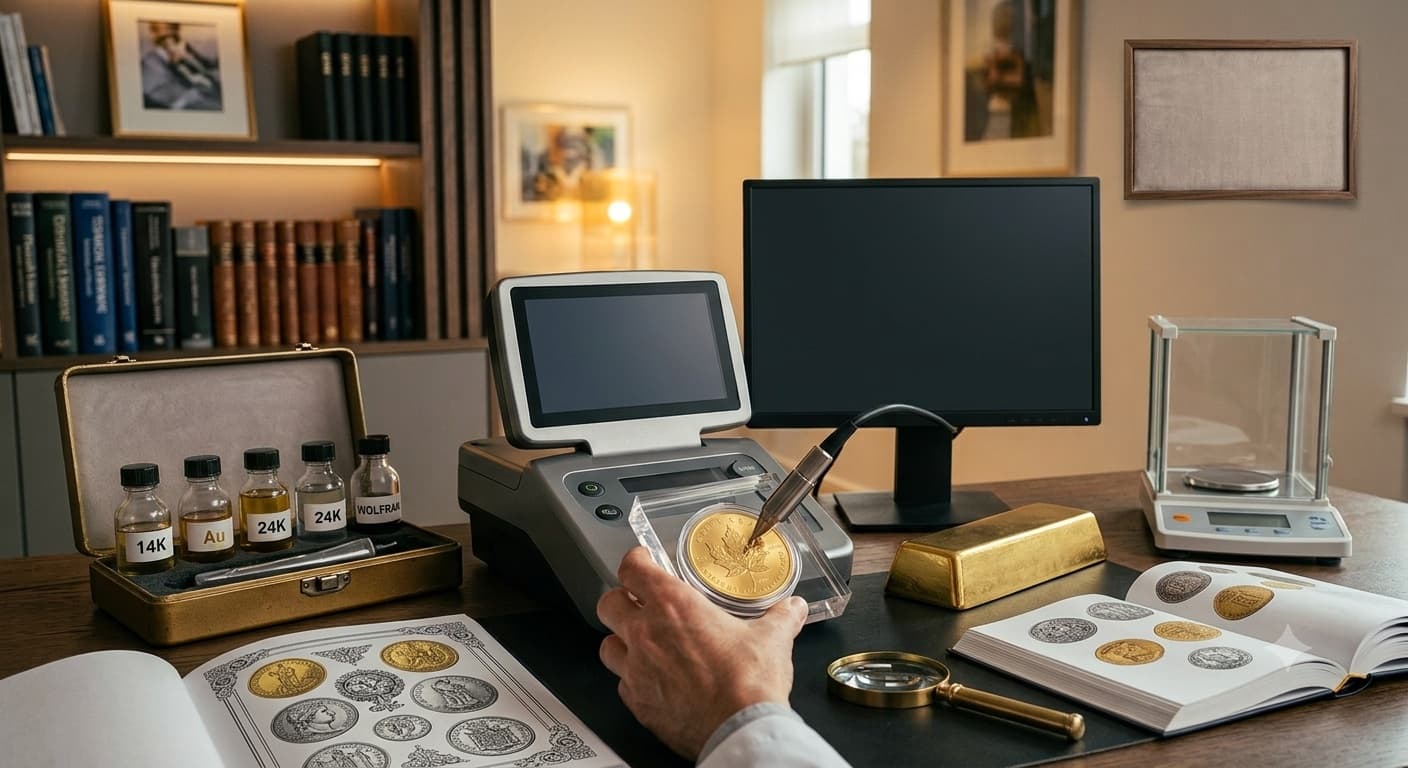
Gold was trading at around 4,033 US dollars per troy ounce on June 25, 2026. Only a day earlier, the price had fallen below the 4,000 US dollar mark for the first time since November 2025. These strong movements illustrate how high the material value of even small gold products has become. However, they also show why a careful inspection of coins and bars is becoming increasingly important.
A recent interview by Handelsblatt with the publicly appointed and sworn expert Peter Zgorzynski highlights a risk that many investors underestimate: modern gold counterfeits do not necessarily consist of cheap metal. Some coins may be made of gold with the correct fineness and yet not represent authentic mintings.
The decisive difference is therefore: Gold value and authenticity are not the same thing.
In recent years, the high gold price has prompted numerous owners to have older holdings checked, reallocated, or sold. As a result, coins and bars from private vaults, estates, and collections are returning to the market.
According to the World Gold Council, global demand for gold, including over-the-counter transactions, rose to 1,231 tonnes in the first quarter of 2026. The demand for bars and coins was particularly striking: it reached 474 tonnes, which was 42 percent higher than the previous year's figure. At the same time, the supply from recycled gold increased by five percent.
More recycling and a more active secondary market do not automatically mean that more counterfeits exist. However, they increase the number of transactions where the origin, identity, and authenticity of a product must be re-evaluated.
Zgorzynski reports in Handelsblatt that more counterfeits are currently entering the market. The expert has worked in the German precious metals industry for around 27 years and inspects gold and silver coins as well as bars for a major German bank, among others.
Many investors imagine a counterfeit gold coin as a gold-plated copy made of lead, brass, or copper. Weight, sound, or color should quickly reveal such a fake.
This expectation is true for simple copies. However, it falls short for modern counterfeits.
According to the expert's descriptions, coins are now being produced whose material composition and fineness can correspond to the values of an original. The coin then actually consists of gold. However, the minting, year, mint mark, or origin are forged.
A criminal interest may lie behind this approach to more easily smuggle gold of unclear origin into the regular market. While stolen jewelry may have identifiable features, an investment coin made from it appears at first glance to be a standardized and internationally tradable product.
Such a coin can have the weight, diameter, and alloy of an original. Nevertheless, it remains an unauthorized copy.
If a counterfeit coin has the correct gold content, its material is not worthless. Nevertheless, the economic loss can be substantial.
A recognized investment coin is not valued on the market solely based on the gold it contains. Its authenticity, marketability, and the unequivocal assignment to an official minting are equally decisive.
If a coin is recognized as a copy upon resale, it can no longer be traded at the usual coin price. Often, the only option left is recovery as scrap gold. This results in testing, processing, and melting costs, as well as a security discount.
In the Handelsblatt interview, Zgorzynski explains this using the example of a 20-franc Vreneli. If such a coin was purchased with a premium of about four percent and later accepted only at a melt value significantly below the spot price, the total loss could add up to nearly 20 percent.
This calculation is an example from the interview partner and not a generally applicable purchase value. However, it illustrates why the material value alone does not compensate for the damage.
With gold bars, the risk often lies in the internal structure. Classic counterfeits consist of a base metal core that has merely been coated with a layer of gold. More sophisticated variants use materials whose physical properties are as similar as possible to gold.
Tungsten is mentioned particularly frequently in this context. Its density is close to the density of gold. If a gold bar is partially filled with tungsten rods or a correspondingly shaped core, the total weight can appear plausible despite a significantly lower gold content.
In addition, the Handelsblatt interview describes bars that actually contain gold but not the stated fineness. A supposed fine gold bar with 999.9 parts per thousand could, for example, consist partly of a gold alloy with a significantly lower gold content.
During a superficial measurement, the outer layer can still provide a correct value. The deviating core remains undetected if no additional testing is used.
Many modern gold bars are offered in a sealed security card. This contains manufacturer information, serial numbers, certificate data, or QR codes.
Such packaging fulfills important functions. It protects the bar, facilitates identification, and can make tampering visible. However, it is not a sole proof of authenticity.
Packaging and certificates can be copied or completely forged. According to the expert, materials can even be combined in such a way that a measurement through the packaging initially shows a plausible conductivity value.
In the case described, the actual deviations were only recognized after the bar had been removed from its packaging.
This does not mean that bars in original packaging are fundamentally suspicious. Rather, the decisive factor is whether the packaging, serial number, manufacturer, and supply chain match.
A professional authenticity check does not consist of a single test. Experts combine several methods whose results can mutually confirm or contradict each other.
| Testing Method | What is examined | Typical Limitation |
|---|---|---|
| Optical inspection and microscopy | Minting image, edge, lettering, surface, die marks, and mint marks | Requires experience, reference data, and precise product knowledge |
| Weight and dimensions | Mass, diameter, thickness, and shape | Matching materials or clever fillings can replicate target values |
| Density test | Ratio of weight to volume | Metals with similar density can influence the result |
| Electrical conductivity | Electrical properties of the material | Alloys, packaging, and multi-layer structures can change measured values |
| X-ray fluorescence analysis (XRF) | Elemental composition of the examined surface | A surface measurement does not necessarily represent the entire core |
| Ultrasonic testing | Material transitions, inclusions, voids, and deviating cores | Requires correct calibration and expert interpretation |
| Origin verification | Manufacturer, invoice, serial number, previous ownership, and supply chain | Documents and security cards can also be manipulated |
In addition to seized counterfeit money, the Deutsche Bundesbank also checks gold and silver coins in circulation for authenticity. For testing devices, it generally recommends methods that can be used to examine several features. Even if this recommendation refers to different types of payment means, it underlines a central principle: a single feature should not be evaluated in isolation.
Technical devices measure material properties. However, they do not automatically know what the minting of a specific coin from a specific year should look like.
With historical gold coins, the smallest details can be decisive. These include deviations in letters, an untypical edge design, incorrect mint marks, or traces of a minting die that cannot match the stated year.
Zgorzynski mentions in the interview, among others, the German 20-mark gold coin with Wilhelm II. It was produced in different mints. Differences can be so small that they only become recognizable through expert knowledge and a precise edge inspection.
Even with well-known investment coins such as the Krügerrand or the Swiss Vreneli, minimal deviations can be decisive. A general analysis device may recognize the gold content. However, it cannot judge whether the minting image, edge, and year authentically belong together.
Each testing method only answers a specific question.
An X-ray fluorescence analysis can show very precisely which elements are in the examined area. However, it does not reliably say in every test configuration what the entire internal structure of a thick bar looks like.
A conductivity measurement can detect conspicuous material properties. However, multi-layer constructions or certain alloys can influence the measured value.
A density test shows whether weight and volume match. However, it does not provide a complete statement about minting, origin, or internal material distribution.
Even a positive ultrasonic test does not replace the optical inspection of a coin. The greatest security therefore arises from the sum of various tests.
The measured value of a device is an indication. Only the expert overall evaluation leads to a reliable assessment.
In Handelsblatt, Zgorzynski criticizes that there are no uniform requirements in the trade as to which testing devices must be present in a branch and what training an inspector should have.
High-quality testing devices are expensive. According to him, an X-ray fluorescence device can cost up to about 80,000 euros. At the same time, companies must regularly train employees and give them enough time for a thorough inspection.
Zgorzynski reports in the interview on his own test with five coins. Four of them were counterfeits. None of the participating dealers clearly identified all the fake coins as copies. According to his account, one dealer would have even purchased the four counterfeits, while he would have rejected the real coin of all things.
This experiment does not represent a representative industry study. However, it illustrates how differently test results can turn out if binding processes, experience, or suitable comparison data are lacking.
As a possible improvement, the expert mentions central testing centers. Instead of having every incoming coin finally evaluated in an individual branch, unclear or high-value products could be forwarded to specialized testing units.
There, several methods can be combined under controlled conditions. In addition, experts can fall back on reference collections, microscopes, material analyses, and documented testing routines.
A centralized process may require more time. In return, the risk of a counterfeit entering the inventory due to time pressure or lack of specialization decreases.
Especially with historical coins and older bars, speed is not the most important quality feature. The decisive factor is whether the product can later be resold without doubt.
Private investors cannot completely replace a professional laboratory test. However, they can significantly reduce the risk when buying.
The most important factor is the origin. An invoice, an established trading partner, and a traceable supply chain are more meaningful than a professional-looking packaging alone.
Particular caution is advised for offers that are significantly below the current market value. The gold price is publicly traceable at all times. A reputable seller normally has no economic reason to sell standardized investment gold far below the material value.
Even photos, certificates, or positive reviews on a sales platform are not enough if the identity of the seller remains unclear.
When buying historical coins, it should also be clarified whether only the gold value or also a numismatic premium is being paid. The higher the collector's surcharge, the more important the expert inspection of the minting becomes.
For bars, the manufacturer, denomination, serial number, and packaging play an important role. Nevertheless, the buyer should not rely solely on the external appearance.
A bar from a traceable, direct supply chain offers more security than an outwardly identical product of unknown origin. The more frequently a bar has been passed on in the secondary market, the more important documentation and re-testing become.
Damaged packaging does not automatically mean that a bar is counterfeit. Conversely, undamaged packaging does not automatically prove its authenticity.
The decisive point is the combination of product, manufacturer, origin, testing, and custody.
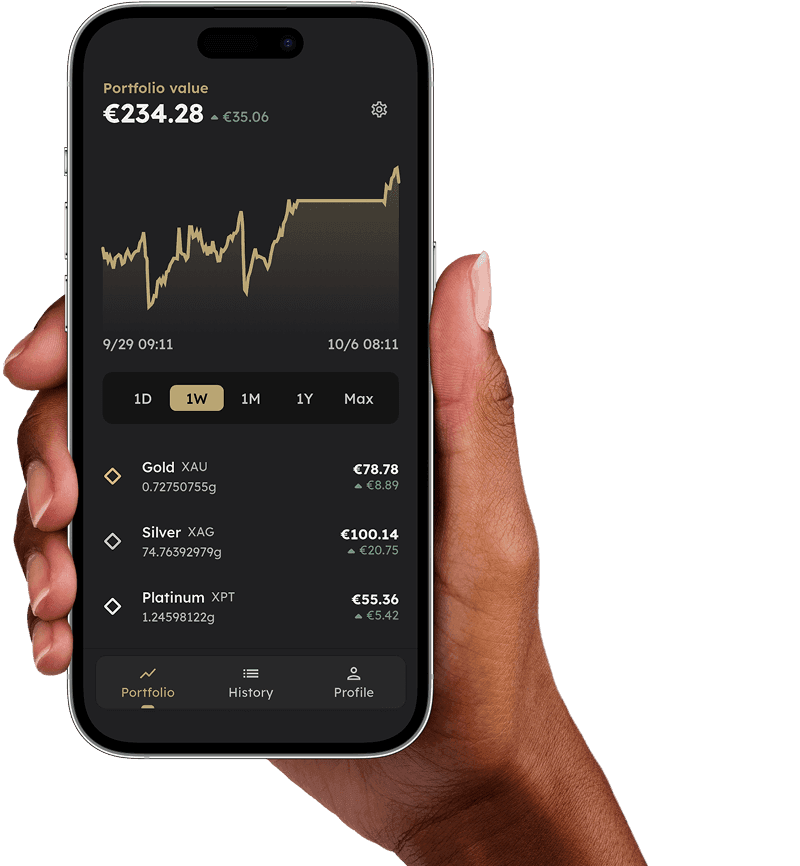
With Spargold, the focus is on physically present precious metal. It is not merely an abstract promise of a later procurement.
However, this physical availability is only part of the security concept. Equally important are controlled procurement, clear allocation, and a traceable chain of custody.
Especially in a market where even gold-containing products can be counterfeit, trust is not created by the material alone. Trust is created by processes.
A gold product must therefore not only be present. Its origin and identity must also be plausible.
The current discussion shows that investors should distinguish between several properties.
A product can contain gold without being a real gold bar from the stated manufacturer. A coin can have the correct fineness without being an authentic minting. Packaging can look professional without coming from the stated refinery.
The material value answers the question of how much gold is contained.
The authenticity check answers the question of whether the product at hand is actually what it claims to be.
Both questions are important. Neither replaces the other.
A correct gold content does not yet prove an authentic coin. A matching weight does not yet prove a solid fine gold bar. An intact security card does not yet prove an unequivocal origin.
Modern gold counterfeits specifically target simple testing processes. Therefore, optical inspection, physical measurements, material analysis, and origin verification must work together.
For investors, this means: It is not just the price that determines the quality of a gold product. Equally important are the trading partner, the supply chain, the inspection, and the subsequent resaleability.
Gold value is measurable – authenticity is created through inspection and origin.
This article is for general information purposes only. It does not constitute individual investment advice or a recommendation to buy or sell.
Stay farsighted
Yours, Helge Peter Ippensen