Gold Overtakes Euro and US Treasuries: Central Banks Continue to Rely on Gold in 2026

August 16, 2026
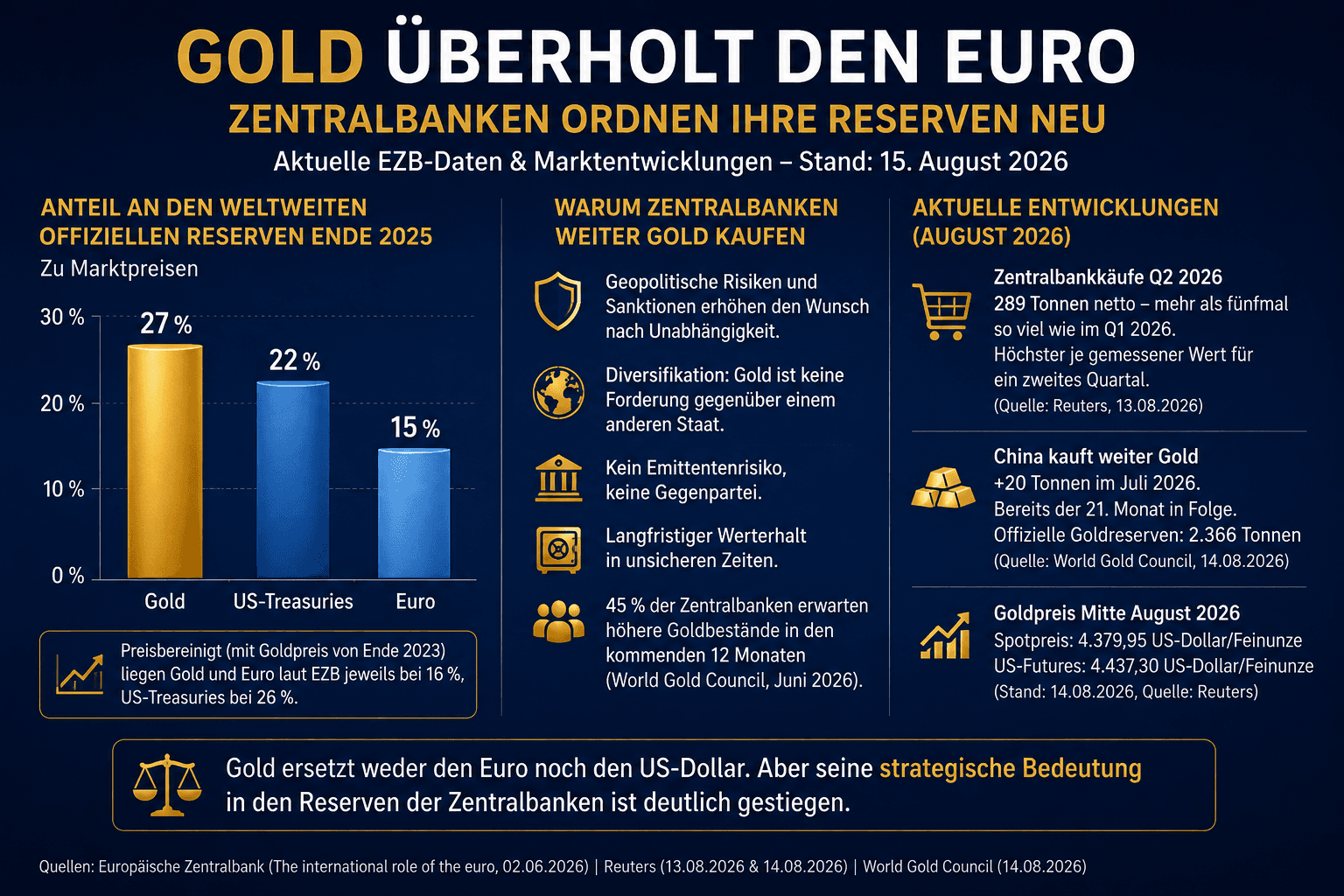
27 percent gold, 15 percent euro. The latest figures from the European Central Bank show a remarkable shift in the international reserve system. By the end of 2025, gold at current market prices already accounted for around 27 percent of global official reserves. The euro stood at 15 percent.
This means that gold is now not only ahead of the euro. Even US Treasuries, which according to the ECB account for a share of around 22 percent, lag behind the precious metal.
The trend continues in 2026. In the second quarter alone, central banks purchased a net 289 tons of gold. At the same time, the gold price moved back toward 4,400 US dollars per troy ounce in mid-August.
The figures show: Gold has once again become a strategic magnitude in the international reserve system.
The most important new figure comes from the current report “The international role of the euro” by the European Central Bank dated June 2, 2026.
According to the report, the share of gold in total official reserves rose to 27 percent by the end of 2025. The euro reached 15 percent, while US Treasuries accounted for 22 percent.
| Reserve Asset | Share at End of 2025 |
|---|---|
| Gold | 27 % |
| US Treasuries | 22 % |
| Euro | 15 % |
This has further intensified the trend from the previous year.
However, the statement “gold is displacing the euro” requires explanation. Gold is not a currency and does not perform the functions of the euro in international payment transactions. What gold has overtaken is the euro's share within official reserves when gold is valued at current market prices.
This exact distinction is important.
At first glance, one might conclude from the figures that central banks have massively reallocated their reserves from the euro and US dollar into gold.
The reality is more nuanced.
A significant portion of the increase is attributable to the gold price. According to ECB calculations, the gold price rose by approximately 60 percent in nominal terms in 2025, after already gaining about 30 percent in 2024.
This automatically increases the value of existing gold reserves and thus also their percentage share of total reserve assets.
The ECB has factored out this effect. If gold holdings continue to be valued at the gold price from the end of 2023, gold only accounts for a share of 16 percent. The euro then also stands at 16 percent, while US Treasuries reach 26 percent.
This significantly changes the interpretation.
At current market prices, gold is clearly ahead of the euro. Adjusted for the massive price increase, however, there is practically a tie between the two reserve positions.
However, the valuation effect only explains part of the story. This is because central banks are indeed continuing to purchase significant quantities of gold.
In 2025, purchases did decline to around 850 tons according to ECB data. Between 2022 and 2024, they had each reached more than 1,000 tons per year.
In 2026, however, demand has accelerated significantly again.
In the second quarter, according to current data, central banks purchased a net 289 tons of gold. This was more than five times as much as in the first quarter and, according to Reuters, the highest value ever recorded for a second quarter.
Based on the average gold price, Deutsche Bank estimates the value of these purchases at approximately 45 billion US dollars.
This is a crucial point: The rise of gold in reserves is not exclusively the result of higher prices. Central banks are continuing to actively expand their holdings.
China demonstrates how current this trend is.
According to data published by the World Gold Council on August 14, the People's Bank of China increased its gold reserves by 20 tons in July alone. It was the largest monthly purchase since the end of 2023 and already the 21st consecutive month in which the Chinese central bank purchased gold.
Official Chinese gold holdings thus reached 2,366 tons according to the World Gold Council, corresponding to around eight percent of Chinese foreign exchange reserves.
The longer-term development is also remarkable. Since the Russian attack on Ukraine in 2022, China has purchased more than 350 tons of gold according to the ECB. Poland follows with around 320 tons, Turkey with about 220 tons, and India with around 130 tons.
Gold purchases are thus no longer a marginal phenomenon of individual emerging markets.
Why do central banks buy gold even though the precious metal pays no interest?
The ECB sees an important factor in geopolitics.
Gold possesses a quality that is gaining importance in an increasingly fragmented international financial system: it is not a claim against another state.
A government bond is always a liability of the issuer. A bank deposit requires a counterparty. Physical gold, on the other hand, possesses no such issuer risk.
This makes gold attractive to central banks that want to diversify their reserves or reduce their dependence on individual currency areas.
The ECB explicitly points out that geopolitical risks remain among the central factors monitored by reserve managers.
Gold is thus increasingly viewed not just as a store of value, but as a strategic reserve asset.
The development could continue.
A survey published by the World Gold Council in June shows that 45 percent of the reserve managers surveyed expect to increase their own institution's gold holdings within the next twelve months.
This is a record figure.
Only one percent expected a decline in their own gold holdings, while 54 percent expected holdings to remain unchanged.
The figures align with the actual purchases in the second quarter and China's recent purchases in July.
The development is also visible in the market.
On August 14, 2026, the spot price for gold rose to 4,379.95 US dollars per troy ounce. US gold futures closed at 4,437.30 US dollars.
Even more interesting is the short-term movement. Since the beginning of August, gold had gained around 400 US dollars or about ten percent at times.
In addition to central bank demand, the US dollar, interest rate expectations, and geopolitical uncertainties play an important role.
A weaker dollar makes gold cheaper for buyers outside the dollar zone. At the same time, gold often benefits from expectations of falling or less sharply rising interest rates because the precious metal itself pays no ongoing interest.
Despite all the momentum, the wrong conclusion must not be drawn from the reserve statistics.
Gold replaces neither the euro nor the US dollar.
The ECB itself emphasizes the disadvantages of the precious metal as a reserve asset. Gold pays no interest, its price can fluctuate significantly, and the storage of physical gold incurs costs.
In addition, there is a structural difference: the gold supply cannot be expanded at short notice if the international financial system suddenly requires additional liquidity.
The dollar and the euro therefore possess functions that gold cannot perform.
Therefore, a second statement from the current ECB report is particularly interesting.
While gold accounts for an ever-increasing share of reserves, the international role of the euro grew moderately in 2025.
It would therefore be wrong to derive a general weakness of the euro from the rising share of gold.
Rather, two developments are occurring simultaneously: the euro remains a central international currency, while gold gains importance as a strategic reserve asset.
That is precisely where the real story lies.
The decisions of a central bank cannot be transferred one-to-one to private investors. Central banks pursue different goals, have different time horizons, and must manage their reserves under completely different conditions.
Nevertheless, the development is remarkable.
Of all institutions, those that support the global fiat money system hold large gold stocks and continue to buy more.
They do not necessarily do this because they are speculating on rising gold prices. For them, diversification, geopolitical risks, and the stability of their reserves are the primary focus.
Gold has thus regained a position that seemed to have long lost importance after the end of Bretton Woods.
The gold price is the visible signal. The reserves show the strategic reality.
Stay farsighted
Yours, Helge Peter Ippensen