Gold and Silver Market 2.0: When Precious Metals Suddenly React Like Risk Assets

February 3, 2026
On February 3, 2026, gold is trading again at around 4,924 US dollars per ounce, after the market was pushed through from nearly 5,595 US dollars to the range around 4,404 US dollars within just a few trading days. This is more than a “normal correction.” It is a lesson in how quickly a market perceived as stable can turn into a volatility machine when momentum, leverage, and liquidity tip simultaneously.
Silver demonstrates this mechanics even more drastically: After a high of over 121 US dollars per ounce, a historically rapid collapse occurred, which according to Reuters ranks among the strongest daily movements in decades.
Many investors associate precious metals with value preservation and crisis resilience. This is often true in the long term as a role in the portfolio, but it does not necessarily describe the short-term market mechanism. In recent weeks, it was striking how strongly price movements in gold and silver were driven by positioning – that is, by the question of who is already invested, how much of it is leveraged, and how quickly one must sell when prices fall.
The fact that gold felt “like a momentum trade” during this phase fits the observation that, in the short term, market structure rather than fundamentals dominated: futures markets, collateral requirements, and systematic strategies can accelerate movements as soon as certain levels are breached.
In reporting, the shift is often attributed to a single news item: expectations of tighter US monetary policy, a stronger dollar, or a change in the Fed narrative. Such impulses can be the spark, but they rarely explain the magnitude.
The decisive factor is usually the second round: when prices fall, risks in leveraged positions increase, brokers raise requirements, traders reduce exposure, and sales are no longer voluntary but technically forced. This is exactly how movements occur that feel like a “waterfall” on the chart.
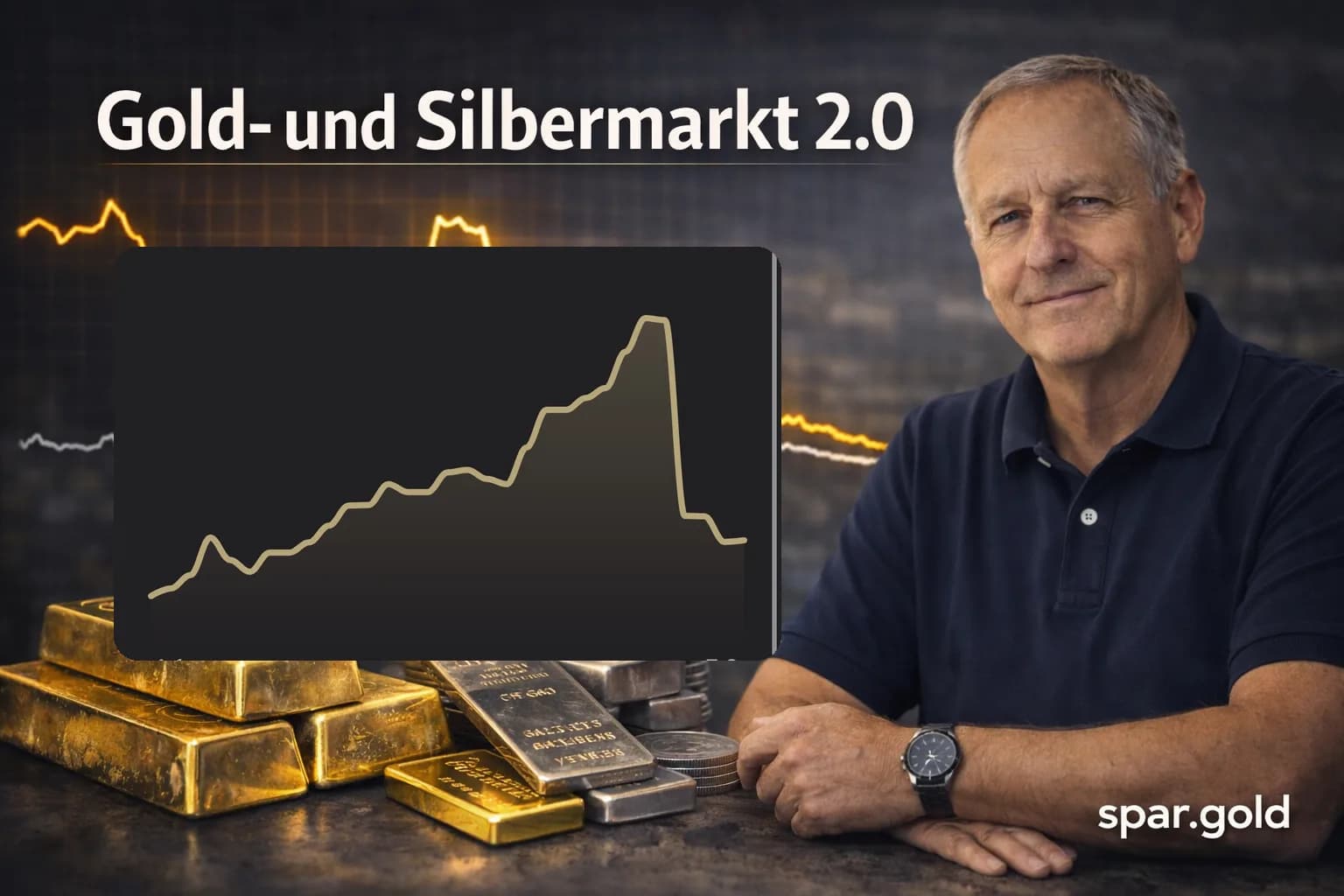
The course of the last two weeks shows three phases: a stable uptrend, acceleration to the high, followed by a sharp discharge with a rebound. In gold, this sequence is clearly readable – including the jump over 5,400 US dollars and the subsequent slump below 4,700 US dollars.
In silver, the range is even more extreme: from well over 116 US dollars down to the area around 71 US dollars, followed by a strong counter-move.
| Date | Gold (XAU/USD) | Silver (XAG/USD) |
|---|---|---|
| 15.01.2026 | 4,614.91 | 92.3425 |
| 16.01.2026 | 4,595.10 | 89.9544 |
| 19.01.2026 | 4,671.02 | 94.7050 |
| 20.01.2026 | 4,763.49 | 94.6150 |
| 21.01.2026 | 4,836.67 | 93.2560 |
| 22.01.2026 | 4,936.75 | 96.1987 |
| 23.01.2026 | 4,982.91 | 102.9727 |
| 26.01.2026 | 5,015.34 | 103.8984 |
| 27.01.2026 | 5,189.62 | 113.0258 |
| 28.01.2026 | 5,400.25 | 116.6095 |
| 29.01.2026 | 5,395.88 | 116.1495 |
| 30.01.2026 | 4,865.35 | 84.7040 |
| 02.02.2026 | 4,666.27 | 79.4546 |
| 03.02.2026 | 4,924.47 | 86.6675 |
When precious metals correct so abruptly, it is not automatically a harbinger of a stock market crash. But it is an indication that “too much leverage” may be present in several markets simultaneously. This is where it gets interesting: In the USA, margin debt according to FINRA statistics was around 1.23 trillion US dollars in December 2025 – a record, about 36% above the previous year.
This is not an alarm button per se. It is context: When liquidity becomes more expensive or volatility increases, forced reductions in leveraged positions often act across markets – and not just in precious metals.
A second component is the infrastructure of price formation: The futures market is where large parts of short-term price movements originate. When activity there increases, it is not just “more trading,” but often more leverage.
Currently, this aligns with CME reporting record activity in the metals complex – including record volume in Micro Silver futures (715,111 contracts in one day) and very high activity in gold contracts as well.
When collateral models and margin requirements also take effect during such a phase, a mechanism is created that can accelerate price movements – both to the upside and the downside.
The modern precious metals market is more global, faster, and more strongly interwoven with derivatives, algorithms, and social signals than many investors assume. This is why movements that previously seemed “crypto-typical” are now also seen in classic markets.
The conclusion is not “precious metals are unsafe.” The conclusion is: In the short term, price is not just fundamentals, but also positioning. And anyone who wants to understand markets looks not only at news but at structure: leverage, liquidity, collateral, and trading volume.
Stay farsighted
Yours, Helge Peter Ippensen