Germany: −11%.
Poland: +54%.
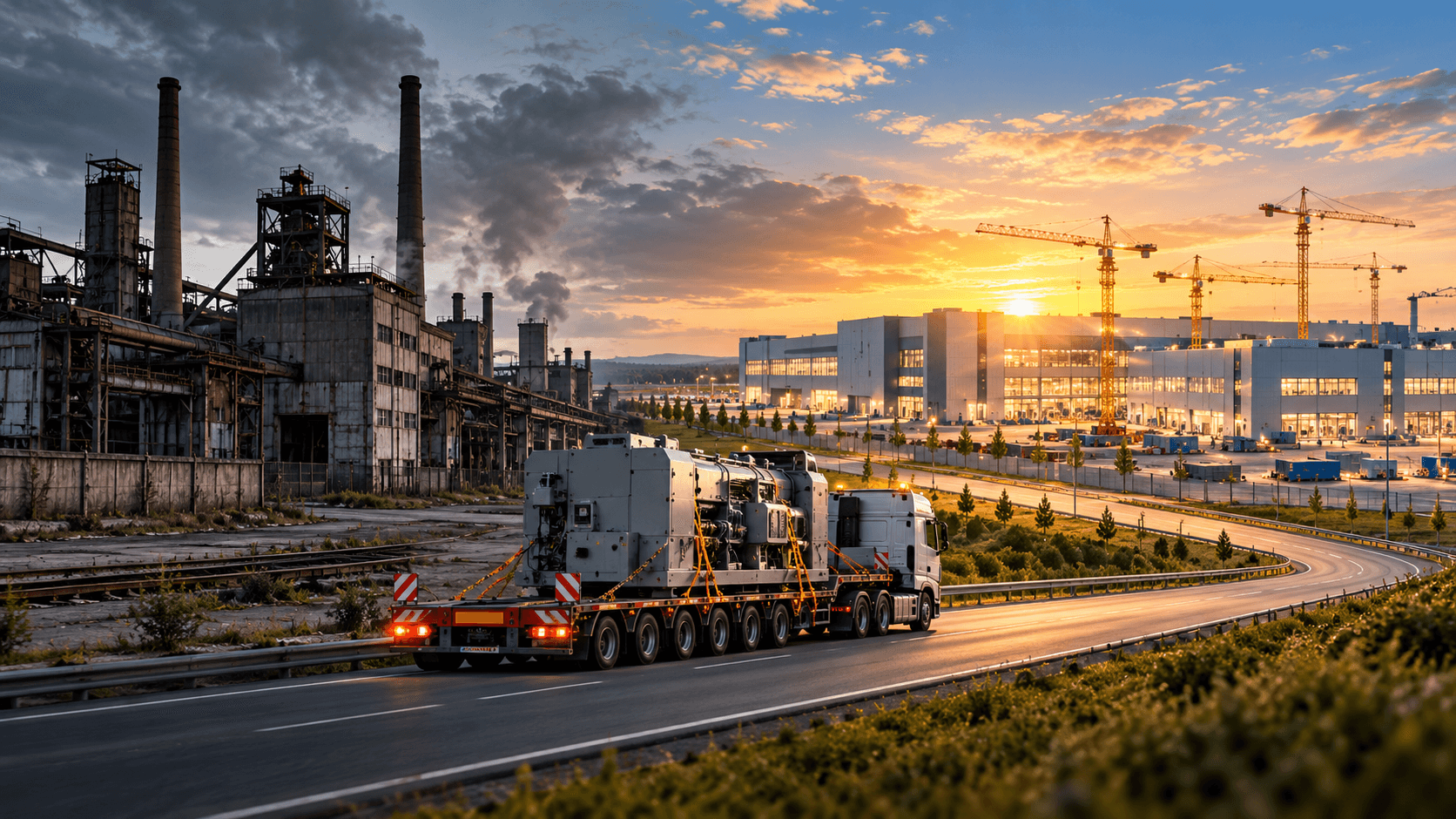
The real industrial production of both countries has developed very differently since 2015.
And now there is a second contrast that seems almost more symbolic:
A lot of gold.
The Polish central bank is rapidly approaching its target of:
Germany, on the other hand, continues to hold the world's second-largest national gold reserve at approximately 3,350 tonnes.
However, in this country, there was serious discussion in 2026 about selling part of this gold to finance crisis aid and investments.
Two neighboring countries.
Two different developments.
And one question:
The underlying Eurostat data measures real industrial production – meaning production volume and not merely revenues inflated by inflation.
2025 is compared with 2015.
Germany:
Poland:
Other European states have also seen significant increases – although national special factors must be taken into account. Denmark's extraordinary rise, for example, is heavily influenced by the pharmaceutical industry. European Commission
The figures explicitly do not mean:
That the overall German economy has shrunk by eleven percent since 2015.
It is the industry that is being measured.
And that is precisely why the development is so interesting for Germany.
Because for decades, industry was a core of the German prosperity model.
Automobiles.
Machinery.
Chemicals.
Metal.
Electrical engineering.
Industrial exports.
For decades, Germany was exceptionally specialized in manufacturing high-quality physical goods and selling them worldwide.
But this very model is under pressure.
In its 2026 Germany Report, the European Commission reaches a remarkably clear finding:
Germany has recorded almost no real economic growth since 2019 and has been among the EU countries with the weakest recovery since the pandemic.
At the same time, global export market shares declined significantly.
The Commission cites several causes, including:
high energy prices,
high labor costs,
a shortage of skilled workers,
declining technological leadership,
stronger competition from China
and weak private investment. Economy and Finance
Particularly noteworthy:
And the Commission already sees signs, particularly in automobiles and machinery, that physical production is shifting abroad, while industry-related services increasingly remain in Germany. Economy and Finance
This is more than a short-term economic dip.
Of course, the figure must be put into context.
Poland started from a lower economic level.
A catching-up country can grow significantly faster in percentage terms than an already highly industrialized economy.
But that alone does not explain the development.
Poland has been gaining industrial capacity and export market share for years.
The EU Commission continues to describe the country as a dynamic economy, supported by investment, consumption, and increasing integration into European value chains. Economy and Finance
This raises an increasingly important question:
Germany?
Poland?
Czech Republic?
USA?
China?
Asia?
Companies do not decide based on national traditions.
They compare:
Energy.
Taxes.
Wages.
Infrastructure.
Permits.
Skilled labor.
Capital.
Market access.
Planning certainty.
And each of these decisions changes the economic map for the next ten years.
At first glance, industrial production and central bank gold have little to do with each other.
And indeed, it would be dubious to claim:
Poland is growing industrially because it is buying gold.
Of course not.
But it is interesting how differently both countries are currently thinking about strategic reserves.
The Polish National Bank has massively expanded its gold reserves in recent years.
At the end of 2022, Poland still held approximately:
228 tonnes.
Then followed extensive purchases.
2023:
more than 130 tonnes.
2024:
around 90 tonnes.
2025:
around 102 tonnes.
And it continued in 2026.
By July alone, Poland was the largest reported central bank buyer of the year with around 90 tonnes. World Gold Council
In September, Warsaw accelerated again.
According to calculations based on published NBP reserve values, approximately:
were added.
This means that by the end of September, Poland likely already owned approximately:
Only a few tonnes are now missing from the official target:
The Polish National Bank intends to publish the final quantity for September on October 21; the approximately 694 tonnes are therefore currently still an estimate derived from the reserve values. euronews
Gold now accounts for approximately:
out. euronews
The Polish central bank's reasoning is actually remarkably classic.
Gold is:
highly liquid,
internationally tradable,
not dependent on the creditworthiness of a company
and:
Thus, it has no classic issuer credit risk.
Additionally, gold reduces the concentration of a reserve portfolio in other currencies and securities. euronews
This is precisely why numerous central banks are now expanding their gold holdings. Poland is among the most aggressive buyers.
Germany is sitting on a completely different gold treasure. The Bundesbank owns approximately:
This gives Germany the second-largest national gold reserves in the world after the USA.
And yet, a remarkable debate emerged in the spring of 2026.
The President of the German Institute for Economic Research (DIW), Marcel Fratzscher, proposed:
His reasoning:
Germany possesses enormous public wealth, while at the same time billions are lacking for crisis management, relief, and investment.
He referred to the gold reserves, in effect, as a:
Part of it could, for example, be activated for infrastructure or other state tasks. onvista
Thus, two completely different ideas suddenly stood side by side.
In Warsaw:
In Germany:
It would be wrong to write:
Germany is not doing that.
The debate stems from a proposal by the DIW President and further public discussions.
The Bundesbank itself explicitly clarified:
A sale of gold reserves to reduce national debt or finance state investments would not be permissible.
Because the owner of the gold is the independent Deutsche Bundesbank – not the federal government. BR.de
The federal government cannot simply say:
Sell a hundred tonnes and build schools or highways with the proceeds.
This very institutional separation is part of the European central bank system.
Just a few days before this article, Bundesbank President Joachim Nagel gave a keynote speech on the importance of gold as a central bank reserve.
And his reasoning sounds remarkably similar to that of the Polish central bank.
Physical gold does not depend on:
a state,
a bank
or another issuer
fulfilling its payment obligations.
Nagel also pointed out that geopolitical risks and rising national debt can increase the attractiveness of diversification into gold.
His conclusion:
There is still much to be said for:
This makes the picture more interesting than a simple comparison of "Poland buys – Germany sells."
The actual situation is:
Poland's central bank is actively buying gold. In Germany, there is public discussion about a sale to finance state tasks – while the Bundesbank itself explicitly defends the strategic value of gold.
This difference is important.
In 2025, the German gold stock decreased by only:
1.26 tonnes.
Why?
Not to finance the budget.
The gold was sold to the federal government at market price so that German gold coins could be minted from it.
Out of a total of around 3,350 tonnes, this corresponds to just:
There is therefore no question of a strategic reduction of German gold reserves at present.
Because it reveals two fundamentally different perspectives on wealth.
One is:
We own an asset. Its value has risen sharply. Why don't we use it and spend the money?
The other is:
Precisely because the world is more uncertain and states are more heavily indebted, we need assets that are not simultaneously someone else's liability.
Both positions can be discussed economically.
But they lead to completely different decisions.
Not as a short-term object of speculation.
Not as a budget item.
But as a:
The word itself says what it's about.
One holds a reserve precisely for situations in which other assets or financing options may no longer function as expected.
This applies to:
Foreign exchange.
Energy.
Raw materials.
and:
Gold.
3,350 tonnes compared to just under 700 tonnes in Poland.
Germany is therefore by no means gold-poor.
On the contrary.
The Federal Republic possesses an exceptionally large buffer.
The more exciting question is therefore:
As unproductive wealth that should be activated?
Or as strategic insurance that is valuable precisely when you don't need it?
Once again:
There is no causal link between Polish gold purchases and German industrial weakness.
But together, the figures tell us something about long-term economic decisions.
Since 2015:
Poland: Industry +54%.
Germany: Industry −11%.
And in 2026:
Poland is approaching 700 tonnes of gold reserves.
Germany is discussing, at least publicly, monetizing part of its significantly larger gold holdings.
This does not prove the economic policy superiority of one country.
But the contrast is remarkable.
The first is:
Productivity.
Factories.
Innovation.
Companies.
Infrastructure.
Investment.
The second:
Reserves.
Risk diversification.
Liquidity.
Hedging.
Strategic assets.
An economy needs both.
No one can live permanently on reserves alone.
But an economy without reserves becomes vulnerable in crises.
Many people view their wealth almost exclusively through the question:
Stocks.
Real estate.
Bonds.
Companies.
This is completely legitimate.
But a second question is equally important:
If an economy falters?
If a currency loses purchasing power?
If debtors run into trouble?
If geopolitical risks increase?
That is exactly why central banks hold reserves.
And that is exactly why diversification can also be sensible for private wealth.
A government bond is:
a claim against a state.
A bank deposit:
a claim against a bank.
A corporate bond:
a claim against a company.
Physical gold is:
That doesn't automatically make gold better.
Gold pays no interest.
Its price fluctuates.
Storage costs money.
But its risk structure is different.
And that is exactly why central banks like Poland are currently buying gold.
But rather:
Because Poland is currently making a conscious decision:
We want more of it.
Germany owns almost five times as much.
And at the same time, the question arises in this country:
One can argue about it.
One should, in fact.
But one thing should not be forgotten:
A reserve often possesses its greatest strategic value precisely when
The industrial development of the past ten years shows how quickly economic weights can shift.
Perhaps that is precisely not an argument for valuing reserves less.
But rather:
Stay far-sighted
Yours, Helge Peter Ippensen