China Increases Gold Purchases Again: Why the Strategy Behind the Purchases is More Important Than the Gold Price

August 15, 2026
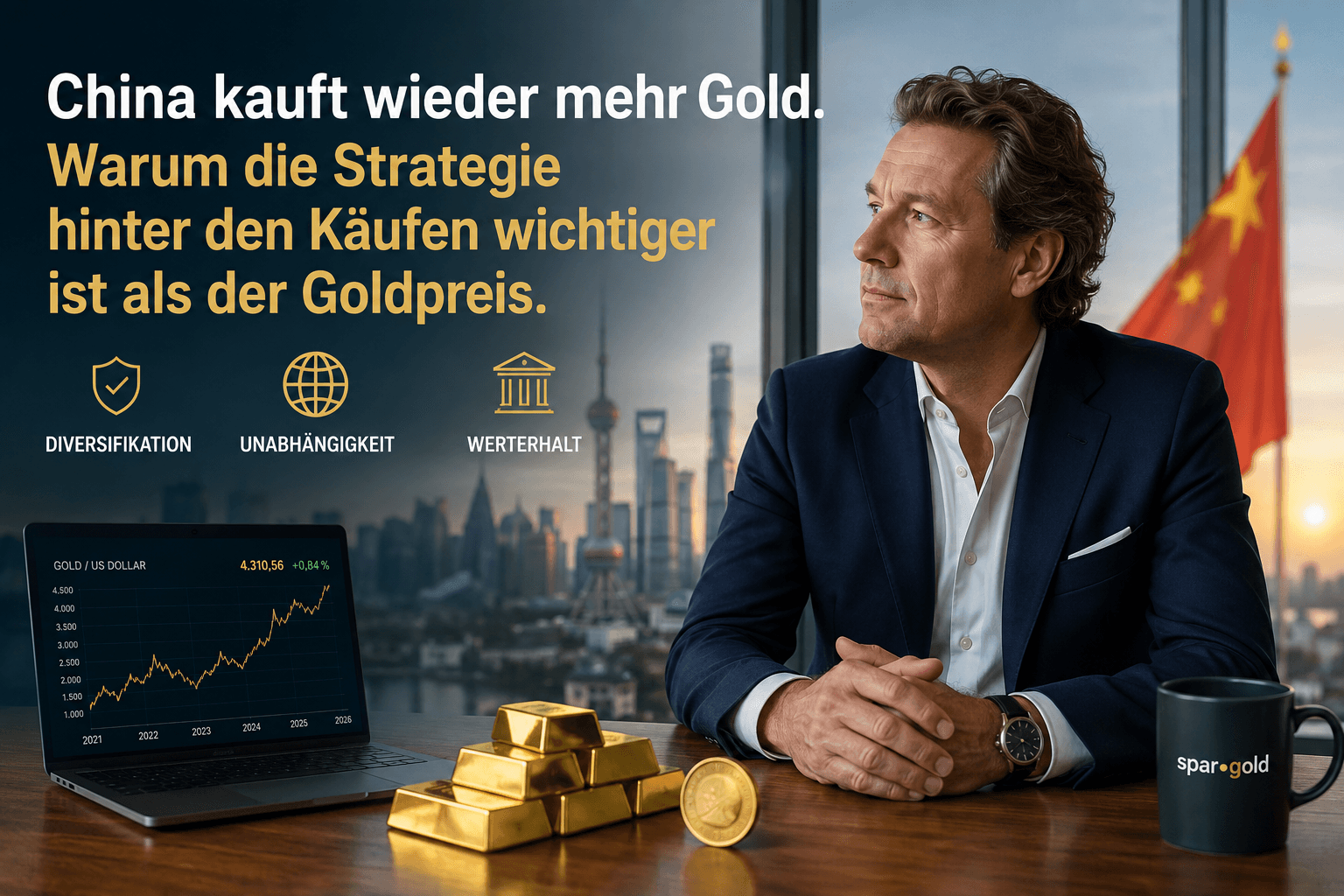
640,000 troy ounces of gold in just one month: In July 2026, the Chinese central bank increased its gold reserves more than at any time since October 2023. This corresponds to nearly 20 tonnes of gold. Officially reported holdings thus rose from 75.44 to 76.08 million troy ounces.
The obvious question is: What does this mean for the gold price?
But perhaps that is not the most interesting question at all.
Much more fundamental is: Why does a state like China buy gold at all – and why is it accelerating its purchases right now?
The current figures show remarkable continuity. The People's Bank of China has now increased its officially reported gold holdings for 21 consecutive months. In July alone, 640,000 troy ounces were added. In June, the figure was already 480,000 troy ounces. Since March, the monthly pace of purchases has gradually increased.
| Key Figure | As of July 2026 |
|---|---|
| China's official gold reserves | 76.08 million troy ounces |
| Purchase in July | 640,000 troy ounces |
| Purchase in tonnes | nearly 20 tonnes |
| Value of gold reserves | 306.35 billion US dollars |
| Purchase streak | 21 consecutive months |
| Gold price performance in July | +0.84% |
Source: Reuters based on official Chinese data, published on August 7, 2026.
The value of Chinese gold reserves is also substantial: at the end of July, they were valued at 306.35 billion US dollars, up from 303.72 billion US dollars at the end of June.
The interesting aspect is less a single monthly figure than the consistency with which China is changing its reserve structure.
Those who view gold from the perspective of a private investor quickly think in terms of prices.
Is the price favorable? Will gold rise? When would be the best entry point?
However, a central bank pursues different objectives.
Within state reserves, gold is not initially a short-term trade. It is a reserve asset that functions differently than a government bond, a bank balance, or a foreign currency position.
That is precisely the crucial point.
China possesses enormous foreign exchange reserves. A stronger allocation of gold can diversify these reserves and reduce dependence on individual currencies and financial systems.
The purchases should therefore be understood less as a bet on the next jump in the gold price and more as part of a long-term reserve policy.
Gold possesses a quality that has become unusual in today's financial system: physical gold is simultaneously an asset and a reserve good without being a claim against another debtor.
A government bond is the liability of a state. A bank balance is a claim against a bank. A foreign currency reserve depends on the respective currency and financial system.
Physical gold differs from this.
Especially in a world where geopolitical tensions, sanctions, trade conflicts, and currency risks increasingly influence reserve policy, this quality can gain importance for central banks.
This does not mean that gold replaces classic currency reserves. However, it explains why many central banks view gold as a strategic supplement.
Often, a “departure from the dollar” is immediately inferred from Chinese gold purchases. This is an oversimplification.
The scale of Chinese foreign exchange reserves is far too significant for that, and the US dollar continues to play a central role in the international financial and trading system.
Therefore, the term diversification is more accurate.
China can gradually reduce its dependence on individual reserve assets without having to completely replace the dollar. Gold is interesting in this context because it exists outside the credit risk of a single issuer.
The development is thus less revolutionary than it is strategic.
And that is precisely why it should be viewed from a long-term perspective.
Another point makes the development noteworthy.
Reuters reported on August 7 that spot gold was recently trading at more than 4,310 US dollars per troy ounce. In July, the gold price rose by 0.84 percent, ending a streak of four declining months.
China accelerated its purchases nonetheless.
This contradicts a mindset that exclusively searches for the supposedly perfect entry price.
For a central bank, the strategic function of an asset can be more important than the question of whether a troy ounce is a few percent cheaper or more expensive today.
The price is visible – the function behind it is decisive.
It would be wrong to derive a direct call to action for private investors from the Chinese purchases. The goals, investment horizons, and financial resources of a central bank differ fundamentally from those of a private household.
However, the mindset behind it is interesting.
China clearly does not view gold solely from the perspective of short-term price movements. Gold fulfills a specific function within the reserves.
This exact question can also be more meaningful for private wealth structures than daily price forecasts.
Not: Where will gold be next month?
But: What role should gold fulfill in the long term within my assets?
That is a significant difference.
Gold pays no interest. It does not generate corporate profits and produces no ongoing cash flow. For this very reason, it should not be equated with stocks or bonds.
Its possible function lies elsewhere: as an independent physical asset and as part of a more broadly diversified wealth structure.
China is currently demonstrating this logic at the state level.
The fact that the central bank accelerated its purchases in July to nearly 20 tonnes, even though gold is trading at a historically high nominal price level, is therefore noteworthy.
Not because it necessarily leads to the next price increase.
But because it shows the continued importance of gold within a long-term reserve strategy.
The headline reads: China buys more gold.
However, the more important news is: one of the world's largest economies has been continuously expanding its gold reserves for 21 months now and has recently increased the pace once again.
Those who only wish to derive a gold price forecast from this may be overlooking the more interesting part of the development.
China treats gold as a strategic reserve.
For investors, this offers at least an interesting change of perspective: not every decision regarding gold must begin with the question of what the price will do tomorrow.
Sometimes the better question is:
What role should gold fulfill in the long term?
Stay farsighted
Yours, Helge Peter Ippensen