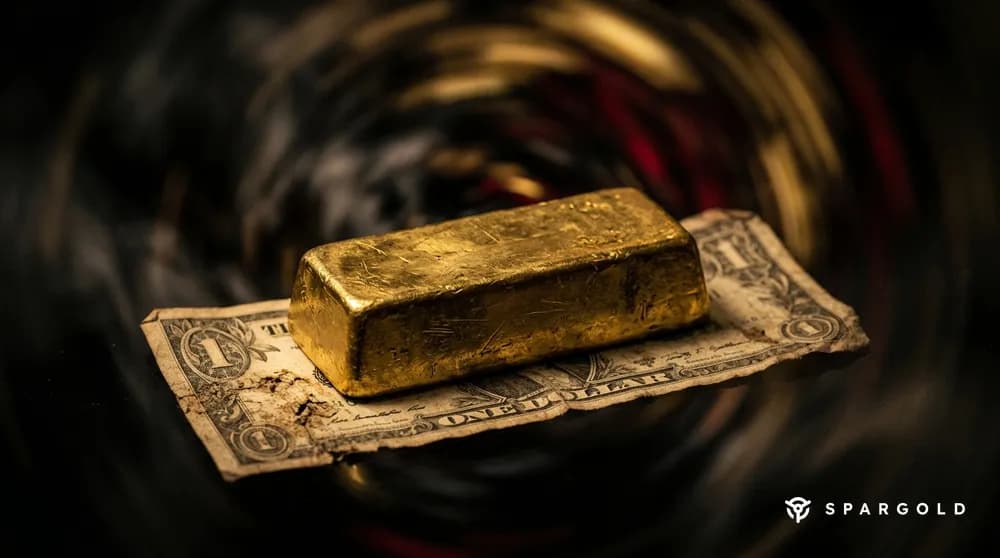
In October 2026, the USA accumulated more than $40 trillion in national debt for the first time. Simultaneously, China holds only $618 billion in US Treasuries — the lowest level in nearly two decades. The replacement for the sold dollars: gold. What this shift means for the gold price.
Debt is not a problem — as long as all creditors believe it will be repaid. But when one of the largest creditors begins to sell and buy gold instead, it is a signal. Not a short-term one. A structural one.
In October 2026, US national debt exceeded the $40 trillion mark for the first time. Annual interest costs now exceed spending on defense and large parts of the social budget. The budget deficit is growing faster than the economy. Investors worldwide are wondering how this debt will ever be reduced — and whether the dollar will hold up as the world's reserve currency in the long term.
China has provided a clear answer to this question: Holdings of US Treasuries fell to $618 billion — the lowest level in nearly two decades. This is a decline of more than a third from the peak. For the US bond markets, China has thus moved from being one of the largest creditors to a marginal player.
What China is buying instead is clear: gold. In September 2026, the Chinese central bank acquired around 23 tons of gold — the largest monthly purchase volume in nearly three years. The buying streak has been running for 23 consecutive months without a break.
The import statistics show this even more clearly: In the first eight months of 2026, China imported more than 1,000 tons of gold worth $158.8 billion. In the entire year 2025, it was 886 tons. China is buying significantly faster in 2026 than in the previous year.
In parallel, China is expanding the infrastructure for a gold-backed alternative system: Yuan-denominated gold futures are expanding, and trading platforms between Hong Kong and Shanghai are becoming more closely linked. This is not a short-term reaction to a price movement. This is a strategic realignment of reserve policy.
If the dollar loses its position as the dominant reserve currency even gradually, the structural need for alternatives increases — and gold is the most historically proven of these. No counterparty risk, no central bank behind it, not debasable by printing. These properties become more valuable when trust in fiat currencies declines.
In October 2026, the gold price is trading at around $4,100 per troy ounce — a cooling off from the all-time high of $4,649 in August. However, the structural tailwind remains: central banks continue to buy, China continues to diversify, and US debt continues to rise.
More on institutional gold demand: Central Banks as Structural Gold Price Drivers — Record Data Q2 2026.
Because rising debt undermines confidence in solvency. A country that spends more than it takes in and finances the difference through new bonds eventually risks that buyers will no longer accept these bonds at attractive terms. This depresses the bond price, increases yields — and weakens the position of the dollar in the long term. Gold benefits from this as a counter-asset without counterparty risk.
Yes — and the data shows this impressively. More than 1,000 tons imported in the first eight months of 2026, 23 consecutive months of purchases by the central bank. China officially reports only a portion of its gold purchases in a timely manner — the actual accumulation of holdings is estimated by analysts to be even larger than the reported figures.
As long as the structural drivers remain intact: growing US debt, ongoing central bank demand, increasing dollar skepticism among emerging markets. These are not short-term phenomena. In this environment, the gold price may come under short-term pressure due to interest rate hikes — however, the structural tailwind from de-dollarization remains.
Legal Notice: This article is for informational purposes only and does not constitute investment advice. All information is provided without guarantee. Please consult an independent financial advisor before making investment decisions.