Gold & Islam

Is gold halal? Investing in gold as a Muslim – including via an app

Yes, buying physical gold is considered permissible (halal) by the majority of Islamic scholars – provided money and gold are exchanged immediately, you become the owner of real gold straight away and no interest is involved. What matters is not whether you buy through an app, but how the purchase works.

Gold has been a store of value for centuries – and many Muslims want to put their savings into gold but are unsure whether buying through an app, a gold savings plan or a gold ETF is compatible with Islamic rules. On this page we explain the conditions that Islamic scholars and the standard-setting body AAOIFI set out for gold transactions, and show transparently how buying works at Spargold – so you can make an informed decision yourself.

Important: Spargold is not an Islamic financial institution and currently has no Sharia certificate and no fatwa. This page is information, not religious advice. If in doubt, ask a scholar you trust.

When is buying gold halal? The 6 conditions

In Islam, gold is one of the so-called ribawi items, for which special exchange rules apply. They go back to a well-known hadith according to which gold for gold, silver for silver and so on are to be exchanged “hand to hand”. AAOIFI Sharia Standard No. 57 on gold, developed with the World Gold Council, sums up the requirements for modern gold trading:

  • 1. Immediate exchange

    Money and gold must change hands at the same moment. Buying with later delivery or later payment counts as forbidden interest through deferral (riba an-nasi’a).

  • 2. Possession at purchase (qabd)

    You don’t have to hold the gold in your hand. Constructive possession (al-qabd al-hukmi) is enough: the gold is assigned to you immediately and you can dispose of it straight away, for example by selling it.

  • 3. Real, physical gold

    You must become the owner of gold that actually exists. Paper gold – a mere promise to pay without allocated metal – does not meet this condition.

  • 4. No interest

    Neither the purchase nor the storage may involve interest – so no buying on credit, no interest-bearing balances and no lending of the gold for interest.

  • 5. Paying with your own money

    You pay with money you already have, for example by bank transfer or from a balance. Many scholars reject buying by credit card, because you pay with a debt.

  • 6. Clarity instead of uncertainty (gharar)

    Price, quantity, fees and ownership must be clear at the time of purchase. Speculative constructions such as futures or leveraged products contradict this principle.

How does buying gold work at Spargold?

Spargold is an app for buying physical precious metals from €5. This is how the process compares with the conditions:

ConditionHow it works at Spargold
Immediate exchangeYou first transfer money to your Spargold balance (with an instant transfer usually available within 1–3 minutes). The purchase is then made from this balance immediately at the current price – with no delay between payment and purchase.
Possession at purchaseThe metal you buy is assigned to you immediately and shows up in the app. You can sell it again at any time during trading hours.
Real, physical goldYou acquire ownership of physical bars, stored insured in the high-security vault “The Reserve” in Singapore. The metals are not on Spargold’s balance sheet. Physical delivery is possible.*
No interestNo interest is paid on balances, and your precious metals are neither lent nor leased.
Paying with your own moneyDeposits are made exclusively by SEPA bank transfer. There are no credit cards and no instalment purchases.
ClarityBuy and sell fees are included in the displayed price; the storage fee is a fixed percentage per year. There are no leveraged or futures products.

* Physical delivery is currently only possible in Singapore, where the metals are stored – shipping to Germany would be extremely expensive. You can, however, sell your precious metal at any time and receive your money.

What else you should know

  • Spargold currently has no Sharia certificate and no fatwa from a scholar or Sharia board.
  • You usually own a share of large bars (e.g. 100 g or 1 kg of gold) rather than a small bar of your own. Scholars regard such a clearly assigned co-ownership share (musha’) as permissible. Showing the specific bar numbers in the app is planned.
  • Precious metal markets are closed at weekends and on public holidays, so buying and selling is not possible then.
  • With the savings plan you buy regularly from your existing balance. Each execution is a separate, immediate purchase.

Which gold investments are problematic?

Not every product with “gold” in its name meets the conditions. Many scholars view the following critically or reject them:

  • Gold ETCs and certificates

    In Germany these are usually debt securities: you don’t own gold, but a claim against an issuer. Some specially structured, Sharia-reviewed gold ETFs abroad, on the other hand, are considered permissible.

  • Futures, options and CFDs

    Futures and leveraged products lack the immediate exchange and are highly speculative. They are therefore generally considered impermissible.

  • Buying on credit or in instalments

    Buying gold with deferred payment breaks the rule of immediate exchange. According to many scholars, this also applies to paying by credit card.

  • Interest-bearing gold accounts and gold leasing

    Accounts where gold is invested or lent out for interest contradict the prohibition of interest.

Are silver and platinum halal?

The same rules apply to silver as to gold, because silver is also one of the ribawi items named in the hadith: the exchange for money must be immediate.

Platinum is not mentioned in the hadith. Most scholars therefore treat it as an ordinary commodity to which the strict exchange rules do not apply. At Spargold all three metals are handled the same way: immediate purchase from your balance, physical metal, no interest.

What do scholars and institutions say?

AAOIFI (Accounting and Auditing Organization for Islamic Financial Institutions): Sharia Standard No. 57, published in 2016 together with the World Gold Council, declares investing in gold permissible as long as the rules on immediate exchange and possession are observed. It is now the main reference for gold products of Islamic financial institutions worldwide.

International Islamic Fiqh Academy (OIC): In its Resolution No. 53 (4/6) of 1990, the Academy recognises entries in an account as a legally valid form of taking possession. The widely held view that an immediate credit can meet the requirements for possession builds on this.

IslamQA and other fatwa bodies: They describe constructive possession when buying gold as a credit to the buyer’s account at the moment of payment. If the gold is only credited later, or can only be disposed of later, the purchase is considered impermissible. Buying a clearly assigned share of gold held in a vault is described as permissible.

Diyanet (Turkey): Turkey’s religious authority stresses that both sides must be exchanged at the same time when buying gold and views online purchases with later delivery critically. More on this on our Turkish page.

Zakat on gold and silver

Under Islamic law, zakat is due on gold and silver held as savings once your wealth reaches the minimum threshold (nisab) and has been in your possession for one lunar year (hawl). The rate is 2.5%.

Depending on the school of law, the nisab is around 80–85 g of gold (Turkey’s religious authority Diyanet, for example, uses 80.18 g) or around 595 g of silver. Scholars differ on whether platinum held as an investment is subject to zakat; many treat it like trade goods. The Spargold app shows how many grams you own at any time, which makes the calculation easier. For your personal zakat calculation, it’s best to ask your mosque or a scholar.
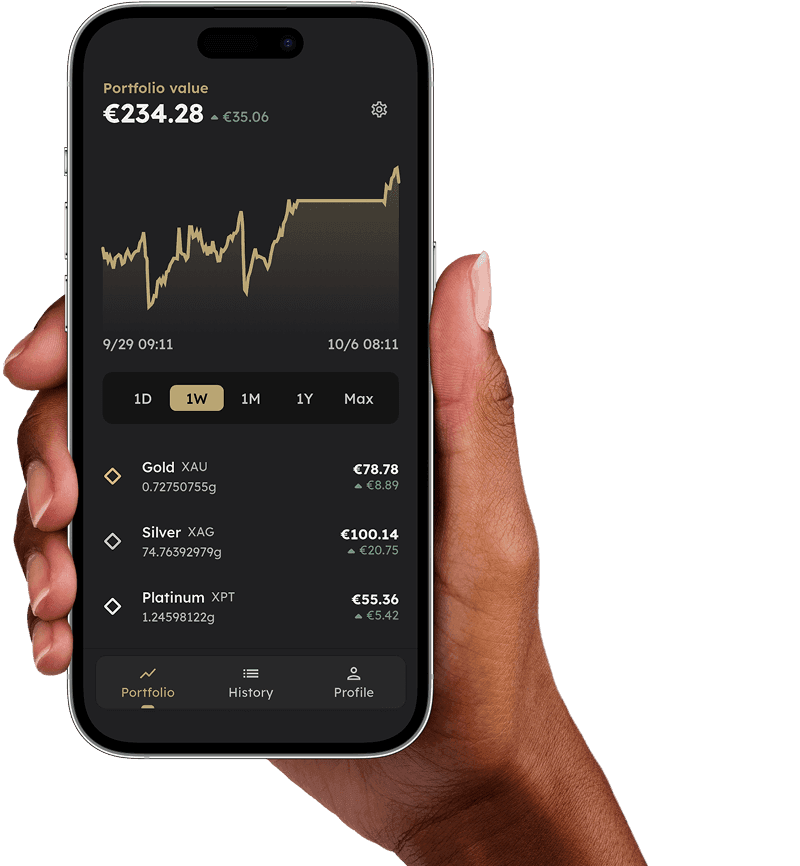
Buy physical gold – transparently and without interest

With the Spargold app you buy real gold, silver and platinum from €5, immediately from your balance and as your property.

Download the app
  • Immediate purchase from your balance
  • Physical bars as your property
  • No interest, no lending, no credit card

Frequently asked questions: gold and Islam

Is it halal to buy gold?

Yes. According to the majority of Islamic scholars, buying physical gold is permissible if money and gold are exchanged immediately, you become the owner straight away and no interest is involved.

Is it halal to buy gold online or through an app?

Buying through an app is not forbidden as such. What matters is that the gold is assigned to you at the moment of payment and you can dispose of it immediately (constructive possession). If the gold is only credited or delivered days later, the condition is not met.

Is Spargold halal?

Spargold currently has no Sharia certificate and no fatwa. However, the process is designed around the criteria scholars set for buying gold: immediate purchase from your balance, ownership of physical bars, no interest, no lending and no credit card. Whether that is enough for you is your decision, or one to make with a scholar you trust.

Is a gold savings plan halal?

A savings plan is a series of individual purchases. If each purchase is made immediately from money you have and you become the owner straight away, the same rules apply to each purchase as to a one-off purchase. At Spargold every savings plan execution is paid from your balance.

Are gold ETFs or gold ETCs halal?

Many scholars view conventional gold ETCs and certificates critically, because you don’t own gold but a claim against an issuer. There are some Sharia-reviewed gold ETFs that represent direct ownership of allocated gold.

Can I buy gold with a credit card?

Many scholars reject this, because a credit card pays with borrowed money and the seller is not paid immediately. Paying by credit card is not possible at Spargold.

Is silver halal?

Yes, under the same conditions as gold: silver is one of the ribawi items named in the hadith, so the exchange for money must be immediate and you must become the owner straight away.

Is platinum halal?

Platinum is not mentioned in the hadith and most scholars treat it as an ordinary commodity. Buying physical platinum is therefore considered permissible; according to the majority view, the strict exchange rules for gold and silver do not apply.

Are storage fees allowed?

Yes. A fee for safe storage is payment for a service, not interest. What matters is that it is transparent.

Do I have to hold the gold physically?

No. According to the majority view and the AAOIFI standard, constructive possession is enough: the gold is clearly assigned to you and you can dispose of it immediately. At Spargold, physical delivery is also possible in Singapore, where the metals are stored. Shipping to Germany would be extremely expensive; instead, you can sell at any time and receive your money.

How much zakat do I have to pay on gold?

Usually 2.5% per lunar year if your gold and silver reach the nisab (depending on the school of law around 80–85 g of gold or 595 g of silver). For your personal calculation, it’s best to ask your mosque or a scholar.

Sources and further reading

Ready to try Spargold?

Invest easily in physical precious metals.

This page is for general information only and constitutes neither religious advice (fatwa) nor investment advice. Scholars hold different views on individual questions. Spargold is not certified by a Sharia board. Precious metal prices can fluctuate; losses are possible.

Last updated: October 2026