Tariffs against Germany over Greenland: What lies behind the US threat and why markets are reacting nervously

January 18, 2026
Over the weekend, a conflict escalated that at first glance seems like geopolitical fiction, but could become very real economically: US President Donald Trump has announced that new tariffs will be imposed on Germany and other European nations starting February 1, 2026 – explicitly as a means of pressure in the dispute over Greenland.
For Germany, this is more than just a foreign policy side note. Tariffs do not only affect individual companies; they can also influence supply chains, prices, exchange rates, and the investment climate. Especially in an environment where many people are already concerned with inflation, interest rate uncertainty, and geopolitical risks, it is worth taking a sober look at what is known so far – and what consequences are plausible.
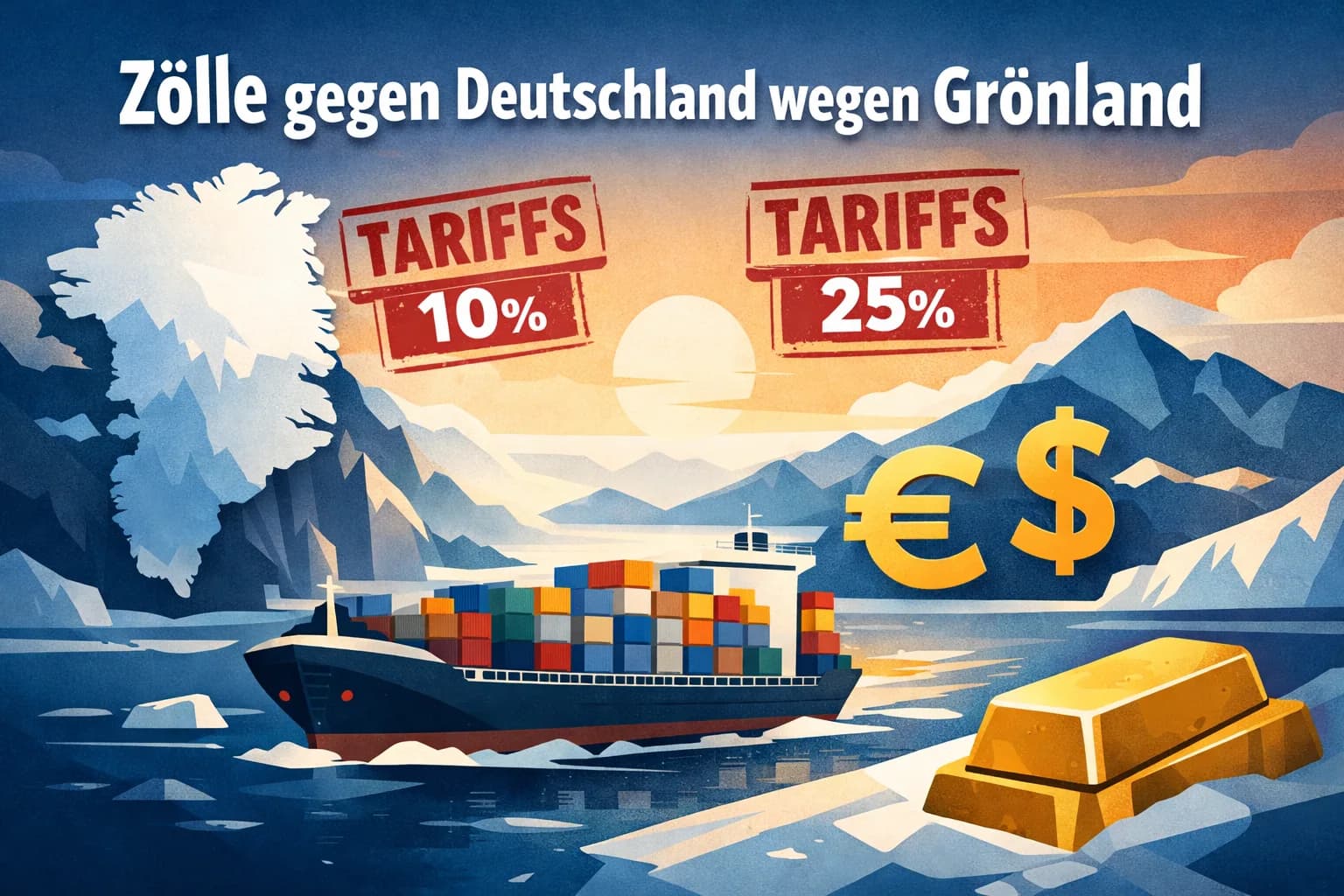
According to consistent media reports, additional tariffs of 10 percent are to apply to all goods from eight European countries starting February 1, 2026, including Germany, Denmark, France, and the United Kingdom. From June 1, 2026, these tariffs are set to rise to 25 percent – until an agreement is reached that allows the US to purchase Greenland.
In parallel, the EU has called a crisis meeting for Sunday, January 18, 2026. Reports indicate a meeting of the ambassadors of all 27 EU states to find a common line.
Greenland is an autonomous territory of the Kingdom of Denmark and is strategically located in the Arctic region. Security and geopolitics play a major role in the debate: Arctic routes, military presence, raw material interests, and the signal to alliance partners. Trump publicly justifies the pressure with national security and directly links economic measures to political goals.
It is precisely this link that makes the situation delicate for the markets. It shifts tariffs from a classic trade topic to an instrument of geopolitical "conditionality": those who do not cooperate politically are burdened economically.
| Timeframe | Measure (announced) | Rate | Affected countries (named) |
|---|---|---|---|
| from Feb 1, 2026 | Additional tariffs on goods imported into the USA | 10 % | Germany, Denmark, Norway, Sweden, Finland, France, United Kingdom, Netherlands |
| from June 1, 2026 | Increase if no "deal" on Greenland | 25 % | same group of countries |
Tariffs rarely act "linearly." Even if part of the burden falls on US importers, frictional losses occur: demand can fall, sales prices come under pressure, or supply chains are restructured. For German exporters, this is particularly relevant because the US market is considered high-margin in many industries.
At the same time, it is important to put the scale into perspective. The President of the Kiel Institute for the World Economy, Moritz Schularick, is quoted in this context as estimating that only about 10 percent of German foreign trade is with the USA and the effects could therefore be "manageable" – provided that Europe reacts in a unified manner.
In the short term, however, three channels may dominate: first, direct export burden; second, uncertainty for investments; third, possible countermeasures by the EU, which would then also affect US companies. From a market perspective, it is often not the first effect that is the largest, but the shock to confidence.
In Europe, countermeasures are being openly discussed at this hour. The EU's Anti-Coercion Instrument, a tool against economic blackmail that has been in force since the end of 2023, is mentioned particularly frequently. It allows the EU to react in a graduated manner when third countries exert economic pressure to force political decisions.
The fact that this instrument has never been used before adds to the explosiveness of the discussion. An activation would have a signaling effect: it would show that Europe is prepared to use economic levers even against its closest partners when political sovereignty is affected.
When trade conflicts are geopolitically charged, markets often look for more "neutral" anchor points. Precious metals are then mentioned more frequently in public debate because they are not tied to the creditworthiness of a state and remain globally tradable. This is no guarantee of specific price movements, but a recurring pattern in phases of increased uncertainty.
It is striking that the gold price on January 18, 2026, is quoted at around 3,962.87 EUR per troy ounce and around 4,596.34 USD per troy ounce. At the same time, EUR/USD is trading at 1.1595. Exchange rates are important here because they strongly determine the perception of gold in the Eurozone: even with a stable dollar price, gold can rise in euros if the euro weakens against the dollar – and vice versa.
In the coming days, concrete steps will be more decisive than headlines. Whether the announcement is implemented legally and administratively, which product groups would be particularly affected in practice, and whether there are exceptions will determine the real effects. Equally important is the European response: a coordinated reaction reduces the risk of individual countries being "divided" – and the EU leadership has already warned against exactly such a downward spiral.
For private financial decisions: anyone who wants to make their portfolio robust thinks in scenarios and correlations instead of betting on individual events. Trade conflicts can dampen growth, distort prices, and increase volatility. In such phases, liquidity, diversification, and the management of currency risks come more to the fore – and thus also the question of what role tangible assets play in the individual risk profile.
Stay farsighted, yours Helge Peter Ippensen