Spar.gold feels like building society savings: predictable saving, consistent wealth accumulation

May 10, 2026
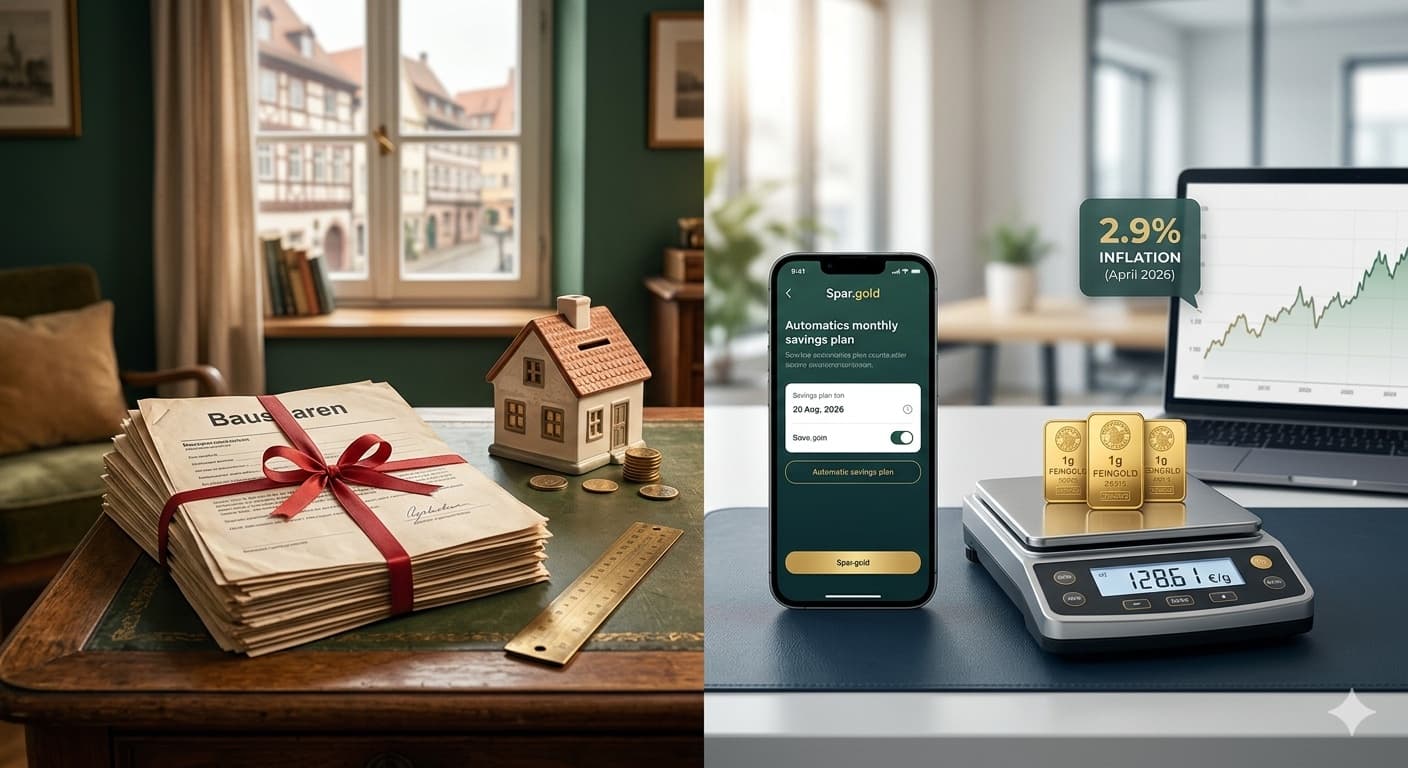
On May 8, 2026, the gold price was 128.61 euros per gram of fine gold. At the same time, Destatis reported a projected inflation rate of 2.9 percent for April 2026. In such an environment, an old virtue comes back to the fore: consistent saving with a clear system. This is exactly why Spar.gold feels familiar to many people – in the same spirit as building society savings.
Building society savings (Bausparen) were never "exciting." They were reliable. You had a fixed savings rate, a clear goal, a contract as a framework, and the good feeling of building something month after month. Spar.gold taps into the same user psychology – just digitally and with gold as a store of value instead of a classic building society credit balance.
The success of building society savings lies less in the romance of interest rates and more in the mechanics. A defined plan beats good intentions every time. Those who sign a contract pay in more regularly. Those who have a concrete goal are more likely to stick with it. And those who have a clear process reduce the risk of doing nothing at all in uncertain times.
The fact that the product is so widespread socially is shown by its scale: there are around 22 million building society savings contracts in Germany. This is no coincidence, but rather an indication that "savings discipline with structure" works for many people.
Spar.gold feels like building society savings because it fulfills the same three promises in everyday life: regularity, comprehensibility, and goal orientation. Instead of "I'll invest sometime," it becomes "I save automatically every month." Instead of unclear one-off decisions, a repeatable process is created. And instead of abstract numbers in an account, there is a tangible value anchor: gold, whose price is formed freely on the market.
Especially in phases where many people ask what interest rates actually "bring" after inflation, the mindset gains importance. Mortgage rates in 2026 also show how quickly framework conditions can turn: in May 2026, top mortgage rates are cited at around 3.77 percent; depending on the commitment period, they were in a range of approximately 3.69 to 4.27 percent at the beginning of April. Anyone observing such an interest rate landscape immediately understands the appeal of predictable routines: not having to decide anew every month, but following through on a line.
To make the comparison tangible, a look at current benchmark values (as of early/mid-May 2026) helps.
| Key Figure | Value | Status/Source |
|---|---|---|
| Gold price per 1 g fine gold (EUR) | 128.61 € | 08.05.2026 |
| Inflation Germany (CPI, projected) | +2.9 % | April 2026 |
| Top mortgage rates (indication) | approx. 3.77 % | 08.05.2026 |
The commonality is the savings mechanism. The differences lie in the target image, return logic, and availability of funds.
| Dimension | Building society savings | Spar.gold |
|---|---|---|
| Basic idea | Save according to plan, finance later | Save according to plan, build up gold holdings step by step |
| "Return" | Contract conditions, possibly loan option | Market price of gold, value development not guaranteed |
| Predictability | Savings rate and framework are fixed | Savings rate and framework are fixed, value fluctuates based on market |
| Target image | Home ownership/modernization as focus | Wealth component/inflation-sensitive saving as focus |
| Liquidity | Contractually regulated, partly tied up | More flexible depending on product logic, but market-dependent |
| Psychology | Contract as discipline anchor | Digital savings plan as discipline anchor |
Many always expect an interest rate answer first when it comes to saving. With building society savings, people ask about the credit interest; with digital forms of saving, they ask about the yield. The reality is often different: the decisive factor is whether people save consistently at all – and whether they have a system that carries them through turbulent phases.
Building society savings have fulfilled this role for decades. Spar.gold takes it over in a digital world where users expect transparency, quick setup, and comprehensible processes. The spirit is the same: not looking for the perfect timing, but mastering repetition.
Gold can fluctuate in the short term, and interest rate landscapes can also change within a few months. Exactly why a reliable process is often more valuable than the hope for the "right moment." Anyone who understands Spar.gold as a digital counterpart to the building society principle recognizes the core: predictable saving, consistent accumulation, staying calm.
Stay far-sighted
Yours, Helge Peter Ippensen