Shanghai and Hong Kong Converge in Gold Trading: What Lies Behind Offshore Delivery and Gold Clearing

January 22, 2026
Gold is currently not just a market price, but an infrastructure signal. This week, the gold price reached new records, occasionally exceeding 4,700 US dollars per fine ounce; Reuters recently quoted spot gold at around 4,737 US dollars with a daily high of approximately 4,750 US dollars. In phases of such momentum, it becomes crucial how reliably physical gold can be delivered, stored, and settled after trading. This is precisely where the new convergence between Shanghai and Hong Kong comes in.
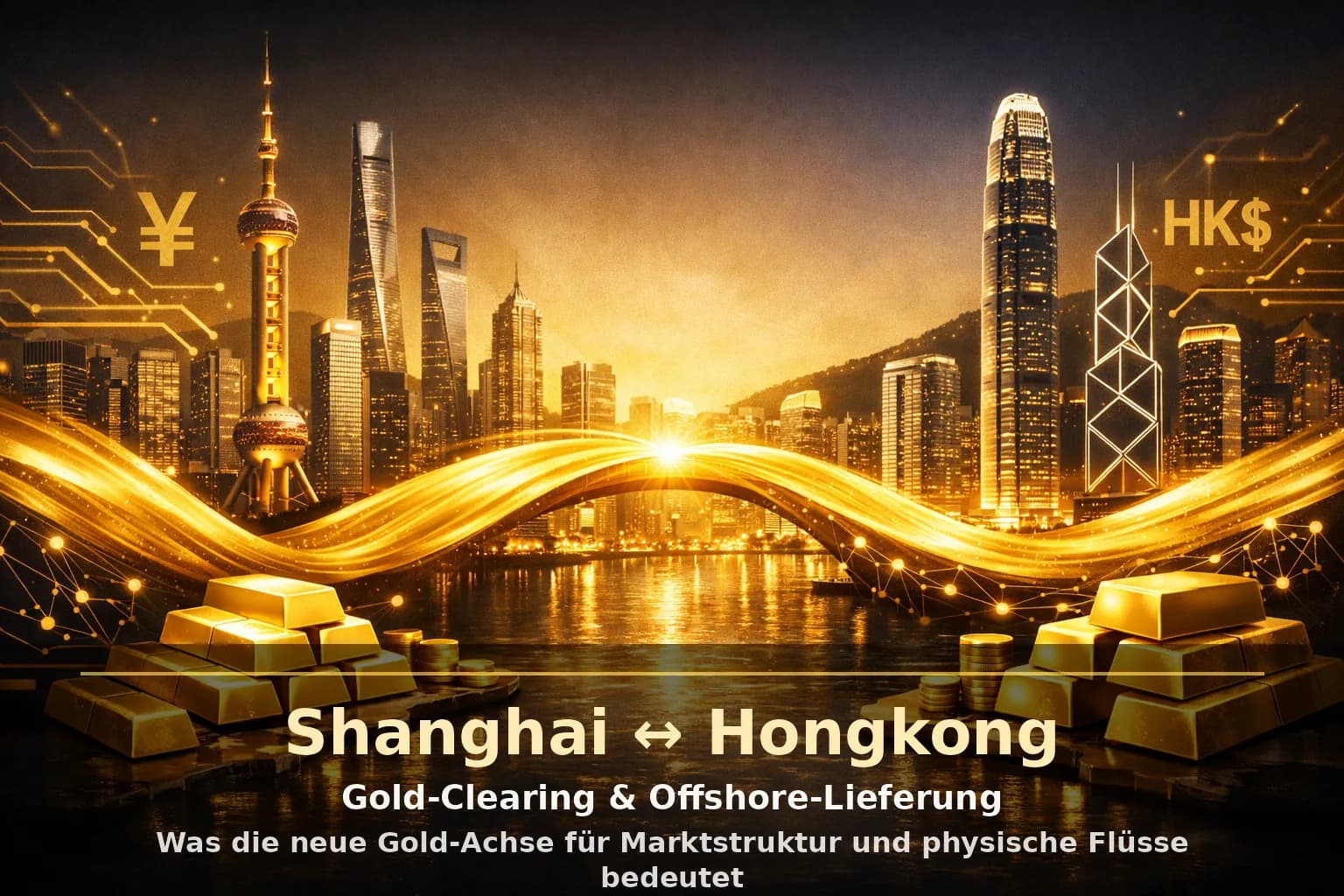
Hong Kong is working to establish itself as a global gold trading hub and aims to deepen its cooperation with the Shanghai Gold Exchange (SGE). According to media reports, a Memorandum of Understanding is in the offing, accompanied by plans for a centralized gold clearing system in Hong Kong, which is intended to make settlement more efficient and cost-effective. For the market, this means: it is not about a single measure, but about linking two roles that characterize Asia in the gold business. Shanghai represents onshore demand and a strongly physical trading logic, while Hong Kong represents international participants, logistics, and financial infrastructure.
When market participants speak of an exchange between Shanghai and Hong Kong "on a gold basis," they usually mean a very specific chain: trading, delivery, custody, and settlement. Hong Kong and the SGE have already implemented a milestone for this. On June 26, 2025, a certified offshore delivery warehouse for the SGE's International Board was launched in Hong Kong; at the same time, gold contracts were listed that are physically deliverable in Hong Kong.
This is more than just a location update. Deliverability at an offshore site lowers the operational hurdle for international players because physical fulfillment, storage, and logistics are bundled in an internationally well-connected hub. At the same time, the connection to the SGE structure, which stands for standardization and market access in China, is maintained. The bridge thus becomes operational rather than primarily political.
Parallel to the delivery infrastructure, Hong Kong is pushing forward with the next stage: post-trade settlement. Centralized clearing is relevant in the precious metals OTC business because bilateral settlements can create friction, especially in volatile phases. The goal is to standardize processes, better manage counterparty risks, and make settlement more predictable. In this context, the SGE is also mentioned as a partner, and there is talk of a trial operation in 2026.
The fact that this project coincides with a week in which gold marks new all-time highs reinforces the signal effect. When the market is nervous and volumes rise, stable settlement paths and physical availability become part of the price quality. This is not a promise about the future price direction, but an indication of what major financial centers in Asia are strategically betting on.
A resilient gold hub requires storage capacity that scales. Hong Kong has communicated visible steps here in recent months. According to official information, the first expansion phase of the precious metals depository at Hong Kong International Airport has been completed; capacity has been increased to 200 tonnes, and there are plans to expand to up to 1,000 tonnes in further phases.
Such figures may seem dry, but they are central: the larger and more standardized the custody, the easier large physical movements, short-term deliveries, or the pledging of metal in trading and financing processes become. Especially in the "physically deliverable" premium segment, this is the foundation for trust and liquidity.
The most exciting question is not whether Shanghai and Hong Kong "cooperate," but how much friction is reduced as a result. Spreads between marketplaces often arise from logistics, time, financing, and settlement risks. If offshore delivery (Hong Kong) and more standardized clearing come together, this can lead in the medium term to physical flows reacting faster and price differences being closed more efficiently.
One important point remains: infrastructure does not automatically change the gold price; it changes the quality of the market. In a week in which spot gold was quoted at around 4,737 US dollars according to Reuters and rose intraday to about 4,750 US dollars, it becomes particularly clear how valuable reliable settlement becomes.
| Component | Date/Status | Relevance for "Gold Exchange" |
|---|---|---|
| SGE offshore delivery warehouse in Hong Kong and deliverable contracts | Start on 26.06.2025 | Physical delivery and settlement in Hong Kong become part of the SGE infrastructure. |
| Expansion of the precious metals depository at HK Airport | Capacity 200 t, expansion plans up to 1,000 t | Scales custody and delivery capability, strengthens Hong Kong as a hub for physical gold. |
| MoU Hong Kong–SGE and plan for centralized gold clearing | Announced, trial orientation 2026 | Intended to standardize settlement, reduce costs, and increase market quality. |
| Gold Price Environment | Spot recently ~4,737 USD/oz, high ~4,750 USD/oz | Record levels increase the focus on robust delivery and settlement paths. |
For private investors, this development is primarily a structural signal. It shows that Asia is not only interested in price discovery, but in the entire value chain surrounding physical gold: storage, delivery, settlement, standards. Those who view gold as a long-term stability component can read such infrastructure steps as an indicator of how professionally and resiliently a market is intended to function in the future. This does not replace an individual decision and is not investment advice, but it helps to understand the mechanics behind the headlines.
Stay farsighted, yours Helge Peter Ippensen