Spargold LogoSpargold Logo
App
Pricing
Savings plan
About
Contact
Blog
Spargold LogoSpargold Logo

The Spargold app enables easy investments in physical precious metals such as gold, silver, and platinum. All precious metals are authenticated, professionally stored, and insured.

Overview

  • App
  • Pricing
  • Savings plan
  • About
  • Contact
  • Blog

Legal

  • Terms
  • Privacy
  • Imprint
  • Disclaimer
  • Our Promise

Follow us

X (Twitter)FacebookInstagramLinkedIn
Made in Germany

© 2022 - 2026 Spargold. All rights reserved.

Back to overview

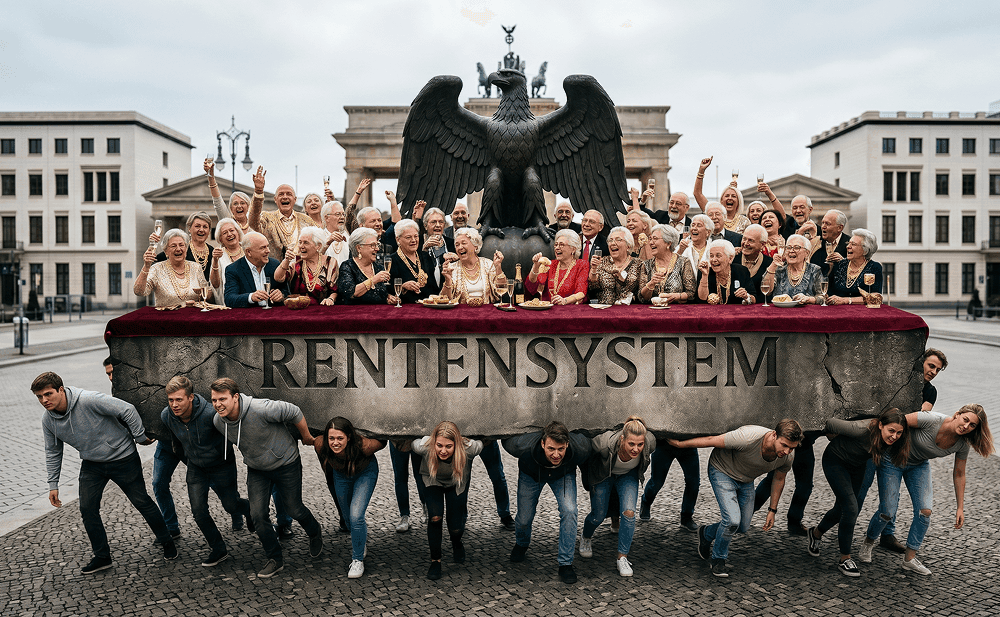
Pension System on the Brink of Collapse: Why Germany is Walking Eyes Wide Open into the Demographic Trap

Author Profile Picture
Nils Gregersen
April 30, 2026
X (Twitter)FacebookWhatsAppTelegram
Pension System on the Brink of Collapse: Why Germany is Walking Eyes Wide Open into the Demographic Trap

The German intergenerational contract was considered the foundation of our social peace for decades. However, the system that was once considered unshakeable is now showing massive cracks. While the baby boomer generation enters their well-deserved retirement, Millennials and Gen Z are inheriting a financial wasteland.

"Statutory pension insurance alone will at most provide basic security for old age. It will no longer be sufficient to secure the standard of living."
— Friedrich Merz, April 2026 (Source: Tagesschau)

In this article, we analyze the hard facts of why the German pension system in its current form will implode and what this means for your assets.

1. The Demographic Moment of Truth: 1.4 Children are Not Enough

The core problem is mathematical in nature. For a population to remain stable, a birth rate of about 2.1 children per woman is necessary. Germany has been below this level for over 55 years.

  • The Status Quo: In 2025, the birth rate is only 1.4 (Federal Statistical Office, 2024).
  • The Shrinkage Effect: If this rate remains, 100 Germans will only have 70 children. In just four generations, the population group will shrink by almost 76% (Transcript Analysis / Destatis).
  • The Aging Population: By 2026, the median age in Germany will rise above 45 years. Almost one in four Germans will then be over 65 years old (UN World Population Prospects).

2. The End of the Intergenerational Contract: From 5:1 to 2:1

The German pension system is pay-as-you-go. This means: today's employees pay directly for today's retirees. This system only works if the ratio of contributors to recipients is correct.

  • Historical Review: In the 1960s, five contributors still financed one retiree (German Pension Insurance).
  • Current Situation: In 2024, this ratio is only about 2.5 to 1.
  • The Forecast: In the 2030s, the ratio will head towards two workers per retiree. When 13 million baby boomers retire by 2036, the system's main pillar will collapse (Cologne Institute for Economic Research, 2023).

3. The "Black Shadow" in the Federal Budget: Pension Subsidies are Exploding

Already today, the pension system can no longer support itself. The state must subsidize it massively with tax money – money that is missing elsewhere.

  • Budget Check: In 2025, the federal government is already spending around a quarter of its total tax revenue to plug holes in the pension fund (Federal Ministry of Finance, 2025 Budget).
  • Lack of Investment: This amount is higher than the spending on education, research, infrastructure, and defense combined. We are consuming the future of the next generations today to maintain the current pension level.

4. Why Immigration Alone Does Not Solve the Problem

It is often claimed that immigration could close the demographic gap. However, the data paints a more nuanced picture.

  • Adjustment of Birth Rates: Immigrants usually adjust their birth rates to the low level of the host society within two generations (Federal Institute for Population Research).
  • The Domino Effect: To keep the system stable through migration alone, Germany would need a constantly high net migration of young people. However, as birth rates are falling worldwide, global competition for young talent is becoming increasingly fierce (World Bank Group).

5. Consequences for the Young Generation: High Burden, Low Return

For young employees in Germany, the situation is particularly precarious. They pay the highest taxes and social security contributions worldwide, but have little prospect of a state pension that secures their standard of living.

  • Tax Burden: The burden of taxes and social security contributions for average earners is often around 40 to 50% (OECD, Taxing Wages 2023).
  • Difficult Wealth Accumulation: Due to rising rents and high real estate prices, it is becoming almost impossible for Millennials to provide for themselves through home ownership.
  • Political Gridlock: Since the older generation represents the largest voting group (the "gray block"), parties have little incentive to push through reforms in favor of the young that could mean pension cuts.

Conclusion: Private Provision is Without Alternative

The German pension system is approaching a mathematical endpoint. The combination of boomer retirement, rising healthcare costs, and a shrinking workforce leaves little room for maneuver. Experts expect the retirement age to rise to 70 or more, while old-age poverty (already at approx. 20% today) will continue to increase (Bertelsmann Foundation).

What does this mean for you?
Do not rely on the state. In times when the paper money system and the welfare state are faltering under demographic pressure, tangible assets such as gold and silver gain importance. Precious metals are a proven hedge against loss of purchasing power and offer a security that the intergenerational contract can no longer guarantee.

Stay farsighted

Yours, Nils Gregersen


This article is for informational purposes and does not constitute investment advice. Fact checks are based on data from the Federal Statistical Office, the OECD, and the German Pension Insurance.

Ready to try Spargold?

Invest easily in physical precious metals.

Download the App
Spargold App
Back to overview