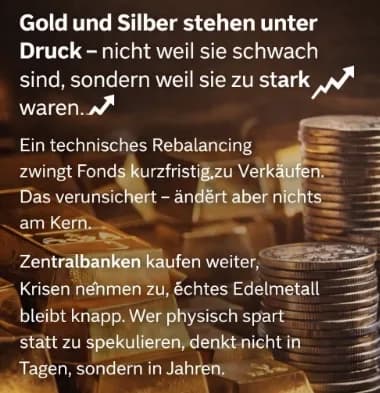
The gold and silver markets have experienced an extraordinary rally in recent months. Gold recorded its strongest annual increase in decades, while the price of silver more than doubled within a few months. This development has caused euphoria among many investors, but also uncertainty. In particular, temporary price declines triggered by technical effects such as index adjustments are often misunderstood and interpreted as a trend reversal. In fact, many factors suggest that these are short-term market mechanisms rather than fundamental risks.
The price increase in precious metals is the result of several factors acting simultaneously. Central banks have significantly expanded their gold reserves, while falling or stagnating interest rates reduce the opportunity costs of holding gold. Added to this are geopolitical tensions, persistently high national debt, and a weaker US dollar. Silver additionally benefits from its industrial use, particularly in the energy transition and electromobility.
The following table shows the approximate development of gold and silver within one year:
| Precious Metal | Price at the beginning of 2025 (USD) | Price at the beginning of 2026 (USD) | Change |
|---|---|---|---|
| Gold | 2,623 | 4,508 | +71.8% |
| Silver | 28.98 | 79.80 | +175.4% |
These figures illustrate why precious metals are currently a strong focus for institutional and private investors.
Many commodity funds and ETFs track major indices such as the Bloomberg Commodity Index. These indices are rebalanced regularly to prevent individual commodities from taking on too much weight in the overall portfolio. Following exceptionally strong price increases in gold and silver, the shares of these precious metals have grown beyond their intended target allocations.
As part of the annual rebalancing, funds must therefore sell gold and silver to comply with index rules. These sales can lead to short-term price pressure, even though the fundamental market situation has not changed. It is important to note that these adjustments are known long in advance and are limited in time.
A simplified overview of the index adjustment:
| Commodity | Weight before rebalancing | Target weight after rebalancing |
|---|---|---|
| Gold | over 20% | approx. 15% |
| Silver | around 8% | approx. 4% |
This reduction is technical in nature and not an expression of falling demand.
Analyst estimates suggest that gold worth several billion US dollars must be sold due to the rebalancing. However, the resulting price effect is considered manageable. For gold, a short-term decline in the range of one to two percent is expected, while volatility in the smaller silver market may be slightly higher.
Crucially, these effects have historically proven to be temporary. In many cases, prices stabilized just a few days after the completion of the index adjustments or even continued their upward trend.
For long-term investors, such fluctuations are generally of secondary importance. The structural drivers for gold and silver remain in place. Central banks continue to buy gold, real interest rates remain low or negative, and geopolitical uncertainties are increasing rather than decreasing. Furthermore, the supply side for both metals can only be expanded to a limited extent.
Major investment banks also remain optimistic. In some cases, further price increases in the double-digit percentage range are expected for gold within the coming quarters. Silver is also still considered a laggard with additional catch-up potential.
Price declines in the wake of index rebalancing are not a sign of the end of the precious metal boom, but rather a normal part of modern financial markets. They arise from technical reallocations and not from a fundamental shift in sentiment. For investors with a long-term horizon, such phases can even represent attractive entry opportunities.
Gold and silver continue to fulfill their role as a hedge against inflation, currency devaluation, and geopolitical risks. Those who understand this function should not be unsettled by short-term movements but should keep the strategic value of precious metals in their portfolio in mind.