New Tax Rule Shakes the Silver Market: Why Bonded Warehouses are Suddenly Becoming More Expensive

April 23, 2026
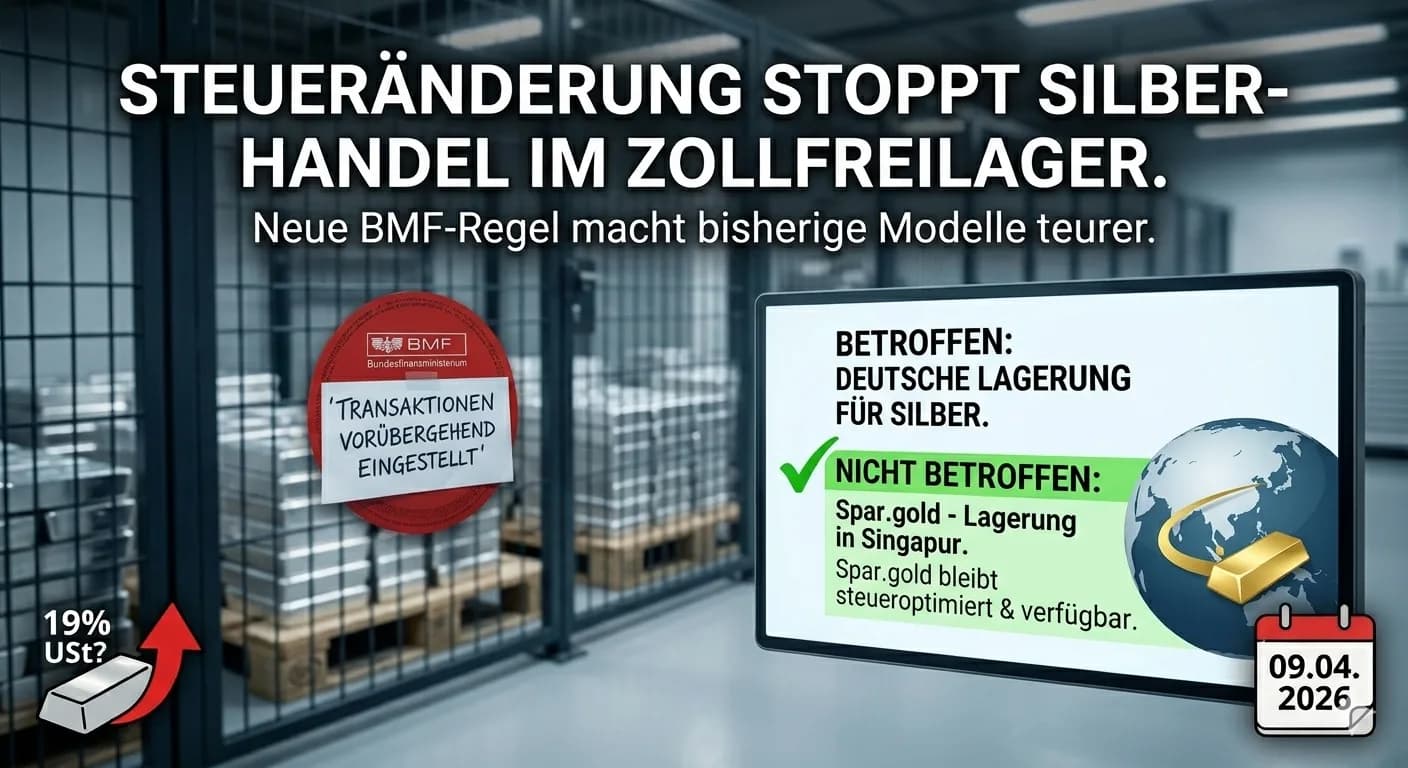
On April 9, 2026, the Federal Ministry of Finance (BMF) issued a circular on VAT exemption for import-related deliveries (§ 4 Nr. 4b UStG), further specifying VAT practice. Crucial here is a formulation that, in reality, decides the fate of entire business models: the tax exemption requires that an import into free circulation for customs or tax purposes is actually intended.
This primarily affects structures where silver and other metals were stored in German bonded warehouses while the goods changed owners multiple times without a real import into free circulation being planned. It is precisely these constellations that become less attractive or practically impossible to map with the new BMF interpretation. Handelsblatt describes the consequences very specifically: investors can no longer bypass VAT on metals like silver using German bonded warehouses, and the first dealers have already suspended transactions.
A clear distinction is important here: it is not „bonded warehouses per se“ that are affected, but specific VAT applications and settlement models involving German bonded warehouses when the import perspective is missing.
Bonded warehouses are customs warehouses where goods from third countries can be stored as long as they are not released into free circulation in the EU. Previously, a setup was attractive for some market participants where physical goods remained in the German bonded warehouse but were traded economically. The BMF now clarifies that the tax exemption according to § 4 Nr. 4b UStG is linked to a „delivery preceding“ an import and that an import exists when goods from a third country are released into free circulation for customs or tax purposes within the country.
The consequence is not abstract, but operational: if the goods remain in the German bonded warehouse and an actual import into free circulation is not intended, the exact requirement to which the BMF links the exemption is missing. This puts pressure particularly on models that relied on „change of ownership without import“.
From an investor's perspective, silver is particularly sensitive because, unlike investment gold, it is typically treated differently for VAT purposes in Germany. Investment gold is tax-exempt under certain conditions according to § 25c UStG, which creates a structural advantage over silver.
If certain settlement routes via German bonded warehouses are now eliminated for silver, the VAT component in the final price becomes more visible again. This explains why the news reached the industry so quickly and why dealers are adjusting processes at short notice.
At the same time, silver fundamentally remains a market with structural tension. According to Reuters, citing the Silver Institute and Metals Focus, the global silver deficit is expected to widen to 46.3 million ounces in 2026, up from 40.3 million ounces in 2025; furthermore, a total of 762 million ounces have been withdrawn from stocks since 2021.
In such an environment, any additional friction in processing acts not as a theory, but as a price factor.
The core message for Spargold customers can be clearly stated without overreaching legally: as things stand today, Spargold does not use a model based on „changes of ownership in German bonded warehouses without an import perspective.“ The logic of the BMF circular is decisive: it is about the link to an actual, intended import into free circulation.
Spargold relies on physical goods and transparent pricing in its model, without depending on VAT effects being achieved via German bonded warehouses through pure storage/accounting structures. Thus, the problem constellation discussed in the market does not target the Spargold setup. This classification is not legal advice, but a sober distinction from the practice described in Handelsblatt, where German bonded warehouses were used specifically as an instrument for VAT optimization.
Many investors look at the spot price first. In practice, the final price is the sum of the spot price, premium, logistics/insurance, and tax or settlement logic. If the tax treatment for certain German bonded warehouse models shifts, the difference between the „price on the screen“ and the „price at purchase“ increases again. The fact that dealers are suspending transactions is therefore primarily a signal for process restructuring: new proof, new supply chain logic, new pricing.
The BMF speaks of a VAT interpretation/application, not a blanket ban on bonded warehouses. In practice, however, details of the supply chain, the contractual import perspective, and the chain of evidence count.
For investors, this means: products and storage models will differ more significantly, and price comparisons will depend even more consistently on the all-in final price.
| Date/Status | Event | Relevance for Silver Investors |
|---|---|---|
| 09.04.2026 | BMF circular on § 4 Nr. 4b UStG, focus on „actually intended import“ | Models without an import perspective (esp. in German bonded warehouses) become more difficult |
| 15.04.2026 | Market/media reactions to the deficit situation and sensitivity in the silver market | Fundamental data remains tight, settlement effects act faster |
| 22.04.2026 | Handelsblatt: first dealers stop transactions | Operational restructuring, uncertainty for previous bonded warehouse models in Germany |
Exact prices vary depending on the product, dealer, premium, and tax treatment. For classification, the example only shows the effect of 19% VAT on a net value of goods.
| Example (simplified calculation) | Net value of goods | VAT (19 %) | Gross final price |
|---|---|---|---|
| Physical silver (value of goods) | 10,000 € | 1,900 € | 11,900 € |
The new BMF interpretation does not shift the silver price, but it shifts the mechanics of how silver can be traded and stored in certain models via German bonded warehouses. For investors, this means: less leeway via settlement routes, more focus on the final end price and the specific structure of the product. And the most important clarity for Spargold customers is: as things stand today, the Spargold model is not dependent on exactly those structures that are now coming under pressure in Germany.
Stay farsighted
Yours, Helge Peter Ippensen