When even the Chancellor says "Basic Security": What Merz's retirement statement really triggers – and what figures reveal about poverty in old age
April 24, 2026
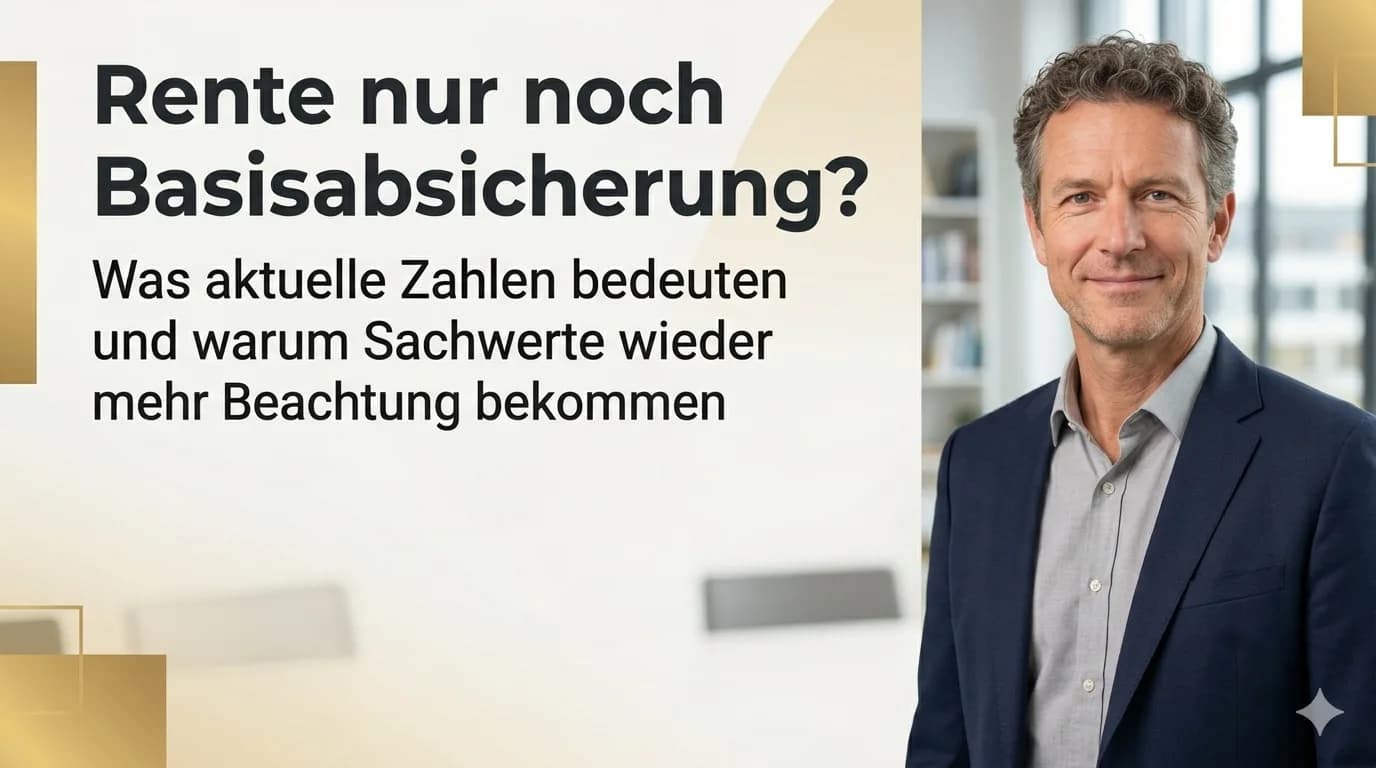
This week, a statement from the Chancellery sparked a debate that many have long felt in their daily lives: Federal Chancellor Friedrich Merz said that the statutory pension insurance would in the future be „at best basic security“; capital-funded elements of occupational and private provision would have to be added.
The sentence is so clear that it leaves little room for interpretation. And that is exactly why it strikes a nerve. A current survey, published in connection with the statement, shows: 69 % of respondents are concerned about poverty in old age.
Whether one reads this figure as a snapshot or a warning signal: it describes how great the uncertainty is as soon as „pension“ is no longer automatically equated with „standard of living“.
„Basic security“ sounds like the minimum, not like the life one has built for oneself. The problem is less the choice of words than the image behind it: If the statutory pension primarily represents the foundation, a gap is created that must be closed individually. This is exactly where the actual social question begins: Who can close this gap – and who cannot?
That this concern is not unfounded is shown by official figures on basic security. In December 2025, around 1.28 million people in Germany received benefits from basic security in old age and in the event of reduced earning capacity – +1.8 % compared to December 2024.
Basic security is not synonymous with poverty in old age across the entire pension system, but it is a reliable indicator that a portion of the population cannot cover their living costs in old age from their own resources.
A second look at the reality of life is worthwhile: According to Destatis, 16.1 % of the population in Germany is considered at risk of poverty (latest published status).
Risk of poverty does not automatically mean „no roof over one's head“. It means that the available income in relation to the social median is so low that participation becomes more difficult. In old age, this can be particularly noticeable because margins often become smaller: rising housing and energy costs, health expenditures, less flexibility for additional income.
What Merz’s statement triggers, therefore, is not primarily a political discussion about „pension formulas“, but a very personal question: Is the combination of statutory pension, possible occupational pension, and private provision sufficient to maintain one's own standard of living – even in an environment where purchasing power fluctuates?
The term „capital-funded“ is often equated with stock market risk in everyday life. In fact, it primarily means one thing: wealth is built up, which later enables benefits from the capital stock. How this wealth is structured can vary greatly – from classic insurance solutions to funds and tangible assets.
Tangible assets have a firm place in this discussion because they do not depend on a single mechanism. They can reflect purchasing power risks differently than pure nominal values. However, this is not considered a guarantee, but a characteristic: tangible assets often react to different drivers than wages, pension points, or interest promises.
Physical precious metals – especially gold – are often described as the „world's oldest currency“. Historically, this is true as a cultural attribution: gold has been used as a store of value for millennia. For today's savers, however, it is more crucial how gold behaves in modern conditions: it is internationally tradable, not arbitrarily reproducible, and has a stabilizing function in many portfolios – without this automatically resulting in a return promise.
The topic is also relevant in Germany from a tax perspective. Gains from the sale of physical gold in private assets are generally tax-free, if there is more than one year between purchase and sale (private disposal transactions).
Important: Tax rules can change and the specific treatment depends on the individual case. Anyone relying on this should check the current legal situation or have it professionally classified.
Many people think of large sums, bars, and vaults when they think of precious metals. In practice, however, provision often begins not with „much“, but with „consistency“. Small regular amounts can help to build up a mechanism at all: conscious setting aside, discipline, clear separation of consumption money and provision money.
The decisive factor here is less the question of „gold or not“, but rather: Does an addition of tangible assets fit one's own goals, time horizon, and liquidity? Someone who is dependent on the money in a few months thinks differently than someone who plans over decades. And someone who is already heavily invested in one asset class needs balance rather than doubling down.
The pension debate quickly becomes emotional. Therefore, a look at sober key figures helps to separate feeling from fact.
| Key Figure | Value | Status/Source |
|---|---|---|
| Concern about poverty in old age (survey in the context of the Merz statement) | 69 % | published 24.04.2026 |
| Basic security in old age & in the event of reduced earning capacity (Germany) | 1.28 million people | December 2025, Destatis |
| At-risk-of-poverty rate (Germany) | 16.1 % | Destatis, PM 03.02.2026 |
| Gold price (1 g, EUR) | 128.61 € | 24.04.2026, 08:32 o'clock |
These figures do not replace personal planning, but they make it visible: The discussion is not theoretical. It has a measurable reality – in concerns, in performance statistics, and in market prices.
When statements like „basic security“ are suddenly officially voiced, the temptation is great to act immediately. That is exactly when a counter-reflex is worthwhile: understand first, then decide. At spar.gold, a principle is therefore in the foreground that creates trust in turbulent times: focus on physical precious metals as a tangible asset component, transparently comprehensible and without promises that no one can seriously give.
The statutory pension remains a central element – if only because of its social mandate. But anyone who wants to actively secure their standard of living will have to deal with additional components. Whether that is an occupational solution, a private capital-funded provision, or an addition of tangible assets: the decisive factor is that the concept fits one's own life and is sustainable in the long term.
Stay far-sighted
Yours, Helge Peter Ippensen