Gold-Oil Ratio on March 18, 2026: When Oil Explodes and Gold Falls – What the Ratio Really Says

March 19, 2026
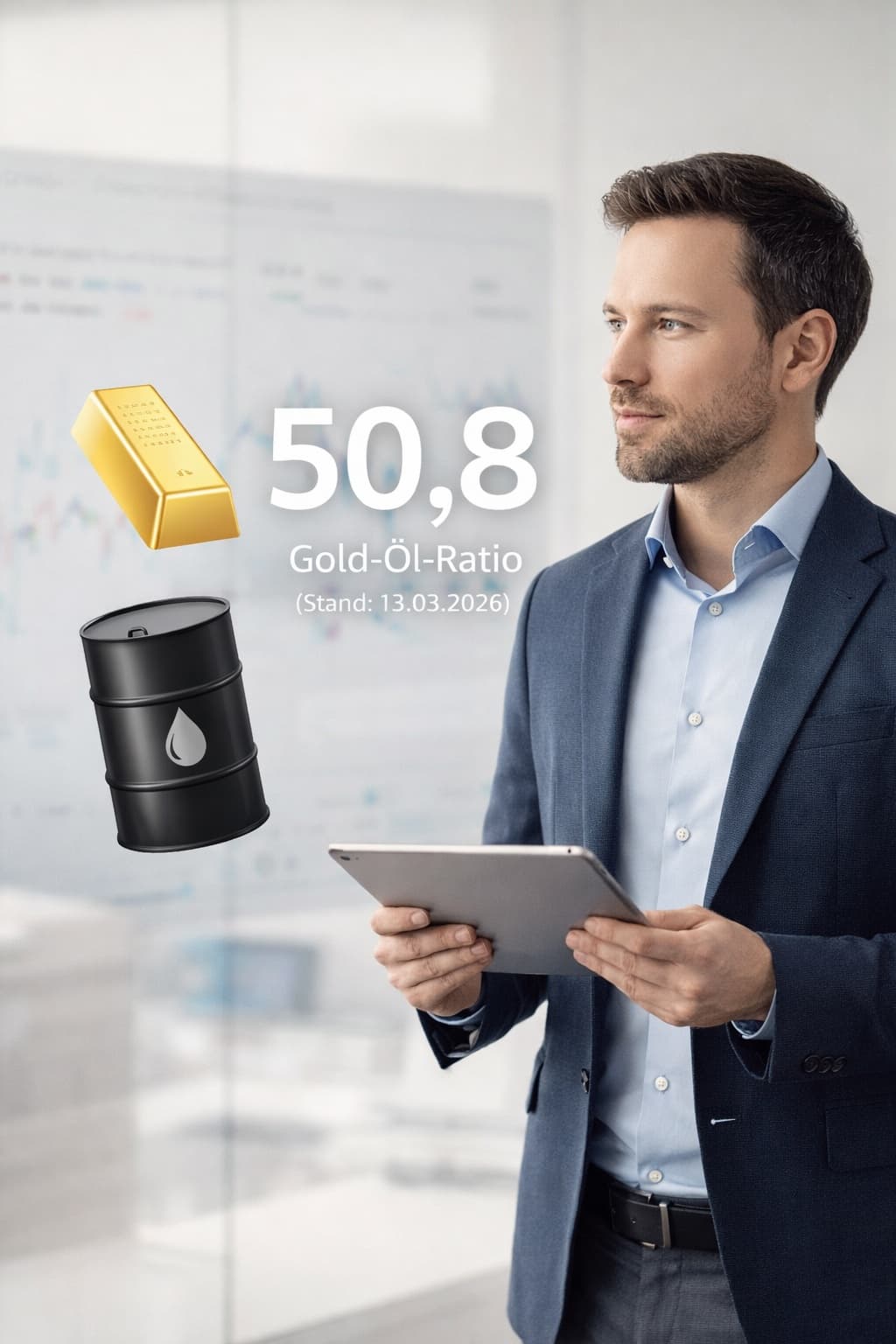
On March 18, 2026, Brent oil surged by approximately 5 US dollars intraday, reaching 108.56 US dollars per barrel according to Reuters. WTI rose to 98.38 US dollars. Simultaneously, gold fell by 2.6% to 4,874.19 US dollars per troy ounce, marking a more-than-one-month low.
Many would spontaneously draw a simple conclusion: "Oil up, gold down – so the all-clear for safety demand." This is exactly where the second level is worthwhile: the gold-oil ratio. Because it doesn't just show prices, but the regime behind them.
The gold-oil ratio describes how many barrels of oil correspond to one ounce of gold, i.e., gold price divided by oil price. This relation is helpful because oil primarily reflects the real economy and immediate supply risks, while gold is "translated" more strongly through monetary policy, real interest rates, dollar strength, and risk aversion. When both markets are simultaneously influenced by conflicts, inflation expectations, and central bank communication, the relation often becomes more meaningful than looking at just one chart.
Using the Reuters values, this results in a gold-oil ratio of approximately 49.54 on a WTI basis and approximately 44.90 on a Brent basis (as of March 18, 2026, Reuters quotes).
The fact that the ratio is falling can mean two things: either oil is rising faster than gold, or gold is falling faster than oil. This time it is a mix of both. The crucial point is the "why" behind the decline in gold: Reuters cites a stronger US dollar and the expectation of "higher for longer" US interest rates as drivers, while rising energy prices simultaneously fuel new inflation concerns.
This is a classic area of tension: Geopolitics drives oil, inflation drives interest rate fears, interest rate fears weigh on gold. In such an environment, a falling ratio is not an all-clear signal – but often an indication that monetary policy is overriding the safe-haven reflex in the short term.
The expectation sounds logical: if the situation escalates, gold rises. Reality is often more complex. When conflicts pull up energy prices, inflation expectations are "re-awakened." This can support the dollar and dampen rate-cut fantasies – and that is exactly poison for gold, even though risk is objectively rising. Reuters describes exactly this pattern on March 18, 2026: oil prices up, inflation fear up, interest rates higher for longer, gold down.
The oil market does not just trade sentiment, but bottlenecks. Reuters reports on March 18, 2026, of threats against energy facilities in the Gulf region and disruptions around the Strait of Hormuz, a key route through which about 20% of global oil and LNG transport passes. In such situations, oil becomes an immediate risk premium.
At the same time, the market reaction shows: Brent significantly above 100, WTI below – this indicates a pronounced geopolitical risk premium in the global reference price, which "impacts" differently depending on region and logistics.
| Metric (as of March 18, 2026) | Value | Classification |
|---|---|---|
| Gold (USD/oz) | 4,874.19 | Decrease of 2.6% to a more-than-one-month low |
| Brent (USD/Barrel) | 108.56 | Oil jumps due to escalation and supply risks |
| WTI (USD/Barrel) | 98.38 | US benchmark rises but remains clearly below Brent |
| Gold-Oil Ratio (Gold/Brent) | 44.90 | Oil dominates the price story in the short term |
| Gold-Oil Ratio (Gold/WTI) | 49.54 | Relatively higher ratio on US basis |
For spar.gold, the following is crucial: precious metals are not a day trade, but a building block for purchasing power protection and risk diversification. A falling gold-oil ratio during a geopolitical escalation is therefore not automatically "bearish for gold" in a structural sense. Rather, it shows that the market is currently in a transition regime where energy inflation dominates monetary policy.
If central bankers indeed remain restrictive for longer due to energy inflation pressure, gold may feel headwinds in the short term, even if uncertainty is high. If the dollar turns later or recession risks rise, the ratio can flip again – often abruptly. This is exactly what the ratio is a good compass for: it forces one to read not just "price," but the "balance of power."
On March 18, 2026, we are experiencing a pattern that surprises many: oil up due to geopolitics, gold down due to interest rate and dollar logic. The gold-oil ratio makes this simultaneity visible and prevents premature conclusions from a single number.
Price is the signal – ratio is the regime.
Stay farsighted
Yours, Helge Peter Ippensen