Gold Above 5,000 US Dollars: Why "Purchase Confirmed" Now Means More Than a Record Price

January 26, 2026
On January 26, 2026, gold rose above the 5,000 US dollar per troy ounce mark for the first time, reaching around 5,111 US dollars at times in early trading. Silver rose in the same momentum to approximately 109 US dollars, placing it significantly above the 100-dollar threshold, which had been surpassed for the first time previously.
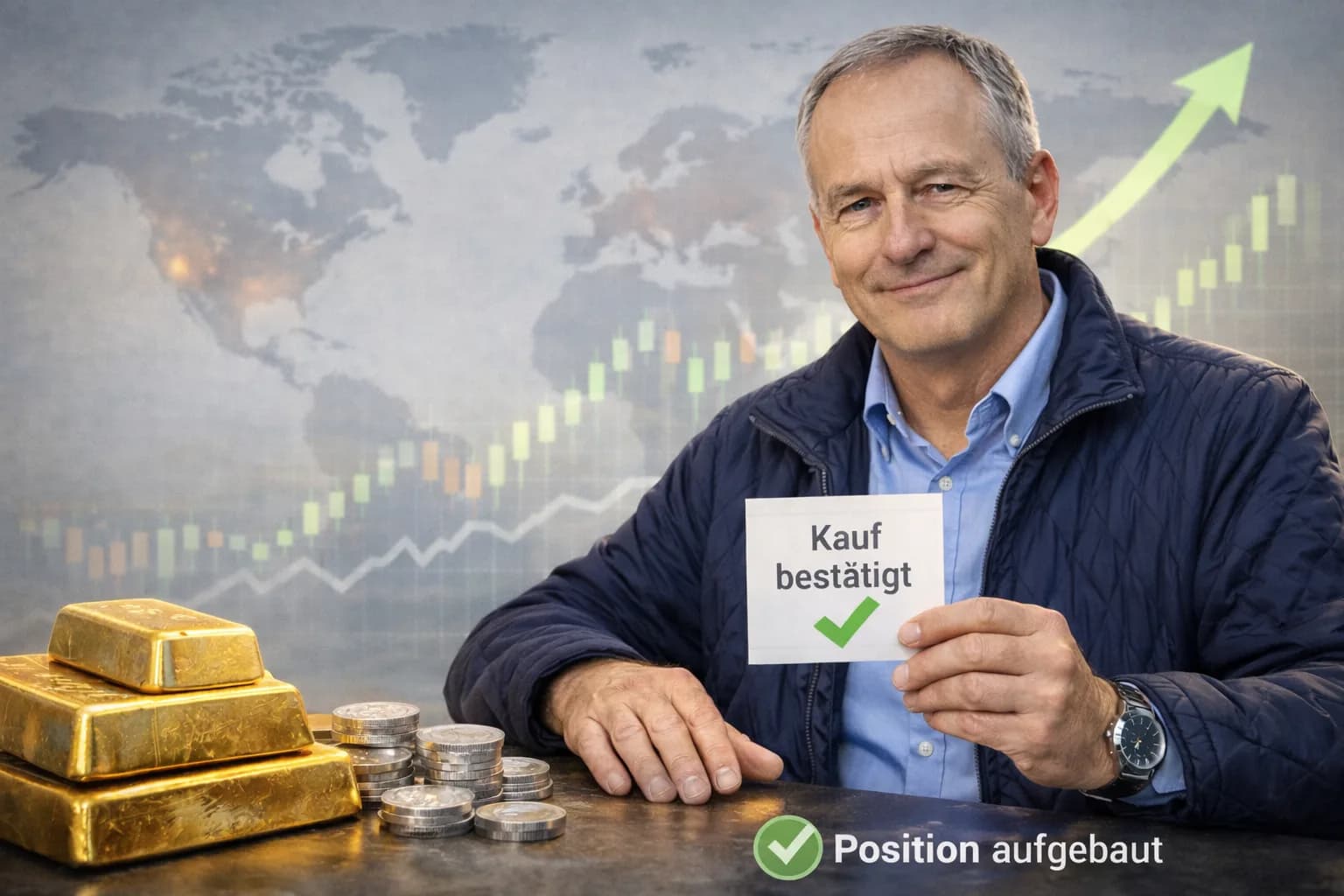
Such marks act like magnets. They make headlines, trigger FOMO, and make the precious metal appear „expensive.“ In practice, however, during phases of strong demand, something else often determines the real market: whether goods are actually available – immediately, physically, deliverable. The image motif „Purchase Confirmed“ fits exactly here: Clicking the shopping cart is one thing. The confirmed, physical position is another.
The current jump is not just a single-day event. Reuters describes that after an exceptionally strong year in 2025 (plus 64 percent), gold is already significantly up in 2026, with the rally supported by geopolitical tensions, dollar weakness, central bank purchases, and strong ETF inflows.
In parallel, silver shows a dynamic typical of bull markets: silver often reacts more „hectically“ than gold because the market is smaller and industrial demand plays a stronger role. The fact that silver moved into the range of 109 US dollars within a short period underlines precisely this leverage effect.
| Metric (as of 01/26/2026) | Value | Classification |
|---|---|---|
| Gold (Spot, record zone) | above 5,000 US$/oz, high around 5,111 | Psychological mark, reinforces momentum |
| Gold: Annual gain 2025 | +64 % | strongest annual increase in decades |
| Silver (Spot, record zone) | approx. 109 US$/oz | significant jump, market very volatile |
| Gold ETFs: Annual inflows 2025 | 89 billion US$ | Record, AUM 559 billion US$, holdings 4,025 t |
This is the intuitive expectation of many investors: if the price rises sharply, it must be scarce. If it falls, there must be plenty. The reality is more nuanced – especially with precious metals.
Large, liquid paper markets exist for gold and silver (spot and futures trading, ETP/ETF structures). Trading can take place there in very large volumes without the physical delivery situation immediately moving to the same extent. The price is thus a very important signal – but it is not automatically the fastest indicator of availability.
This is precisely why a second look gains importance in record phases: What is happening with denominations, delivery times, premiums, and „immediately available“?
For gold, demand comes in waves when uncertainty increases. Currently, this uncertainty is primarily interpreted geopolitically, while monetary policy also plays a role: when markets bet on lower or at least prospectively falling interest rates, the attractiveness of non-interest-bearing tangible assets increases.
In addition, there is a structural factor that is often underestimated: central banks do not buy for „yield reasons,“ but for reserve logic. The World Gold Council provides an example regarding the People’s Bank of China: for 2025, a total of 27 tons of officially reported purchases were mentioned, with holdings at 2,306 tons at the end of 2025.
For silver, a second engine is added alongside investment demand: industry. In many applications, silver is difficult to replace – and if investors simultaneously discover gold's „little brother,“ this can move the market disproportionately. The fact that silver jumped from price levels around 30 US dollars into triple digits at times within a year shows how quickly sentiment can discharge in a tight market.
Record prices are neither a buy signal nor a sell signal. They are initially an indication of a new market phase. In such phases, a pragmatic framework of two questions helps.
The first question is: What is driving the movement – short-term news or long-term shifts? Currently, major market reports cite geopolitical risks, dollar/interest rate factors, central bank purchases, and record-high ETF inflows as the mix.
The second question is: How „real“ is my position? Those who view precious metals as a tangible asset are not only interested in the chart but also in the ability to physically deliver, store, and clearly assign ownership. This is exactly where the difference between „orderable“ and „immediately available“ arises during boom phases.
Price is a signal – availability is reality. And a position only feels like a tangible asset when it is physically assigned and deliverable.
Stay far-sighted
Yours, Helge Peter Ippensen